
Before approving a premium resin, ask which production or service test the lower-cost candidate cannot pass. That missing requirement is what makes a material upgrade defensible. For many molded components, PPS vs PEEK is not a contest between a “good” and “better” polymer. PPS is often the economical production choice for chemically resistant, dimensionally stable electrical and fluid-handling parts. PEEK earns the premium when higher temperature, toughness, fatigue, wear or sustained mechanical performance is genuinely required.
Decision map:
- Confirm the real temperature and load
- Check chemistry and moisture
- Review wall thickness and flow length
- Account for fillers and shrinkage
- Validate total qualified cost
Find the requirement PPS cannot meet
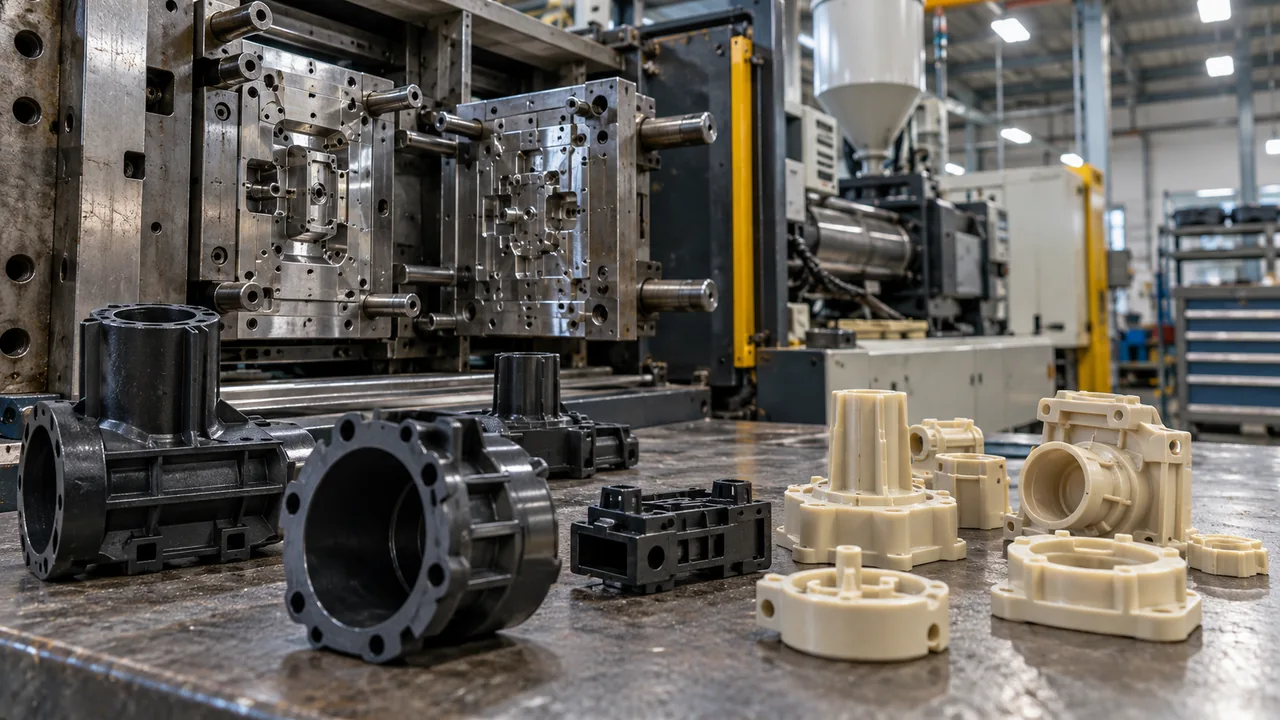
Begin with PPS if it satisfies the service environment. Move to PEEK only when a measurable requirement crosses the PPS boundary. Examples include higher sustained temperature under load, demanding fatigue life, greater toughness, severe wear or a regulatory grade available only in the PEEK family. The PEEK decision should be tied to a numerical requirement PPS cannot satisfy, such as retained load, fatigue cycles or wear rate. Without that trigger, a premium material can become permanent specification cost without measurable benefit. Record the failed PPS condition and the PEEK acceptance margin. For example, a connector housing may already meet its heat and dimensional limits in a suitable PPS grade, while a repeatedly loaded wear element may require a different margin.
This approach prevents “specification by reputation.” It also creates a defensible purchasing decision because the premium is connected to a testable failure risk. Write the limiting requirement before comparing quotations. If PPS has not failed a relevant test, PEEK should be evaluated as an option rather than treated as a necessary upgrade. If PPS has failed, preserve the evidence so the replacement is tested against the same condition. Unfilled, glass-filled, carbon-filled and tribological grades should not be mixed in one family comparison. Reinforcement changes stiffness, impact behavior, shrinkage and electrical properties as well as price. Shortlist grades with equivalent regulatory and reinforcement status before reviewing data. A fair comparison pairs grades with comparable reinforcement and intended use, then separates tensile strength, impact, fatigue and creep.
Where the two materials separate
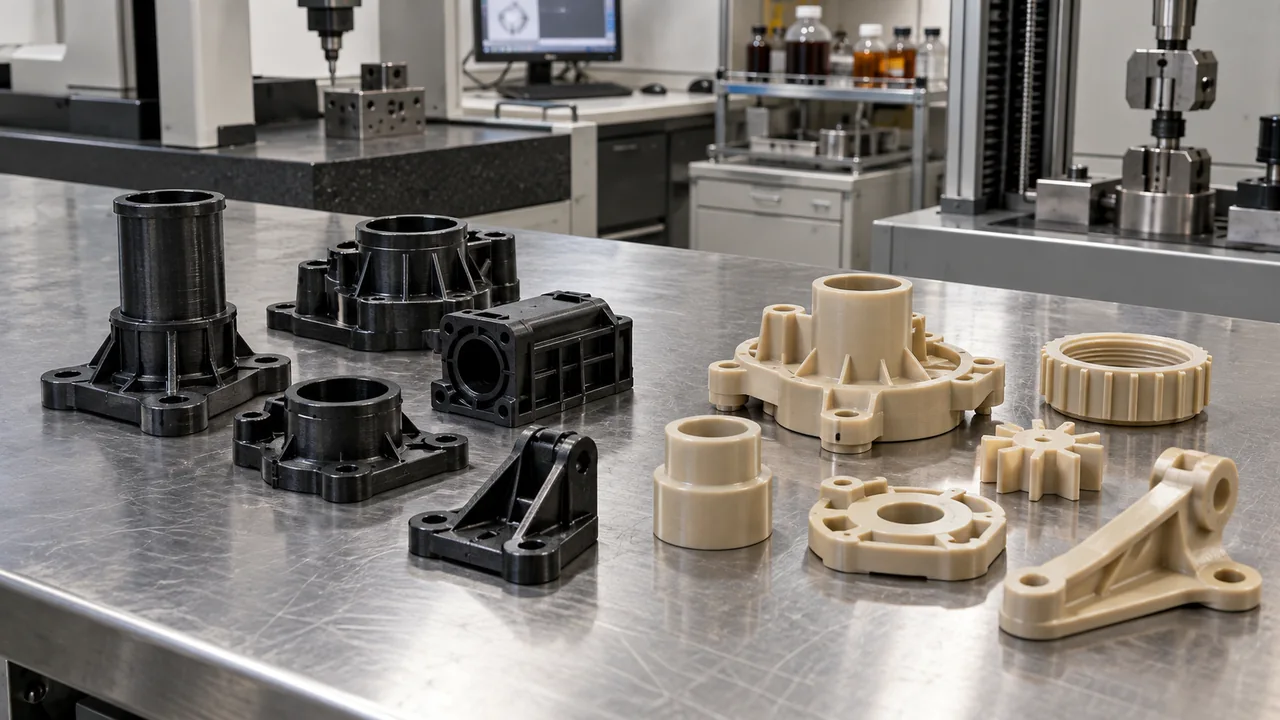
| Decision | PPS | PEEK |
|---|---|---|
| Cost-sensitive high-volume part | Often preferred | Use only when performance justifies it |
| Highest structural performance at heat | Application dependent | Stronger starting point |
| Thin, stiff electrical components | Strong candidate, especially filled grades | Possible but may be excessive |
| Wear and fatigue | Grade dependent | Often preferred |
Chemical resistance still requires a real exposure list

Both polymer families are used in harsh chemical environments, but neither should be approved from a broad “excellent” rating. Name the fluid, concentration, temperature, contact time and stress. Add cleaners, assembly chemicals and process fluids that may touch the part only during maintenance. A high stiffness value can coexist with poor performance at a notch or weld line. Electrical behavior can also change with conductive fillers. Ask which property matters in the assembled component and compare it under the corresponding test condition. The best datasheet entry in a column is not necessarily the best molded-part choice. Chemical resistance can decline where threads, press fits or over-tightened fasteners add local tensile stress. Temperature and exposure duration can further separate PPS and PEEK behavior. Condition complete assemblies with the exact fluid and then inspect strength, sealing and dimensions. Fluid-handling components require more than a visual immersion check.
For a sealed system, consider permeation, compression set of adjacent seals and differential thermal expansion—not only whether the polymer visibly degrades. Test the part under pressure or assembly strain, then measure seal behavior and retained dimensions. Include mixtures, contamination and cleaning agents where they are part of real service. Chemical tables are useful screening tools but often do not reproduce a loaded molded feature. A conservative selection identifies the untested condition and requests validation before turning a general resistance statement into a purchasing specification.
PPS can be easier to justify, not automatically easy to mold
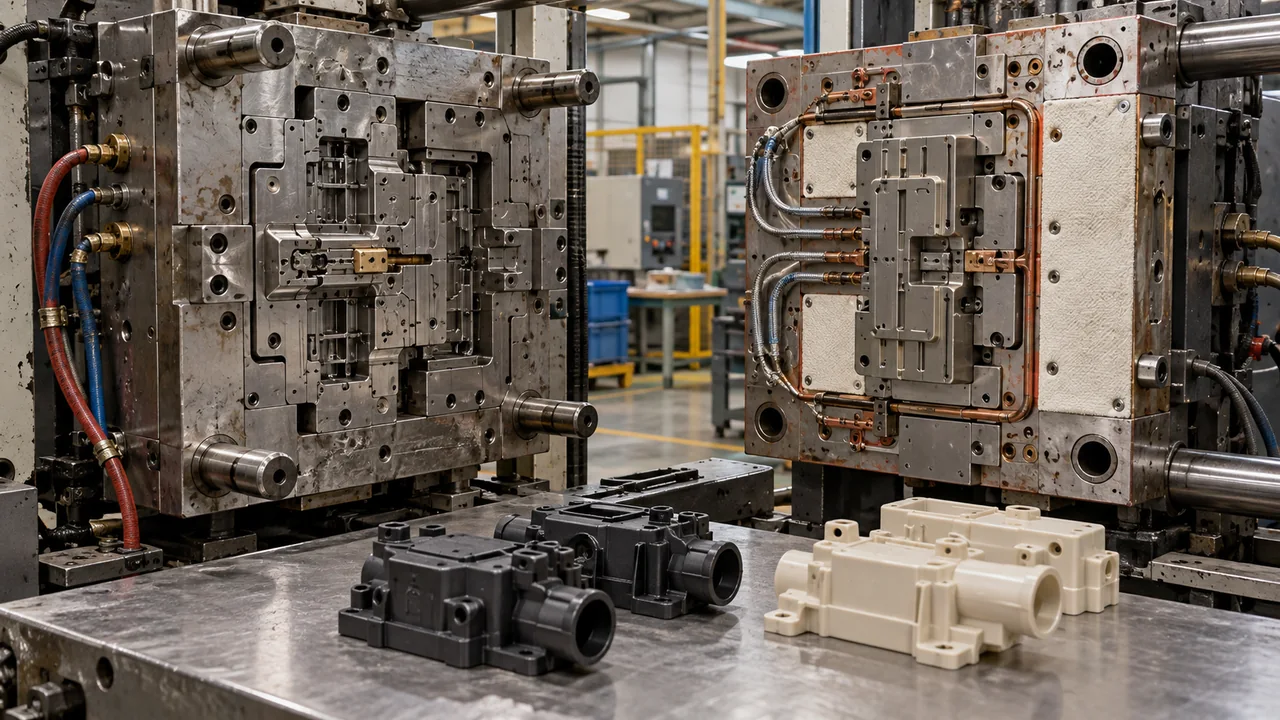
PPS and PEEK are semi-crystalline. Mold temperature and cooling history influence their final morphology, dimensions and surface appearance. Glass-filled PPS can be abrasive and highly directional; PEEK demands still higher thermal capability and close residence-time control. Both materials are semi-crystalline, so cavity-surface temperature and cooling balance influence final morphology. A controller setpoint cannot prove that deep cores, slides and cavity edges reach the same condition. Map the mold surface at equilibrium and correlate it with dimensions from each cavity. Map the tool’s actual surface conditions around deep cores, slides and cavity edges.
The tooling decision should include steel hardness, heating method, insulation, venting, gate location and fiber orientation. That is why both belong within a controlled Moulage de polymères haute température workflow rather than a standard resin substitution. Heater setpoints and coolant outlet readings may not reveal local differences that alter crystallinity or packing. For filled grades, confirm gates and vents remain within acceptable dimensions after wear. A process that works on a freshly serviced tool may drift later. Tool temperature balance and maintenance provisions belong in the qualification plan for both materials.
Watch the reinforced-grade trap
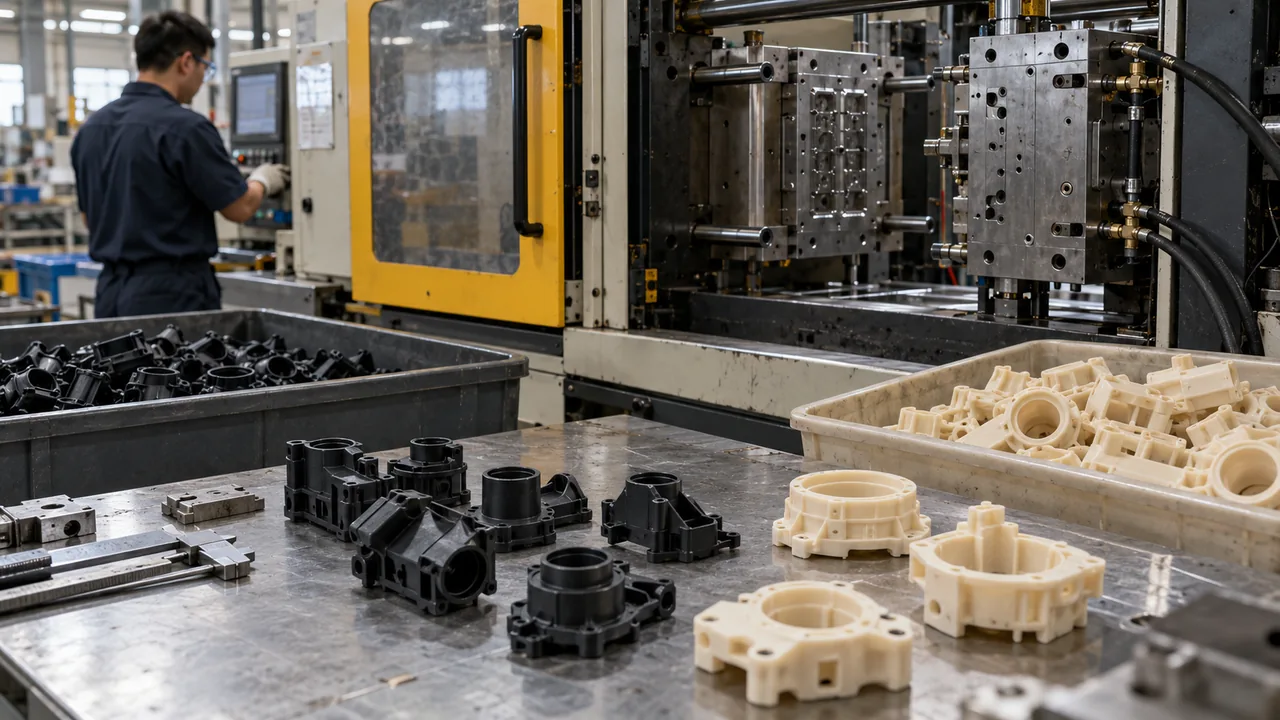
A 30% or 40% fiber-filled grade may show impressive stiffness and low shrinkage in the flow direction while behaving very differently across the flow. Ribs, bosses and weld lines can redirect fibers and move the weakest region into a critical load path. Compare the exact PPS grade et des PEEK grade, not unfilled family averages. Filled grades develop directional stiffness and shrinkage as fibers turn around ribs, holes and gates. The strongest datasheet direction may not align with the product load path, especially across weld lines. Use flow analysis and cut specimens from representative molded locations when the load is critical. Think about an annular component filled from one gate: fibers turn around the core and meet at a weld line opposite the gate. A radial pressure load can then act through a direction not represented by the strongest datasheet result. Review gate alternatives, support ribs and transitions before choosing reinforcement solely for stiffness. Representative parts should be tested in the load direction that controls field performance, including the region where flow fronts meet.
Calculate the cost of qualification
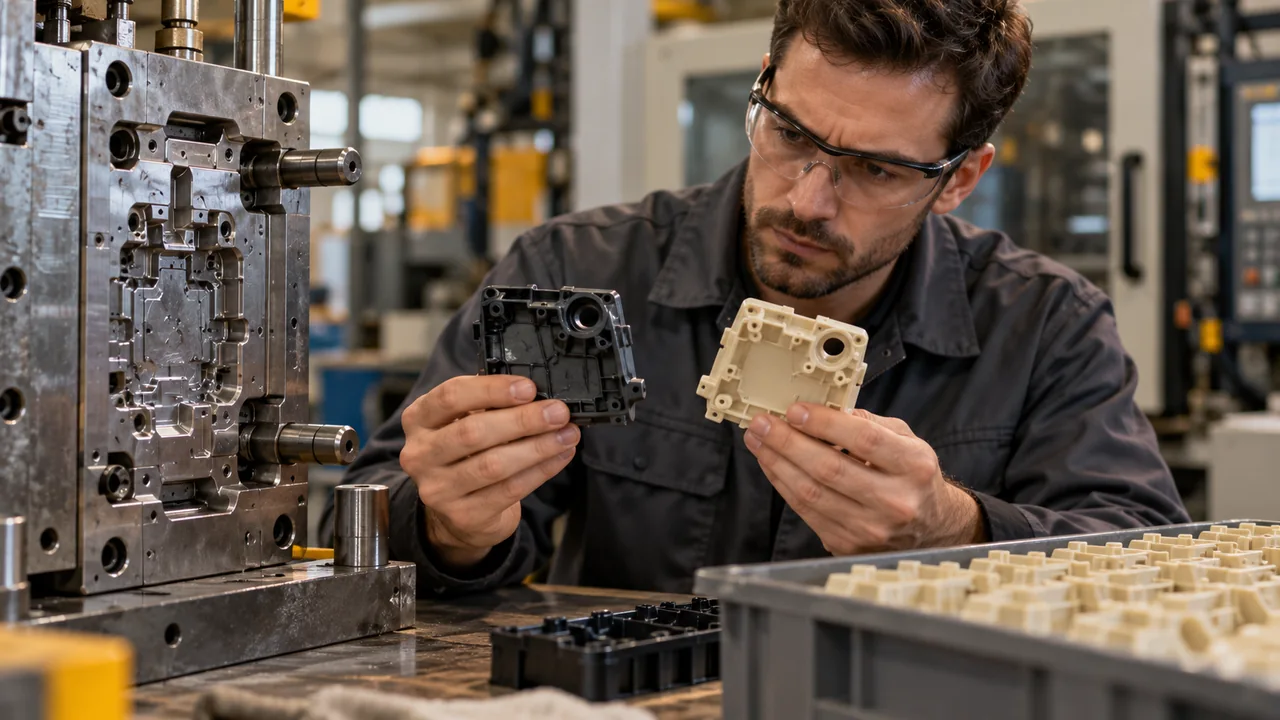
Material price is only one line. Include drying, purging, hot-tool setup, cycle time, scrap, cavity maintenance, inspection and validation samples. PEEK may reduce risk enough to justify its premium; PPS may deliver the same approved performance at a lower recurring cost. The drawing and acceptance test should reveal which statement is true. A robust PPS process can be less expensive for years, while marginal PPS can generate sorting and field risk every production run. PEEK should be justified by the risk it removes rather than by reputation. Compare approved yield, inspection burden and service failure cost over the forecast program life. Separate initial qualification cost from recurring production cost. Tool changes, development samples and validation may favor retaining PPS when it already satisfies the requirement. Recurring scrap or extra inspection may favor PEEK if it creates a wider verified margin. Ask suppliers to state the assumptions behind yield and cycle time rather than comparing unsupported percentages. The decision record should connect each added cost with the specific failure risk or operation it removes.
Questions fréquentes
Is PEEK always stronger than PPS?
Not in every comparison. Reinforcement, temperature, test method and load direction can change the result. Compare exact grades under the intended condition. A comparison should include the weakest molded region, not only standard tensile bars. Gate location and reinforcement can change which direction controls the actual assembly.
Which polymer is better for electrical components?
PPS is widely considered for stable, flame-resistant electrical components; PEEK is useful when the environment also demands extreme heat, wear or mechanical performance. Match the grade to flame, insulation and temperature requirements at the specified thickness. Conductive fillers may change the electrical behavior even within the same polymer family.
Can a PPS mold run PEEK?
It may not be suitable without review. PEEK can require higher thermal capacity, different shrinkage allowances, gate changes and more demanding residence-time control. Inspect machine interfaces and tool surface capability before approving reuse. Qualification should also account for changed packing, ejection and dimensional behavior at the production cycle.