
An injection molding DOE is a planned experiment that relates selected process factors to measured part responses. It is useful when the question involves interactions or several competing requirements. It is not simply a sheet of different settings, and it cannot rescue unidentified samples, unstable material preparation, or an inspection method that cannot distinguish the effect being investigated.
For the engineer reviewing a supplier trial, the first question is whether the experiment can support the conclusion attached to it. A single attractive part at one setting is not a process window. A large spreadsheet is not proof either. Follow the evidence from the original problem through the design of experiments (DOE), sampling, analysis, and a separate confirmation.
Define the response before choosing the settings
“Improve quality” is too broad to design an experiment around. Identify an observable response: a defined assembly gap after conditioning, part mass, a critical diameter, or a specific appearance classification. State where and when it is measured, which cavities are represented, and what makes the result acceptable. Different responses may need different sampling and analysis.
Suppose a hypothetical molded nylon connector shell changes fit after storage. Measuring it immediately after ejection answers a different question from measuring it in the agreed conditioned state. If those states are mixed within the experiment, an apparent processing effect may partly reflect moisture history or elapsed time. Define the state before collecting data, not after seeing the trend.
The measurement system must be suitable for the expected change. A fixture that locates the shell differently on each check may add more variation than the factor under study. Repeated readings of one component can help evaluate that measurement behavior, but they do not establish how independently produced components vary. Separate measurement checks from process replication.
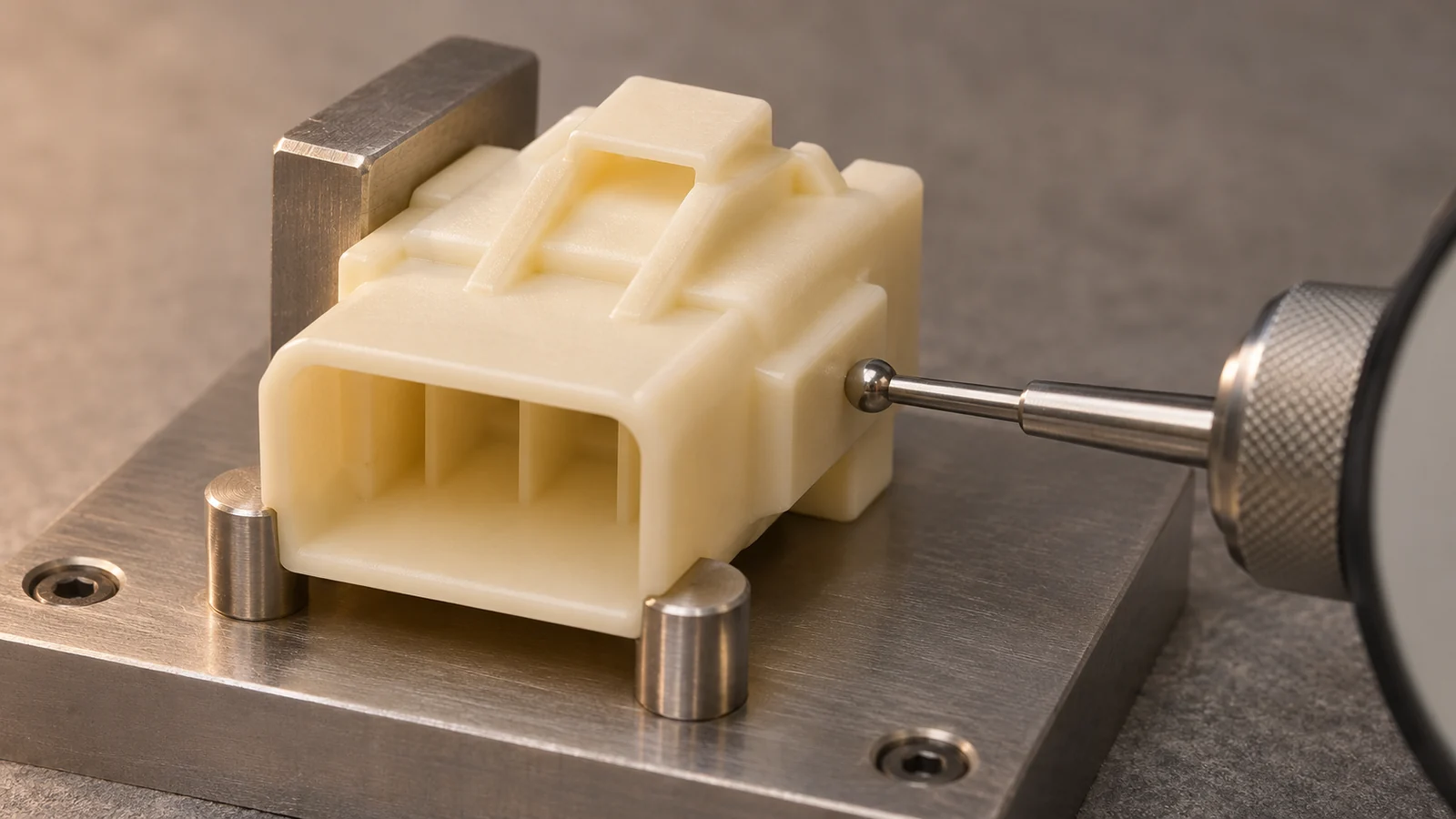
This is why Precision Injection Molding depends on the relationship between the part, process, and inspection method. A precise-looking numerical result is not automatically a meaningful result. Confirm the drawing reference and method with the people responsible for acceptance.
Give the experiment a question it can answer
Choose factors for an engineering reason. Melt conditions, mold temperature, fill behavior, packing, and cooling can affect different responses, but they should not all enter every study by default. Screen likely influences or investigate a defined interaction. Establish feasible levels with the responsible processing team and the selected resin’s guidance; do not use machine limits as a substitute for a safe, relevant range.
A factorial design studies combinations of factor levels. A fractional design can reduce the number of combinations, but some effects may be confounded: the data cannot independently separate them under that design. The design should therefore match the decision. A small screening exercise may identify factors for further work without supporting a detailed optimization claim.
The NIST experimental-design guidance distinguishes comparative, screening, and response-surface objectives. That distinction is useful in a supplier discussion: ask whether the trial is intended to select influential factors, compare known alternatives, or estimate behavior inside a chosen region. Those are different claims, not interchangeable labels for “DOE complete.”
| Question at the start | What the plan must distinguish | Conclusion to avoid |
|---|---|---|
| Which factors deserve further study? | Likely main effects and important confounding | These settings are already the final optimum |
| Does packing respond differently at two mold conditions? | The combined effect, not only separate averages | One factor always has the same effect |
| Is the chosen region suitable for release? | All relevant part responses and confirmation evidence | A fitted model alone proves production capability |
Review the proposed design before production time is committed. Explain any hard-to-change factor, limited material, or equipment restriction to the analyst. These constraints can be accommodated in a suitable design, but hiding them after the run order has changed undermines the interpretation.
A run is not the same as a bag of parts
Each run needs an identity tied to the intended and observed conditions. Record the tool and cavity, resin lot, actual process observations, sample collection period, and relevant interruptions. After a factor change, the team needs an agreed basis for when the system has stabilized enough to collect samples. There is no universal number of discard shots that suits every change.
Several consecutive parts from one stable setting describe that period. They are not automatically independent repetitions of setting up and running the condition again. Likewise, measuring the same part repeatedly does not add new molding runs. The analysis must use the actual experimental units and sampling structure rather than treating every spreadsheet cell as an independent observation.
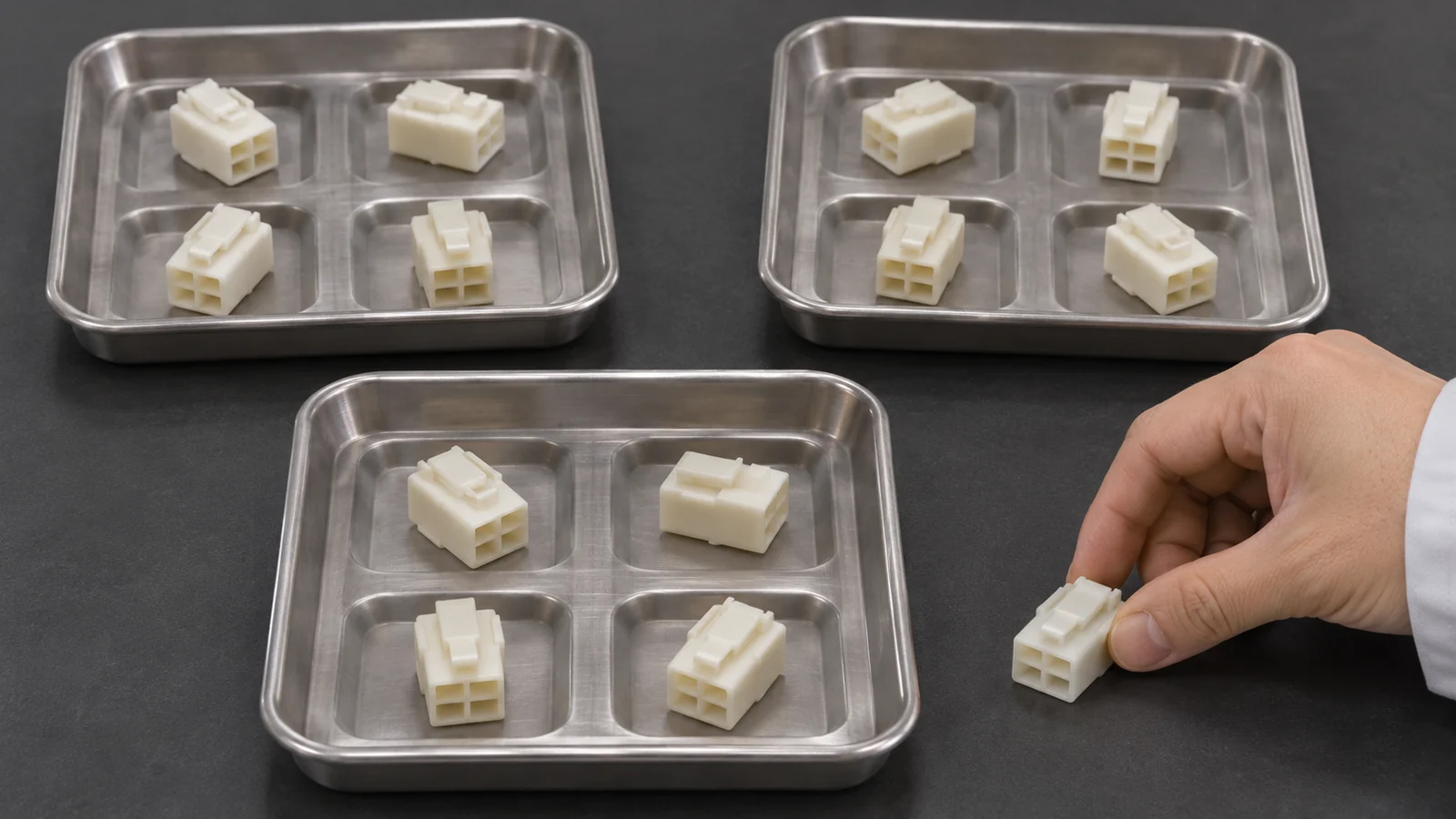
Run order also matters. If every low-temperature condition is produced early and every high-temperature condition late, time-related drift can become entangled with the intended factor. Randomization or an appropriate blocked design can help address this. Where thermal stabilization or material constraints prevent unrestricted random order, document the restriction and use a design suited to it.
Preserve cavity identity instead of pooling away a persistent difference. An average across cavities can conceal a condition that improves one location and worsens another. A plan may analyze cavities separately or include their structure explicitly; it should not silently assume that all pieces in a multicavity shot are interchangeable independent experiments.
Read an interaction before choosing a winner
An interaction means the effect of one factor depends on another factor’s level. A packing change may affect a response differently under two cooling conditions. Looking only at the overall average effect can miss that relationship and encourage a setting choice that works in one combination but not another.
MKS’s injection-molding DOE application note discusses interacting factors and compares experimental designs with different confounding. Its specific settings belong to that study, not to a different resin or mold. The transferable lesson is to review what the design can identify before accepting its fitted effect estimates.
Ask the analyst to explain uncertainty and model adequacy in ordinary engineering language. Are important effects inseparable? Do residual patterns suggest drift or another missing influence? Were excluded runs removed for a documented process interruption, or because they contradicted the preferred result? A statistical output needs those questions beside it.
Do not optimize one response while ignoring another acceptance requirement. A condition associated with lower mass might also weaken a remote feature or change a cosmetic boundary. The preferred operating region must satisfy the relevant responses together. A composite score can assist a trade-off, but its weighting should not hide a mandatory failure.
Reserve material and time for confirmation
Confirmation asks whether the proposed conclusion holds when the selected condition is run again and the parts are evaluated under the agreed method. Plan this before using the available material on exploratory runs. A model fitted to the original data should not be presented as its own independent confirmation.
- Identify the proposed condition and the specific predictions or acceptance decisions to check.
- Run the confirmation under a documented, suitable setup and sampling plan.
- Measure every required response, preserving cavity, timing, and conditioning information.
- Compare the observations with the intended conclusion and investigate disagreements.
- State which material, tool, machine, and operating scope the finding actually covers.
The illustrative connector scenario and accompanying images explain planning only; they are not Jucheng factory photographs or experimental results. No acceptance values or claimed improvements are supplied here. Real limits, replication, and sample counts require the responsible engineering and statistical review for the project.
Turn the findings into a bounded process record
Connect the experiment to the next decision through a controlled record. Keep the objective, design, observed conditions, sample identities, measurement method, analysis, exclusions, and confirmation together. State remaining limitations, such as an untested resin lot or a factor held fixed. A future team should be able to tell what was demonstrated without reconstructing the experiment from emails.
For injection molding DOE discussions within a Jucheng Injection Molding tooling project, provide the part’s critical responses and unresolved questions alongside the CAD and material information. Agree the study scope with the technical team; the presence of a trial service does not itself establish that a particular experimental design or analysis is included.
A completed injection molding DOE can support process selection and further validation, but it does not eliminate change control. Different tooling, material, equipment, or measurement conditions may require new evidence. Keep the conclusion as specific as the experiment that earned it.
DOE review questions
Can a short screening DOE replace process qualification?
No. Screening identifies influences within the study’s scope. Qualification and production release require the applicable evidence and approval process. A screening result can guide that work without settling every required response or operating condition.
Should a run that produced a defect be discarded?
Not merely because the part failed. A failure may identify an important boundary. Document process mishaps separately, retain the reason for any exclusion, and assess whether the planned analysis remains valid. Removing unfavorable results without justification can invalidate the conclusion.