
A lighter part does not automatically have a lower gas assist injection molding cost. Removing plastic can reduce one expense while adding gas-control hardware, tool features, development work, or inspection. Compare the total cost of accepted parts that meet the same functional requirements, not the weight of one molded sample.
The comparison becomes misleading when one quotation covers a solid component and the other quietly changes its wall structure, appearance, or load requirement. First establish what both routes must deliver. Then separate one-time investment, recurring production spending, and the uncertainty that still needs a trial.
Price the same job before comparing the process
Define the drawing revision, resin basis, appearance surfaces, assembly interfaces, and required performance before requesting alternatives. Gas assistance may allow a hollow section where the original design was solid. That is a design change to evaluate, not permission to compare two parts with different acceptance requirements.
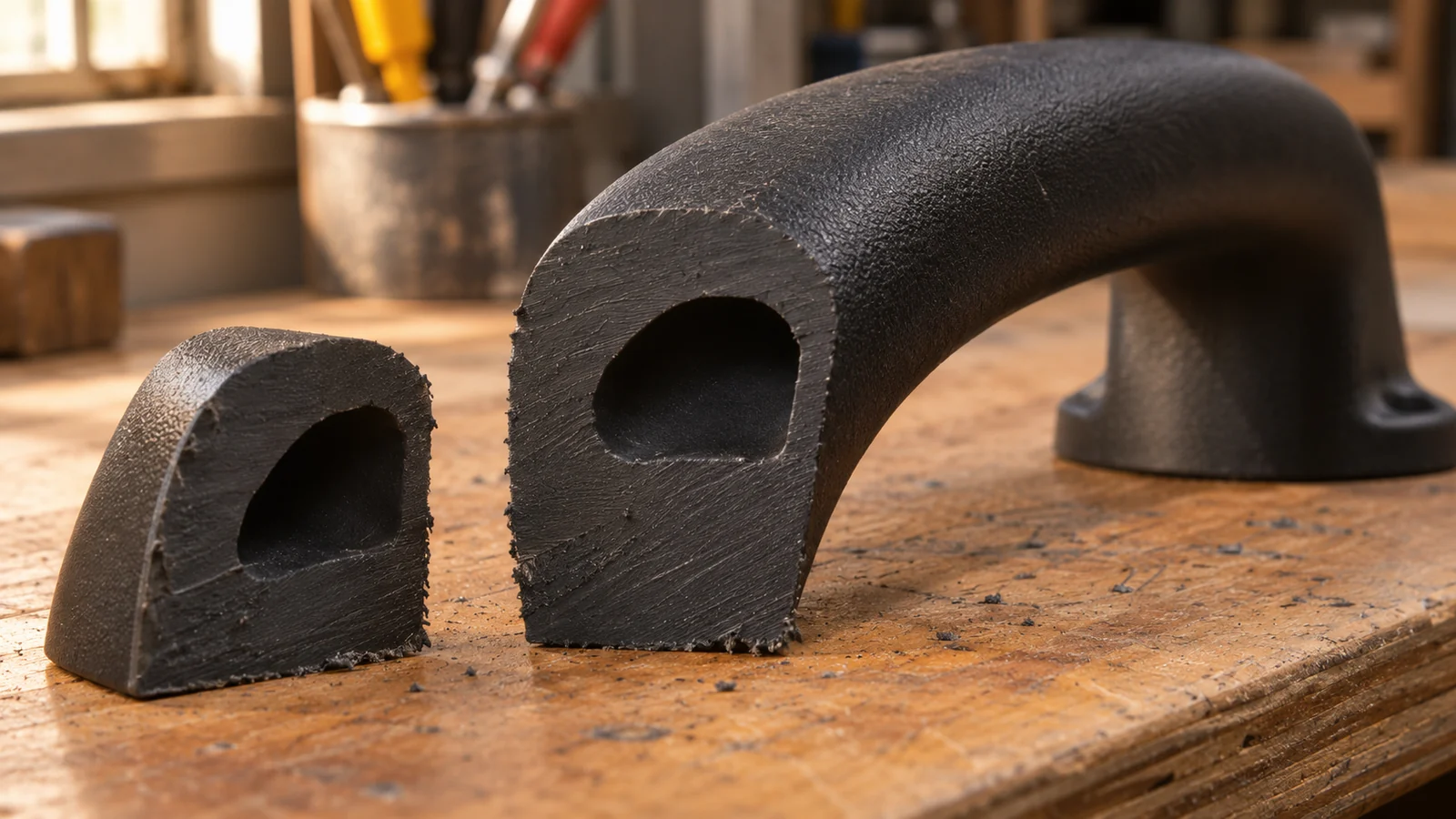
Consider an illustrative industrial equipment handle. The solid design and the gas-assisted concept must both satisfy the agreed mounting loads, usable grip, visible finish, and assembly clearances. Their geometries need not be identical, but their required functions must be comparable. A hollow concept that needs extra brackets or a finishing operation should include those additions in its quotation.
The handle example and accompanying images are hypothetical illustrations, not Jucheng project photographs, measured savings, or evidence of load approval. Actual wall distribution and performance require suitable inspection and testing. A polished external surface cannot establish whether the internal gas channel follows the intended path.
For a Gas Assist Injection Molding review, identify whether the proposal uses internal gas assistance to create a hollow channel or another gas-assisted method. Different methods change the tool and part differently. Do not apply a published result from external gas assistance to an internal hollow handle without examining that difference.
Follow the removed resin through the calculation
Material cost starts with actual consumption, not only the mass of the shipped part. Include runners or overflows where applicable, startup material, rejected pieces, and the agreed treatment of recoverable material. A reduction in nominal part weight does not reduce all these categories by the same proportion.
Ask whether the selected grade and finish remain the same. A revised formulation, additional color control, or different reinforcement may change both the purchase price and the processing behavior. If the gas-assisted design requires a different grade to meet the load or appearance requirement, compare the complete material route rather than multiplying the original resin price by a lighter weight.
Resin savings also differ from cycle savings. A reduction in the heaviest section may shorten its cooling contribution, but gas injection, holding, venting, screw recovery, handling, or another operation can become limiting. Use a demonstrated or explicitly estimated complete cycle. Do not subtract cooling seconds from a quotation while ignoring added sequence time.
Mack Molding’s gas-assist discussion distinguishes internal and external methods and describes potential material, cycle, and tooling trade-offs. Those examples help identify what to investigate. They do not establish a savings percentage or press-size reduction for an unrelated part or a Jucheng quotation.
List what gas assistance adds
The mold proposal should identify the features needed for gas entry, control, discharge, and the intended melt displacement. Relevant items may include gas pins, seals, channels, overflow arrangements, or other process-specific components. The construction depends on the selected method; a generic equipment list cannot define every tool.
Separate project tooling from shared equipment and operating charges. A supplier might recover the cost of gas-control equipment through a tooling fee, a setup charge, or the part rate. None of those arrangements is inherently wrong, but the quotation should make clear what the buyer pays, what is owned, and what remains available if the project moves.
Gas supply belongs in the recurring comparison. The supply method, actual use, pressure-control arrangement, and maintenance requirements affect the expense. Ask for the costing basis rather than inserting a universal nitrogen price or assumed consumption. Gas-system selection and operation require qualified personnel and the applicable safety procedures; this cost review is not an operating instruction.
Development can require additional work to establish gas penetration, wall distribution, appearance, and performance. Define the trial scope, proposed inspections, and correction responsibilities before interpreting a low tooling price as a complete project budget. Equally, do not assume every gas-assisted part needs the most extensive inspection method available.
Build a quote that survives a change in yield
Use accepted output as the common denominator. If a run consumes material and machine time but produces rejected parts, that expense still belongs to the production route. A quotation based on ideal cycles and zero rejects should be labeled as such rather than compared directly with a conservative production estimate.
| Cost group | Ask for this basis | Watch for this mismatch |
|---|---|---|
| Initial tooling and development | Included gas features, trial stages, inspection and corrections | One offer includes validation while the other stops at first samples |
| Material consumption | Selected grade, total consumed mass and recovery assumptions | Shipped part weight is compared with full production consumption |
| Production time | Complete sequence, active cavities and expected availability | Cooling reduction is treated as the complete cycle reduction |
| Quality and secondary work | Accepted yield, trimming, finishing, inspection and assembly | A cheaper molded piece needs extra work to become acceptable |
| Repeat-order support | Setup, servicing, spares and any minimum batch charges | Annual demand is priced as one uninterrupted run |
A useful bookkeeping relationship is: total project spending equals one-time costs plus recurring costs for the required accepted output, with separately identified transition or exceptional costs. Divide by the accepted quantity only when all categories use the same scope. This is an estimating framework, not a market-price model.
To review gas assist injection molding cost, mark each line as a supplier commitment, an estimate requiring trial confirmation, or an unresolved input. A lower total supported by several optimistic assumptions may be less useful than a slightly higher, clearly bounded offer.
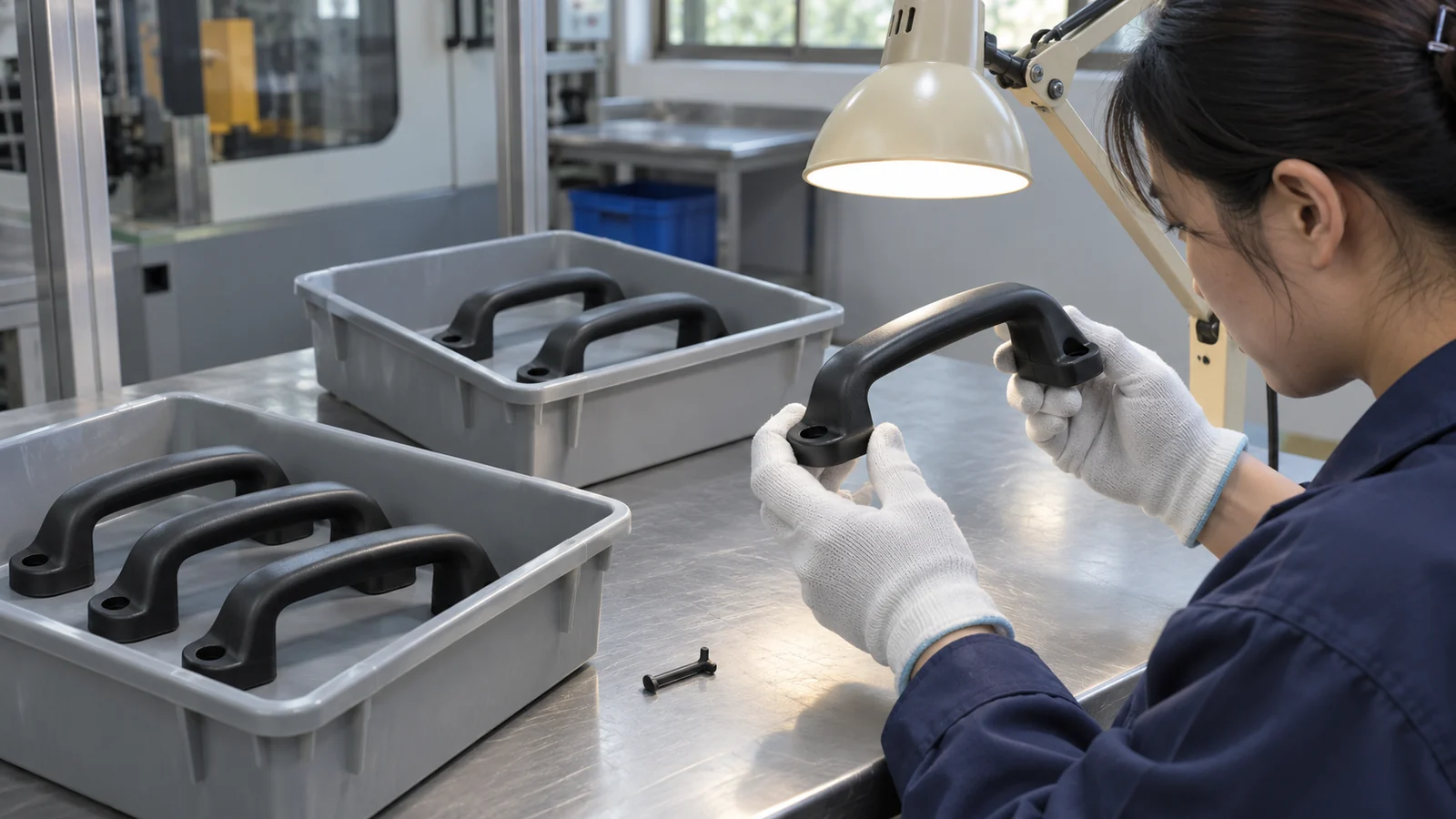
Keep cost consequences tied to their causes. If an extra inspection is required because the remaining wall must meet a defined requirement, record that requirement and the proposed sampling. If a process change is expected to remove a painting step, confirm the agreed appearance on molded samples before deleting painting from the budget.
Test the decision against remaining demand
Higher initial tooling can be justified by lower recurring spending, but only over the output that can reasonably use the tool. Compare confirmed orders separately from forecasts. Product revisions, cancellation risk, order frequency, and the timing of approvals can change how much demand is available to recover the investment.
If the gas-assisted route has a higher initial cost and a genuinely lower recurring cost per accepted part, a simple break-even quantity is the additional initial cost divided by the recurring saving per accepted part. This relationship applies only when the saving is positive and the assumptions remain comparable. It does not account automatically for financing, taxes, changing batch sizes, or future redesigns.
Run a sensitivity check before treating that quantity as a decision. What happens if accepted yield is lower than estimated, an additional appearance step remains necessary, or the project requires several short runs instead of one long campaign? Change these inputs individually and together where they are related. A narrow projected advantage can disappear without any single estimate being wildly wrong.
Also distinguish released capacity from cash savings. A shorter cycle may free press time without removing fixed salaries or depreciation. Its commercial value depends on the costing arrangement and whether the capacity can be used. Avoid counting both an unchanged overhead allocation and a speculative extra-sales benefit as guaranteed savings.
When requesting a Jucheng Injection Molding comparison, submit the functional requirements, resin basis, accepted quantity, order schedule, and appearance standard with the model. Ask for the assumptions behind gas assist injection molding cost and which items the trial must confirm. The useful output is a comparable route decision, not a universal promise that hollow plastic is cheaper.
Cost questions buyers ask
Should gas-system equipment be purchased by the buyer?
That depends on the commercial and production arrangement. Clarify who supplies and owns the equipment, how its cost is recovered, and what happens during relocation or servicing. Do not assume a quoted part rate includes every project-specific asset.
Can a gas-assisted part be quoted accurately before a trial?
A supplier can estimate against a defined design and assumptions, but some process and acceptance inputs may remain uncertain. Separate firm scope from provisional cycle, consumption, and yield figures. Agree how trial findings affect the final quotation.
Is the lowest material consumption always preferable?
No. The remaining wall and structure must still meet the specified duty. Compare acceptable performance and complete production cost, including any added support or inspection, rather than minimizing resin mass in isolation.