
Vibration Welding
Vibration welding joins compatible thermoplastic components through relative mechanical motion and pressure at their interface. Frictional heating produces a molten joining region, which consolidates as the motion stops and the joint is held. The process can be considered for larger molded assemblies, but it requires suitable geometry, robust fixturing and a defined path for the resulting weld flash.
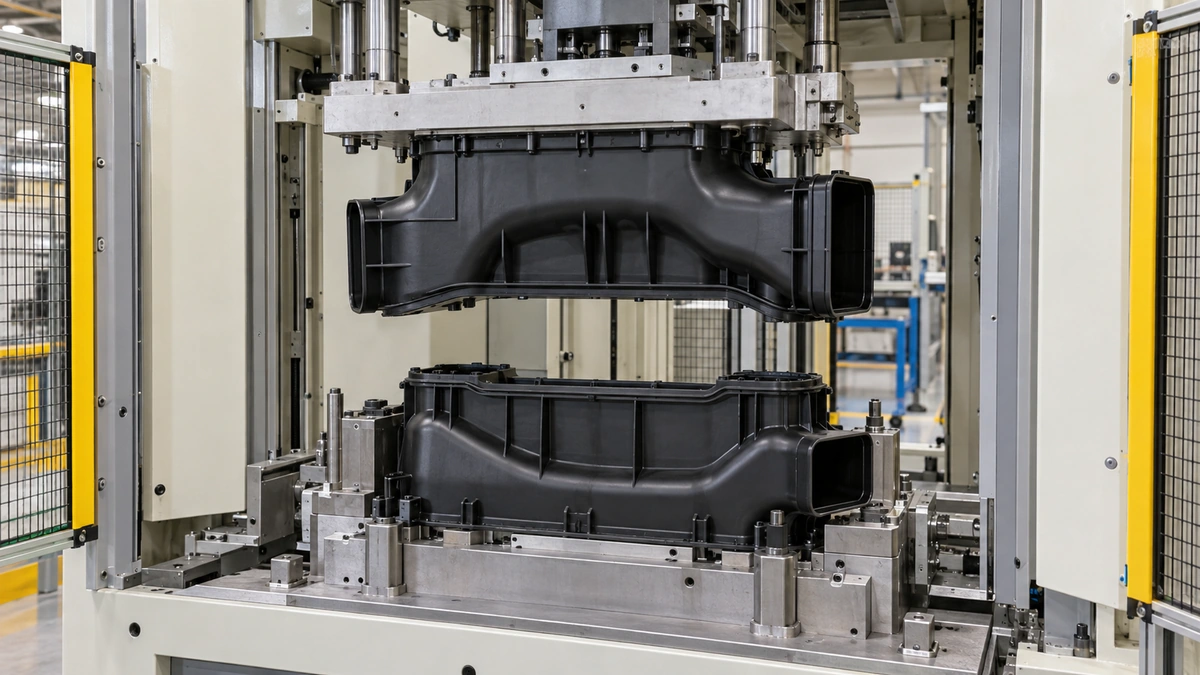
The interface must permit movement
Linear vibration welding requires relative motion between the parts. Features that mechanically lock the halves before welding can obstruct that movement. Review alignment features, internal ribs and nearby components in both the initial and final positions.
The joint also needs a reasonably controlled fit around its path. Warped molded halves can create uneven contact, making a nominally continuous flange difficult to weld consistently. Address these conditions in the plastic injection molding specification.
Plan where the displaced material goes
Welding can push molten material from the joint. A flash trap or other containment feature may be needed to protect appearance or internal function. For air or fluid paths, assess whether loose particles or protruding flash could be unacceptable.
| Design region | Question before tool release |
|---|---|
| Joint flange | Can it make consistent contact while accommodating motion? |
| Outer seam | Is the weld witness visible or concealed? |
| Inner flow path | Where will flash collect? |
| Fixture contact | Can the part withstand clamping without distortion? |
Qualify the assembly as a system
- Measure representative molded halves and their interface condition.
- Establish a supported welding setup and process window.
- Inspect final geometry and contained flash.
- Verify strength or sealing using the product’s acceptance criteria.
The final assembly may require a functional check after conditioning. A room-temperature sample alone may not represent performance after exposure to operating heat, fluids or repeated loads.
Frequently asked questions
Is vibration welding limited to round components?
No. Unlike spin welding, linear vibration welding does not require a circular rotational joint. The geometry must still allow the necessary relative movement.
Can internal parts be installed before welding?
Potentially, but they must tolerate the motion, clamping and thermal effects. Review their clearances and sensitivity before approval.
Can the process compensate for large molded warpage?
Do not assume so. Incoming geometry is part of the welding process capability and needs control.
Review the joint before committing to tooling
Send assembly CAD, resin grades and the intended operating conditions. Coordinate the interface with custom mold making and define acceptance with quality control.