
PBT-DuPont Crastin SK605
Achieving uncompromised electrical insulation alongside heavy-duty mechanical stiffness under high heat requires a high-performance polyester, which Celanese’s Crastin SK605 (formerly DuPont) delivers through its 30% glass fiber reinforced polybutylene terephthalate matrix. Featuring a density of 1.53 g/cm³ and a melt mass-flow rate of 10 g/10 min, this lubricated, semi-crystalline grade is the global benchmark for intricate automotive connector arrays, electrical bobbins, and consumer appliances. Jucheng Precision, under IATF 16949 and ISO 9001 frameworks, specializes in molding Crastin SK605. Supported by our 5-axis CNC-machined H13 steel tooling, we control its anisotropic shrinkage (0.3% parallel, 1.1% normal) to eliminate warpage, verified by Zeiss CMM.
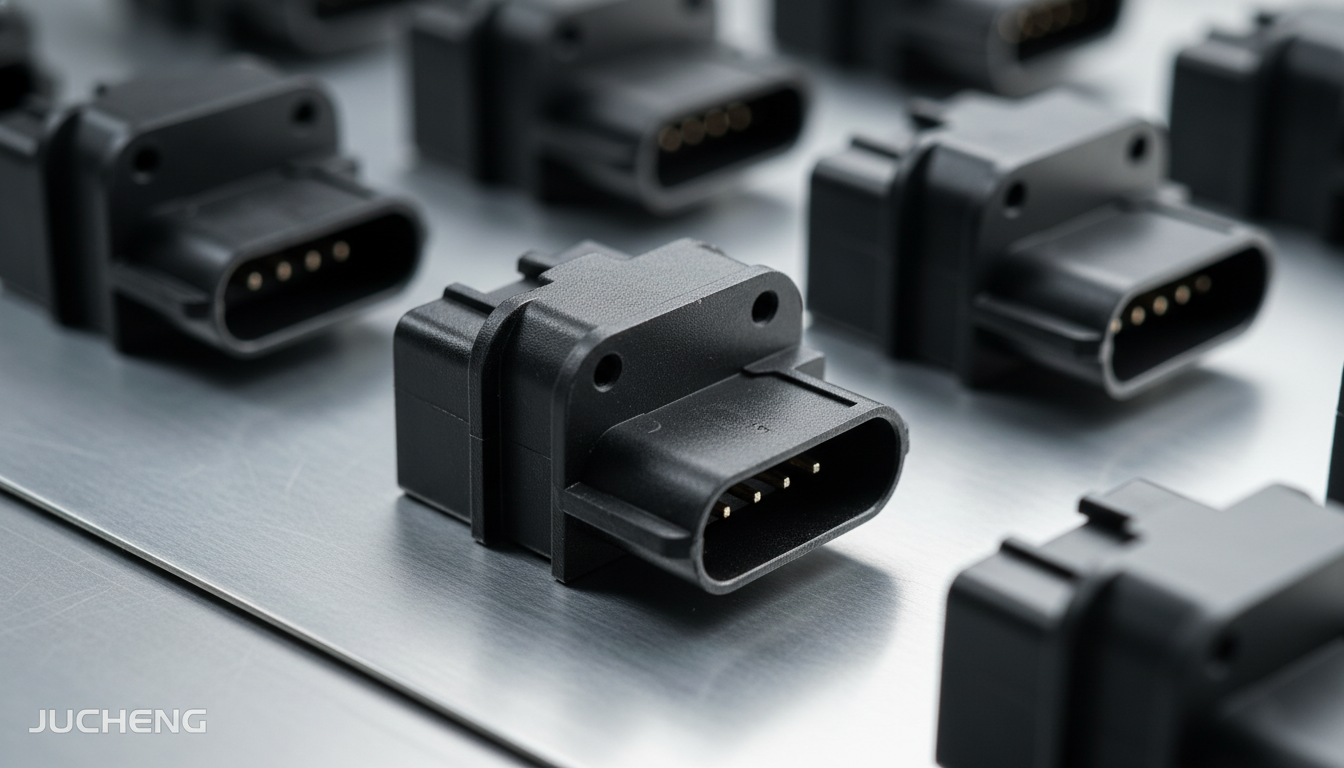
Crastin SK605 Mechanical Strength & Electrical Insulation Profile
Crastin® SK605 NC010 is a 30% glass fiber reinforced, lubricated polybutylene terephthalate resin engineered by Celanese (formerly DuPont) to deliver exceptional strength, stiffness, and high arc resistance:
| Mechanical / Electrical Metrics | Typical Value (ISO Standard) | Molding & End-Use Advantage |
|---|---|---|
| Tensile Stiffness | Tensile Modulus 10,000 MPa / Strength 140 MPa | Provides exceptional, metal-like structural rigidity, replacing die-cast zinc or aluminum brackets in automotive interiors. |
| Electrical Isolation | Dielectric Strength 20 kV/mm (at 2mm) | Outstanding insulation resistance and arc-tracking resistance, preventing voltage leaks in high-voltage EV connectors. |
| Processing Flow | MVR 7.0 cm³/10min (MFR 10 g/10min) | Easy-release lubricated matrix ensures smooth, rapid flow and clean, automatic ejection on high-speed automated runs. |
Structural Component Process Configurations for Crastin SK605
With its high-stiffness reinforcement and lubricated chemistry, Crastin SK605 is highly optimized for complex dynamic components:
| Process Category | Molding Compatibility & Process Setup Details |
|---|---|
| Precision Electrical Connectors | Excellent. Fully optimized for automotive engine block sensor plugs, high-density multi-pin connectors, and dynamic relay housings. |
| Heavy-Duty Windings & Bobbins | Excellent. High tensile modulus prevents part deformation or deflection under high copper wire tension on multi-slot bobbins. |
| High-Aesthetic Appliance Trims | Good. Easy-release lubricants combined with optimized tooling result in premium surface finishes with minimized glass fiber visibility. |
PBT-DuPont Crastin SK605 Mold Engineering Blueprint
Molding an un-lubricated crystalline composite like Crastin SK605 requires strict moisture control and optimized gating to prevent abrasive tool wear and warpage:
Hardened S136 Tooling (Abrasive Wear Prevention)
30% glass fibers act as an abrasive medium under high injection speeds. Jucheng’s tooling division prevents cavity erosion by constructing molds with premium S136 stainless tool steel hardened to 48–52 HRC and machined on our 5-axis CNCs, ensuring long-term parting line precision and flash-free components.
Anisotropic Shrinkage & Warpage Control
Crastin SK605 shrinks much less along the flow (0.30%) than perpendicular to it (1.10%). We use Moldflow simulation during our free DFM review to balance gate locations, aligning glass fibers uniformly to prevent component warping and out-of-tolerance dimensions.
Desiccant Drying Protocol (Hydrolysis Prevention)
PBT is highly sensitive to moisture at high melt temperatures. Wet molding results in rapid hydrolytic chain cleavage, causing severe splay, gas bubbles, and a major drop in impact strength. We desiccant dry Crastin SK605 resin at 120°C (248°F) for 3–4 hours, keeping moisture below 0.04%.
Balanced Cooling Loops
To prevent warping in complex electrical frames, we machine balanced, conformal cooling circuits directly into core blocks to speed up heat dissipation, further reducing cycle times and preventing thermal warpage.
Key Application Fields for PBT-DuPont Crastin SK605
- Automotive Electrical & Powertrains (IATF 16949): High-voltage EV connectors, ignition coil bobbins, throttle sensor housings, headlamp bezel assemblies, and electric water pump housings.
- Electrical Components & Smart Grids: Industrial circuit breakers, heavy-duty relay sockets, terminal blocks, smart power meters, and coil bobbins.
- Consumer Electronics & Appliances: Heavy-duty appliance handles, outdoor spotlight housings, high-temperature indicator bezels, and structural chemical valve housings.
Properties
| Density | 1.53 g/cm³ |
| Melt Mass-Flow Rate (MFR) (250°C/2.16kg) | 10 g/10 min |
| Melt Volume-Flow Rate (MVR) (250°C/2.16kg) | 7 cm³/10min |
| Tensile Modulus | 10,000 MPa |
| Tensile Stress at Break | 140 MPa |
| Tensile Strain at Break | 2.7 % |
| Flexural Strength | 210 MPa |
| Flexural Modulus | 9,000 MPa |
| Charpy Notched Impact Strength (23°C) | 9 kJ/m² |
| Melting Temperature (DSC) | 225 °C |
| Heat Deflection Temperature (HDT @ 0.45 MPa) | 215 °C |
| Heat Deflection Temperature (HDT @ 1.80 MPa) | 205 °C |
| Linear Mold Shrinkage (Flow Direction) | 0.3 % |
| Linear Mold Shrinkage (Cross Direction) | 1.1 % |
| Dielectric Strength (2.0mm) | 20 kV/mm |
| Maximum Part Size | 1000 x 800 mm |
| Minimum Part Size | 1 x 1 mm |