
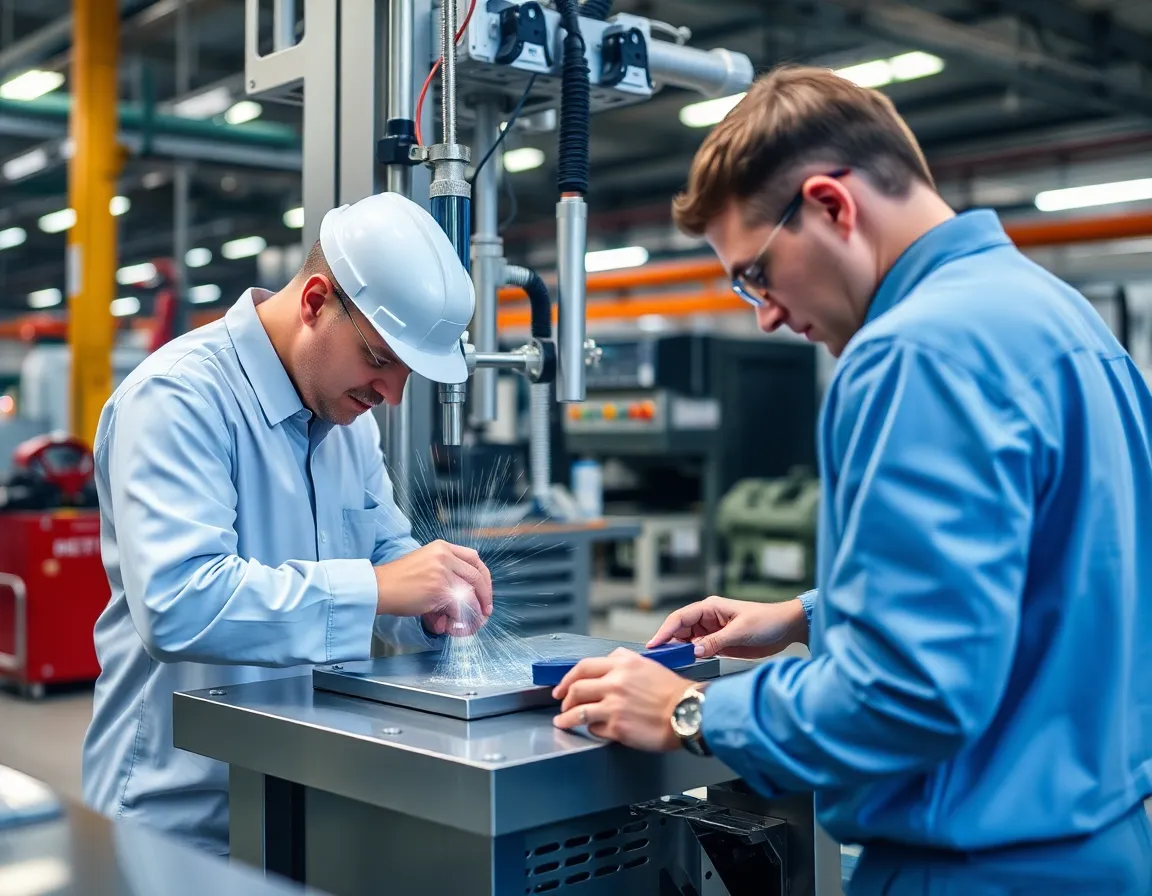
Introduction: The Evolution of Modern Manufacturing
The manufacturing landscape has undergone a seismic shift over the past two decades. Gone are the days when a single material—often a specific grade of plastic or aluminum—defined an entire product’s lifecycle. Today’s most innovative devices, from wearable medical sensors to aerospace actuators, demand a complex symphony of materials: rigid polymers for structural integrity, soft elastomers for sealing, conductive metals for circuitry, and even bio-compatible ceramics for implantable components. This convergence of needs has given rise to a specialized discipline known as multi-material contract manufacturing. At its core, this is the practice of outsourcing the production of a single finished component or assembly—which integrates two or more distinct materials—to a third-party manufacturer with the specialized equipment, tooling, and process expertise to handle that complexity. Unlike traditional contract manufacturing, which often focuses on a single process like injection molding or CNC machining, multi-material manufacturing is an integrated, holistic approach. This guide will dissect what this entails, how it functions, why it has become indispensable, and how you can leverage it for your next product launch.
Defining Multi-Material Contract Manufacturing: Beyond Simple Assembly
To truly understand this field, one must first distinguish it from simple assembly or traditional subcontracting. A contract manufacturer (CM) that merely screws a metal bracket onto a plastic housing is performing assembly. A multi-material contract manufacturer, however, creates the material bond at the molecular or mechanical level during the primary forming process. This involves techniques like two-shot (2K) injection molding, overmolding, insert molding, and multi-process transfer molding. The value proposition lies not in simply combining parts, but in creating a monolithic, inseparable structure that offers performance characteristics unattainable by joining separate components.
For instance, consider a handheld power tool. A standard CM might mold a rigid nylon housing and then glue a rubber grip over it. A multi-material CM will mold the nylon base, then rotate the tool in the same machine to inject a thermoplastic elastomer (TPE) directly over the nylon. The chemical bond created during this process ensures the grip never peels off, provides superior vibration dampening, and eliminates the need for adhesives or mechanical fasteners. This is the essence of the discipline: process integration for enhanced material synergy.
The Core Technologies Driving the Sector
Multi-material manufacturing is not a single technology but a portfolio of advanced processes. The most common include:
- Two-Shot (2K) Injection Molding: This uses a specialized injection molding machine with two barrels. The first shot solidifies the rigid substrate, and the second shot injects a softer or differently colored material over or around it. This is ideal for high-volume production of items like toothbrush handles, automotive interior switches, and medical syringes.
- Sobremoldagem: Often used interchangeably with 2K, but strictly speaking, overmolding involves taking a pre-formed substrate (which may have been molded elsewhere or machined) and placing it into a second mold to be covered with another material. This is common for adding soft-touch coatings to metal or for encapsulating electronics.
- Moldagem por Inserção: This involves placing a pre-manufactured component—typically metal (like a threaded nut or electrical contact)—into the mold cavity before injecting plastic around it. This creates a robust mechanical lock, eliminating secondary pressing operations.
- Multi-Process Manufacturing: This is a broader term where a CM combines various techniques in a single workflow, such as 3D printing a complex internal lattice structure, then overmolding a silicone skin over it, followed by laser welding of a metal insert.
These technologies require unique machinery—such as rotary platen presses—and, critically, advanced mold design that accounts for differential shrinkage, thermal expansion, and chemical compatibility between the materials.
Why Choose Multi-Material Contract Manufacturing? Key Benefits
The decision to move from single-material to multi-material production is driven by tangible, quantifiable benefits that impact the bottom line and product performance.
1. Enhanced Product Performance and Ergonomics
The primary driver is functional superiority. Combining a rigid plastic with a soft elastomer yields products that are both structurally strong and comfortable to hold. In medical devices, this means a rigid housing for electronics with a soft, pliable patient-contact surface that reduces tissue damage. In consumer electronics, it allows for integrated gaskets that provide IP67 waterproofing without the need for separate rubber O-rings, which can be lost or improperly seated during assembly. The result is a product with superior haptics, acoustic sealing, and impact resistance.
2. Reduced Assembly Costs and Supply Chain Complexity
Every part you eliminate from your Bill of Materials (BOM) reduces cost. Multi-material manufacturing consolidates what would be a three-part assembly (housing, gasket, and fastener) into a single molded piece. This eliminates the cost of purchasing those separate parts, managing multiple suppliers, paying for secondary assembly labor, and dealing with inventory logistics. According to industry studies, part consolidation via multi-material molding can reduce total manufacturing costs by 20-40% for complex electromechanical devices. Furthermore, there is less risk of quality issues arising from improper manual assembly.
3. Design Freedom and Miniaturization
When components are molded together, designers are no longer constrained by the need for screw bosses, snap-fit features, or welding flanges. This allows for significant miniaturization. For example, a multi-material pump diaphragm can be molded directly onto a rigid actuator arm, creating a hermetic seal in a space that is 50% smaller than a traditional mechanically fastened assembly. This is critical in the development of next-generation implantable drug delivery systems and microfluidic diagnostics.
4. Improved Product Reliability and Aesthetics
Mechanical joints are often the weakest point of any product—they are susceptible to vibration loosening, galvanic corrosion, and moisture ingress. By eliminating these joints, multi-material parts exhibit higher long-term reliability. Aesthetically, the process allows for seamless integration of different colors and textures without visible parting lines or seams. A matte soft-touch grip that transitions flawlessly into a glossy rigid shell is a hallmark of premium product design, achievable only through this method.
Critical Applications Across Industries
The versatility of multi-material contract manufacturing has made it the standard across several high-stakes industries.
Medical and Life Sciences
This is arguably the most demanding sector. Multi-material molding is used to produce insulin pens with soft-grip bodies and rigid internal mechanisms. Surgical staplers require handles that are rigid enough to transmit force yet soft enough to prevent surgeon fatigue. Furthermore, the production of combination products—like pre-filled syringes with elastomeric rubber tips molded onto plastic plungers—relies heavily on this technology to ensure a tight seal without leachable adhesives. Contract manufacturers in this space must adhere to ISO 13485 and FDA regulations, ensuring the material bond is validated for biocompatibility and sterilization resistance.
Automotive and E-Mobility
Modern vehicles are packed with sensors, connectors, and control units that must survive extreme temperature fluctuations and vibration. Multi-material molding is used to create sealed connectors where a liquid silicone rubber (LSR) gasket is molded directly onto a PBT (polybutylene terephthalate) housing. This provides an absolute seal against moisture and road salts. Additionally, the interior cabin uses 2K molding for decorative trim with integrated soft-touch surfaces, and for airbag covers that require a defined tear seam between a rigid substrate and a flexible skin.
Consumer Electronics and Wearables
In this industry, aesthetics and thinness are paramount. Smartwatches use multi-material frames where a stainless steel antenna is insert-molded into a ceramic or polymer backplate. Earbuds rely on overmolding to bond silicone ear tips to rigid acoustic tubes. The structural frame of laptops often features overmolded rubber feet that are virtually impossible to pull off, thanks to the chemical bond formed during manufacturing. The ability to create complex curves and integrate antennas without visible seams is a direct result of this technology.
Best Practices and Critical Considerations for Success
While the benefits are immense, multi-material manufacturing is not a plug-and-play solution. It requires meticulous planning and a partnership approach with your contract manufacturer.
Material Selection: The Golden Rule
Not all plastics stick together. If you are using 2K molding, you must ensure that the two polymers are chemically compatible. For example, polypropylene (PP) is notoriously difficult to bond to other materials without specialized adhesion promoters. Conversely, ABS and TPU (thermoplastic polyurethane) form excellent chemical bonds. If materials are incompatible, the CM must design mechanical interlocking features—such as undercuts or holes—into the substrate to physically lock the second material in place. Your CM’s material scientists should be involved in the design review before the mold is cut to validate this chemistry.
Design for Manufacturability (DFM) for Multi-Material
The design rules differ significantly from single-shot molding. You must account for the shrinkage differential between the two materials. If the soft material shrinks more than the rigid one, it can cause warpage or internal stress. Wall thicknesses must be balanced to prevent flow marks. Furthermore, the mold design is complex—it requires precise temperature control zones to ensure the first shot does not melt or deform when the second shot is injected. A successful DFM review will focus on gate placement, venting, and the sequencing of the injection cycles.
Selecting the Right Contract Manufacturing Partner
Do not select a partner solely based on the number of molding machines they own. Look for a partner with in-house tooling capabilities for complex rotating molds, as this is where the true engineering challenge lies. Ask for case studies of similar multi-material projects. Inquire about their process validation protocols—how do they test the bond strength? Do they use pull-testing or ultrasonic inspection? For regulated industries, they must be able to provide a full Material Traceability Report. Furthermore, consider their location; a partner with a cleanroom environment is essential for medical and optical applications.
Prototyping and Iterative Testing
Even the best simulation software cannot fully predict the behavior of two materials bonding under high pressure and temperature. It is essential to build prototype molds—often using soft tooling or 3D printed inserts—to test the material interface. This phase is critical for evaluating the peel strength and environmental resistance (e.g., UV exposure, chemical resistance). A professional CM will insist on a rigorous Design of Experiments (DOE) to optimize the melt temperature and injection speed for the second shot, as these parameters directly affect the adhesion quality.
Conclusion: The Future is Multi-Material
As products continue to shrink in size while growing in functional complexity, the limitations of single-material manufacturing become increasingly apparent. Multi-material contract manufacturing represents a paradigm shift from "make parts and join them" to "grow the complete part in one step." It offers a compelling value proposition: lower total cost through consolidation, enhanced user experience through optimized haptics, and engineering breakthroughs that were previously impossible. However, success demands more than just buying a 2K injection molding machine. It requires a deep understanding of polymer chemistry, advanced mold flow analysis, and a collaborative relationship between the OEM’s design team and the manufacturer’s process engineers.
For any product development team facing the challenge of integrating dissimilar materials—whether for a waterproof connector, a wearable health monitor, or a high-performance automotive component—engaging a specialist multi-material contract manufacturer early in the design phase is not just a recommendation; it is a strategic imperative. By leveraging their expertise in tooling, material science, and process control, you can accelerate your time-to-market, reduce warranty risks, and deliver a product that stands head and shoulders above the competition in both performance and durability.