
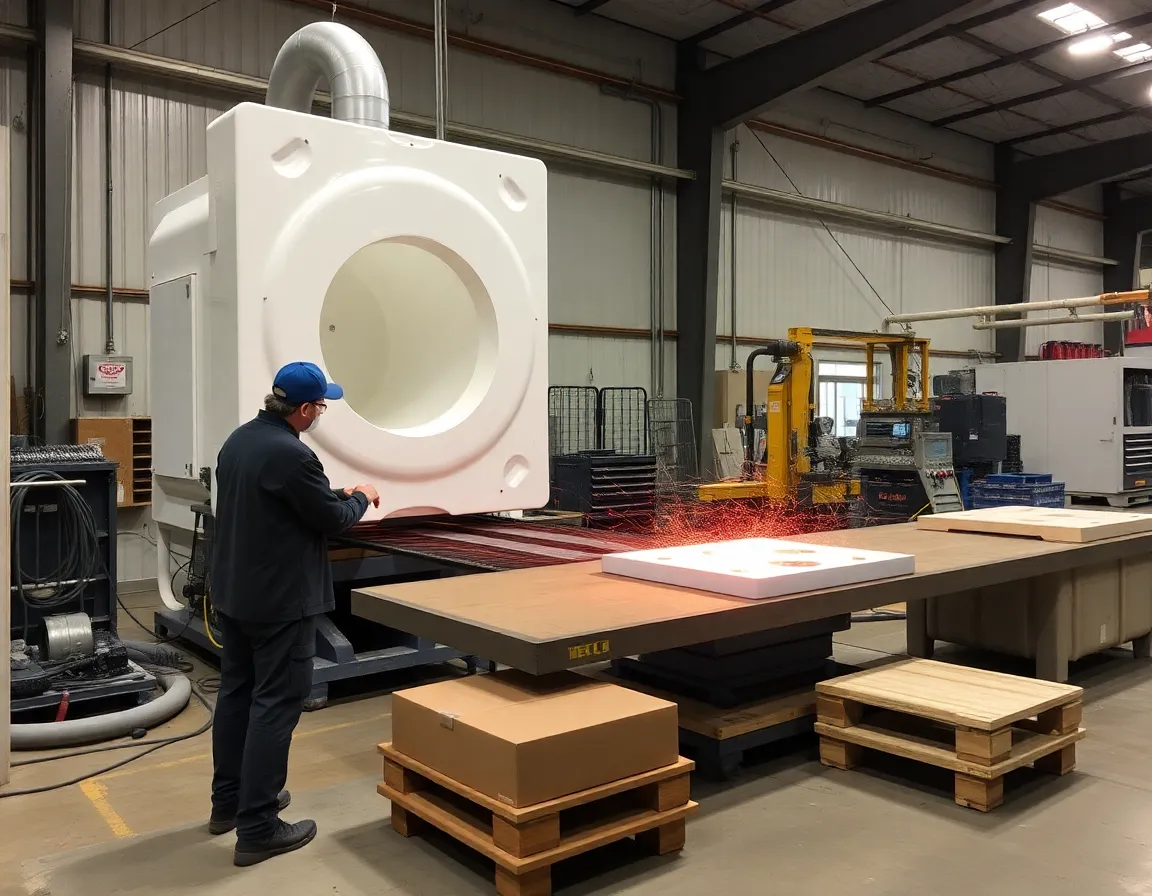
The Strategic Advantage of Contract Mold Making
In the high-stakes world of precision manufacturing, the difference between a product’s success and its catastrophic failure often lies in the unseen geometry of a steel cavity. Contract mold making—the practice of outsourcing the design, engineering, and fabrication of injection molds, die-cast tooling, and compression dies to a specialized third-party vendor—has evolved from a simple cost-saving measure into a critical strategic lever. For original equipment manufacturers (OEMs) and product developers, partnering with a dedicated mold maker is no longer about filling a capacity gap; it is about accessing a depth of metallurgical knowledge, CNC machining precision, and process simulation expertise that is impossible to replicate in-house without massive capital expenditure.
This article peels back the layers of this niche industry to reveal the precision production secrets that separate world-class contract mold makers from commodity shops. We will explore the intricate lifecycle of a mold—from DFM (Design for Manufacturability) analysis to final validation—and uncover how these experts achieve tolerances measured in microns, extend tool life, and compress lead times. Whether you are sourcing a prototype mold for a medical device or a high-cavitation production tool for automotive components, understanding the mechanics and philosophies of elite contract mold making will empower you to make informed, strategic decisions.
The Core Process: From CAD File to Hardened Steel
The journey of a contract mold begins long before steel is cut. The true secret to precision production lies in the digital pre-production phase. A reputable contract mold maker does not simply receive a part file and start machining; they engage in a rigorous collaborative engineering review. This is where the "secrets" of efficiency are actually won or lost.
Design for Manufacturability (DFM) and Mold Flow Analysis
During the DFM review, mold engineers scrutinize the customer’s part design against the physical laws of polymer flow and shrinkage. They identify potential weld lines, sink marks, and gas traps that would render a part cosmetically or structurally defective. Using advanced Mold Flow Analysis (MFA) software, they simulate the injection process on a computer, predicting how the molten resin will fill the cavity. This digital rehearsal allows them to optimize gate locations, runner sizes, and cooling channel layouts before a single chip of metal is removed. The secret here is iterative simulation; top-tier shops will run dozens of virtual iterations to achieve a perfectly balanced fill, ensuring that every cavity in a multi-cavity mold fills at the exact same pressure and temperature.
Material Selection and Heat Treatment Metallurgy
Precision is not just about machining; it is about the stability of the substrate. The choice of tool steel—whether P-20 for low-volume prototyping, H-13 for high-heat die casting, or S-7 for high-impact stamping—dictates the mold’s lifespan and resistance to wear. However, the real secret lies in the heat treatment cycle. Contract mold makers often use vacuum furnaces with precise temperature ramping and quenching controls to achieve a specific Rockwell hardness (typically 48-62 HRC). This process must be followed by stress-relieving and, for high-end tools, cryogenic treatment to convert retained austenite into martensite. A poorly heat-treated mold will warp, crack, or wear out prematurely, regardless of how perfectly it was machined.
Precision Production Secrets: Machining and EDM Mastery
Once the design is locked and the steel is prepared, the physical fabrication begins. This is where the "secrets" of achieving micron-level accuracy come into play. It is a symphony of subtractive manufacturing technologies, each with a specific role.
High-Speed Machining (HSM) and 5-Axis Milling
Modern contract mold makers rely heavily on high-speed machining centers operating at spindle speeds exceeding 20,000 RPM. The secret here is not just speed, but trochoidal milling strategies—a technique that involves a constant radial engagement of the cutting tool, allowing for deeper cuts with less heat generation and tool deflection. This enables the machining of complex 3D contours and deep ribs with exceptional surface finishes. For truly complex geometries, 5-axis machining allows the cutting tool to remain perpendicular to the cutting surface, reducing the need for multiple setups and eliminating tolerance stack-up errors. The benefit is the ability to machine hardened steel (pre-hardened to 52 HRC) directly, avoiding the distortion that can occur during post-machining heat treatment.
The Art of Sinker and Wire EDM
When a mold cavity requires sharp internal corners, square shoulders, or deep, narrow slots that a milling cutter cannot reach, Electrical Discharge Machining (EDM) takes over. Wire EDM is used to cut precise through-holes, such as ejector pin holes and core pins, with a surface finish so fine that it acts as a built-in polish. Sinker EDM involves a pre-machined graphite or copper electrode that is slowly eroded into the steel to create complex cavity shapes. The secret to precision in EDM lies in the generator settings—controlling the spark gap and pulse duration to minimize the recast layer (white layer) on the steel surface. Elite shops use EDM in a "flushing" environment with deionized water or oil to ensure debris removal, resulting in a mirror-like finish that requires minimal manual polishing.
The Human Element: The Toolmaker’s Bench
Despite the dominance of CNC and EDM, the final 10% of precision is still achieved by hand. The master toolmaker is the unsung hero of contract mold making. Their job involves fitting, spotting, and polishing. "Spotting" involves applying a thin layer of blue dye to the core and closing the mold to check for contact points. The toolmaker then meticulously scrapes or files down high spots to ensure perfect steel-to-steel contact. This ensures that when plastic is injected, it does not flash (leak out) between the parting lines. The polishing phase is equally critical; a toolmaker may spend days hand-polishing a lens-grade cavity with diamond paste, progressing from 400 grit to 15,000 grit to achieve a surface roughness of less than 0.01 microns. This human intervention is the ultimate secret to achieving optical clarity or textured finishes that machine tools alone cannot replicate.
Production Optimization: Cooling, Venting, and Lifespan Extension
Creating the mold is only half the battle; the true value of a contract mold maker is revealed in the production phase. A mold that produces perfect parts but takes 60 seconds to cycle is a liability. The best shops design for thermal efficiency and robustness.
Conformal Cooling Channels
Traditional straight-drilled cooling lines often leave hot spots in the mold, leading to warpage and extended cycle times. The precision production secret used by advanced contract makers is additive manufacturing (3D printing) of mold inserts. Using Laser Powder Bed Fusion, they can create conformal cooling channels that follow the exact contour of the part cavity. These channels allow water or oil to flow within 2-3 millimeters of the part surface, dramatically accelerating heat removal. This results in cycle time reductions of 30-50% and eliminates differential shrinkage, ensuring a flatter, more dimensionally stable part. This is the single most effective way to reduce the cost per part in high-volume production.
Advanced Venting and Ejection Strategies
Air trapped in a mold cavity compresses and burns the plastic, creating black streaks or short shots. The secret to flawless molding is strategic venting—placing microscopic gaps (typically 0.0005 to 0.001 inches deep) at the end of the fill. Contract mold makers use porous steel inserts (e.g., 3M’s Dycon) or mechanical vent pins that allow air to escape while blocking molten plastic. Furthermore, ejection must be balanced. The mold maker calculates the exact placement of ejector pins, blades, and lifters to push the part out without distortion. They often use nitrogen gas springs instead of mechanical springs for faster, more reliable ejection, and add wear-resistant coatings like Titanium Nitride (TiN) or Chromium Nitride (CrN) on sliding cores to prevent galling and extend tool life.
Quality Assurance and Validation Protocols
Precision is not an opinion; it is a measurement. The final secret to successful contract mold making is a rigorous, data-backed validation process that leaves nothing to chance.
First Article Inspection (FAI) and CMM Reporting
After the mold is built and sampled, the parts are subjected to First Article Inspection. Using a Máquina de Medição por Coordenadas (CMM) with a scanning probe, the contract mold maker measures hundreds of data points across the part. This is compared against the original CAD model to produce a color-coded deviation map. The secret here is not just reporting errors, but using the data to make micro-adjustments. If a part is 0.02mm off in a specific corner, the toolmaker will return to the press, adjust the local temperature profile or gate size, and re-run the trial. This iterative process continues until the CMM report shows a "green" (within tolerance) result across all dimensions. Top-tier shops provide full PPAP (Production Part Approval Process) documentation, including material certs, heat treat reports, and SPC (Statistical Process Control) data.
Mold Try-Out and Process Parameter Development
Finally, the contract mold maker must develop the "winning recipe" for the injection molding machine. This involves a scientific molding approach, where the mold maker documents the optimal melt temperature, injection pressure, packing pressure, and cooling time. They use sensores de pressão de cavidade e temperature sensors embedded in the mold to monitor the process in real-time. The secret is to establish a processing window that is wide enough to be repeatable in a production environment. They will perform a Design of Experiments (DOE) to find the parameters that are least sensitive to slight environmental variations (humidity, resin batch changes). This ensures that when the mold is transferred to the customer’s production floor, it runs consistently, day after day, without requiring constant operator intervention.
Choosing the Right Contract Partner: A Summary of Best Practices
To leverage these secrets, product owners must approach vendor selection with a critical eye. The cheapest quote is rarely the most cost-effective in the long run. When evaluating a contract mold maker, consider the following:
- Technical Capability: Do they offer in-house DFM and Mold Flow simulation? Do they have 5-axis machining and sinker EDM? If they outsource these, they lose control over tolerance.
- Metallurgical Expertise: Do they have in-house heat treatment or a strict partnership with a certified vacuum furnace house? Ask about their cryogenic treatment protocols.
- Communication Infrastructure: Precision production requires daily communication. Look for shops that offer real-time mold monitoring portals and video conferencing for design reviews.
- After-Sales Support: Will they provide engineering support for mold maintenance and repair? Do they have a spare parts inventory for critical wear components like ejector pins and core inserts?
- Industry Certifications: ISO 9001 is a baseline. For medical or automotive, look for ISO 13485 or IATF 16949 certification, which mandates stricter documentation and traceability.
In conclusion, contract mold making is a marriage of art and science. The precision production secrets discussed—advanced simulation, high-speed machining, EDM finishing, conformal cooling, and scientific validation—are not guarded mystical rituals. They are the result of disciplined engineering, investment in cutting-edge machinery, and a culture obsessed with metrology. By understanding these processes, you can better evaluate your vendors, set realistic expectations for lead times and tool life, and ultimately bring higher-quality products to market faster and more profitably. The mold may be invisible to the end consumer, but its precision is the fingerprint of your product’s success. Choosing the right contract partner is choosing to unlock that hidden potential.