
Cold Runner Injection Mold Manufacturing
Minimizing initial tooling investments and simplifying mold maintenance while maintaining rapid resin color changes requires proven cold runner engineering. Cold runner injection mold manufacturing utilizes two-plate or three-plate mold bases where the polymer runner solidifies during each cycle along with the parts. At Jucheng Precision, an ISO 9001 and IATF 16949 certified manufacturer, we specialize in high-reliability 2-plate and 3-plate cold runner tooling. Driven by 25+ in-house 5-axis CNC machining centers and 35+ injection presses, we process heat-sensitive thermoplastics and engineering resins, engineering optimized sub-gates and automatic runner separation verified by Zeiss CMM inspection.
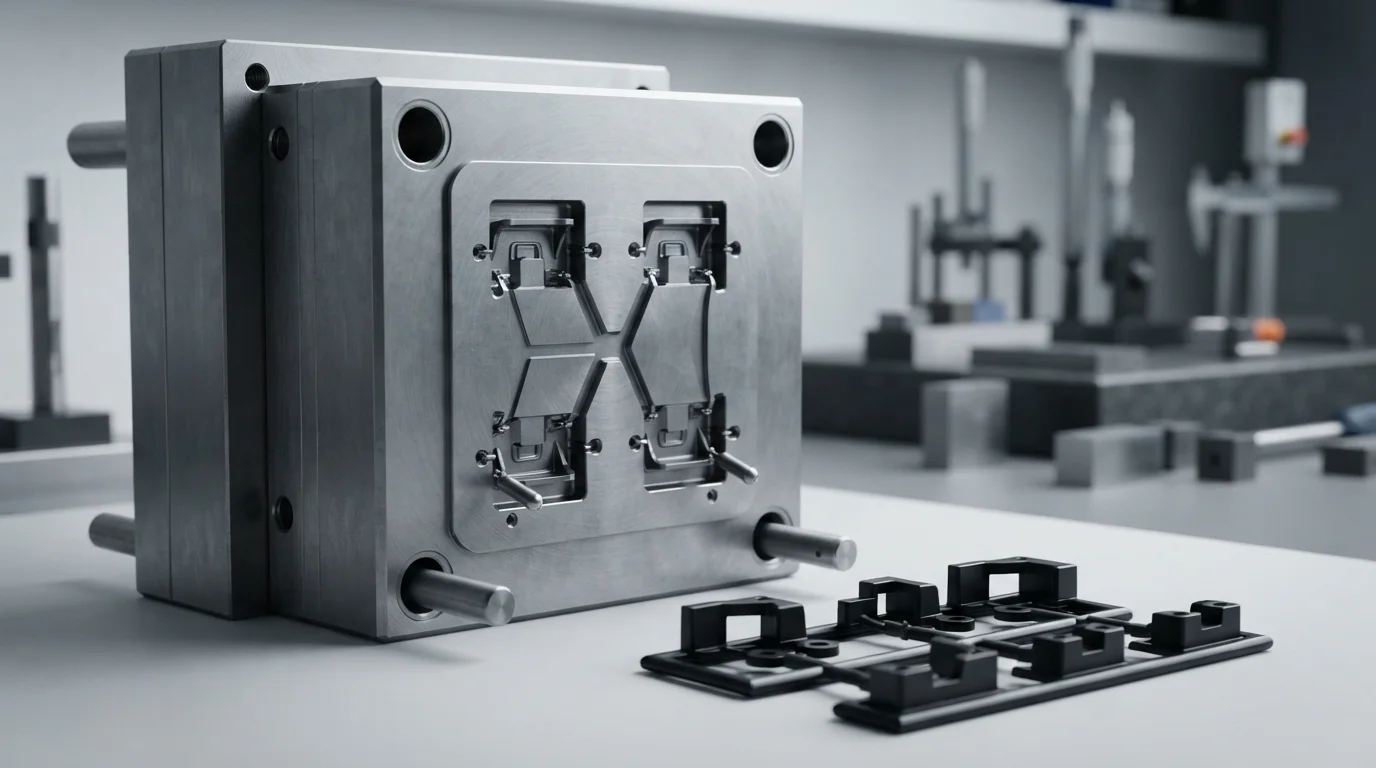
Custo-benefício Cold Runner Mold manufacturing for versatile plastic part production. Built with precision 2-plate or 3-plate mold bases, cold runner tooling provides low upfront tooling costs, simple maintenance, and rapid material or color changes during Moldagem por Injeção de Plástico runs.
Cold Runner Mold Structures: 2-Plate vs. 3-Plate Molds
Cold runner systems solidify the runner channel during each cycle alongside the part. We engineer two distinct mold plate configurations based on your gate location needs:
Two-Plate Cold Runner Molds (2-Plate)
The most common and economical mold structure. The parting line opens once to eject both the molded parts and the connected runner sprue together. Utilizes edge gates, sub-gates (tunnel gates), or direct sprues. Ideal for simple part geometries and low-to-medium volume production.
Three-Plate Cold Runner Molds (3-Plate)
Features two distinct parting lines. One opening ejects the runner system while the second opens to eject the parts. Allows pinpoint gating directly on top of the part center, enabling automatic runner degating without the cost of a Hot Runner Mold.
Cold Runner vs. Hot Runner Tooling Matrix
Comparing conventional cold runners against hot runner systems helps determine the most economical tooling path for your production budget:
| Tooling Attribute | Cold Runner Mold | Hot Runner System Tooling |
|---|---|---|
| Upfront Tooling Cost | Significantly Lower (No heated manifolds or electronics) | Higher (Requires heated manifold blocks & controllers) |
| Maintenance Complexity | Simple & Inexpensive (Mechanical cleaning & polishing) | Complex (Requires tip replacement & electrical wiring checks) |
| Color & Resin Changes | Fast & Easy (Ideal for frequent material changes) | Slower (Requires purging heated internal manifold channels) |
| Heat-Sensitive Polymers | Excellent (Zero risk of thermal degradation in runner) | Requires strict temperature control (Risk of degradation) |
Tooling Engineering: Sprue Design, Sub-Gates & Runner Regrind Optimization
Proper cold runner sizing balances fill pressure against runner waste during Fabricação de Moldes Personalizados:
1. Trapezoidal & Full-Round Runner Profiles
We engineer full-round or modified trapezoidal runner channels using 5-axis CNC milling. This maximizes volume-to-surface-area ratios, reducing pressure drops and preventing premature melt freeze-off.
2. Automatic Sub-Gates & Tunnel Degating
To eliminate manual trimming labor, we machine tunnel sub-gates or banana gates below the parting line. The runner shears off automatically upon part ejection, delivering clean gate cosmetics on Moldagem por Injeção de Baixo Volume runs.
3. Heat-Sensitive Resin Protection (PVC & Thermoplastics)
Thermally unstable polymers like Polyvinyl Chloride (PVC), ABS, e Policarbonato (PC) benefit from cold runners. Because resin moves continuously without residing in heated manifolds, thermal degradation and acid gas outgassing are completely avoided.
4. Efficient Sprue Regrind Recycling
Solid cold runners can be granulating into regrind and blended back with virgin resin at controlled ratios (typically 10% to 20%), recovering material costs on non-critical industrial parts.
Ideal Application Scenarios for Cold Runner Tooling
- Prototype & Short Production Runs: Molde de Injeção de Protótipo builds, pilot runs, and low-to-medium volume manufacturing where hot runner investment is economically unjustified.
- Frequent Resin & Color Sampling: Medical, automotive, or industrial product lines requiring constant resin changes or custom color matching.
- Thermally Sensitive Polymers: Clear PVC fittings, Poliamida (PA/Nylon) brackets, Elastômero Termoplástico (TPE) grips, and heat-sensitive elastomeric seals.
Perguntas Frequentes (FAQ)
Q: Why choose a cold runner mold over a hot runner mold?
A: Cold runner molds cost significantly less upfront, require simple mechanical maintenance, allow quick resin/color changes, and are highly suitable for heat-sensitive polymers that degrade in hot manifolds.
Q: What is the difference between a two-plate mold and a three-plate mold?
A: A 2-plate mold opens at one main parting line, ejecting parts and sprues together. A 3-plate mold opens at two distinct parting lines, allowing automatic pinpoint degating at the part center.
Q: Can cold runners be recycled and reused?
A: Yes. Cold runner sprues can be granulated into regrind and blended with virgin resin (typically at 10% to 20% ratios) for non-critical parts, recovering material costs.
Q: How do you perform mold validation on cold runner tooling?
A: Every tool undergoes scientific Mold Trial & Validation sampling (T0/T1) on our electric presses, followed by Zeiss CMM dimensional inspection and Mold Repair & Maintenance checks.