
A lighter molded base is useful only if its mounting points still hold their load. Foam injection molding materials must meet two requirements: the resin must tolerate the product’s service conditions, and the chosen grade must form a repeatable cellular structure in the intended process. Passing one requirement does not prove the other.
This distinction matters when a drawing carries over a solid-plastic specification to a foamed housing, cover, or equipment support. The polymer name may remain unchanged while local density, skin thickness, and load-bearing behavior change. Treat the first material shortlist as a testable proposal, not permission to reuse the old strength assumptions.
Keep the product requirement separate from the foaming target
Begin with what the finished component must do: support a sustained load, survive handling, hold a fastener, resist a chemical, or preserve an assembly datum. State the load direction and duration as well as the temperature and exposure. “Lightweight and strong” is not an acceptance criterion because it leaves both the service condition and the allowable change undefined.
A solid-resin datasheet helps narrow a shortlist, but its specimen does not reproduce the skin-and-core structure of a foamed part. Nor does a density measurement alone reveal whether a screw boss, rib root, or loaded corner has a suitable local section. Ask which evidence applies to the resin and which must come from a representative molded component.
Durante una foam injection molding materials review, keep structural foam molding tied to these functional requirements. Define an acceptable part before choosing a reduction in mass. Otherwise, the project can reach its weight target while losing the stiffness or attachment performance that justified the design.
Specify the foaming route before comparing resin grades
Physical and chemical foaming are not interchangeable material specifications. A physical route introduces a blowing gas into the melt; a chemical route relies on an agent that releases gas under the relevant processing conditions. Compatibility involves the resin, additives, processing window, and equipment arrangement—not simply whether the base polymer can be injection molded.
Trexel’s foaming guide distinguishes material and process compatibility across its chemical and physical systems. Use that distinction to question a proposed combination, rather than treating one supplier’s settings or claims as universal instructions. Confirm the current grade and agent recommendations with their manufacturers before a trial.
Record the resin manufacturer, grade, reinforcement, color package, and any approved recycled content. A substitution within the same polymer family can change flow, moisture requirements, or the way cells develop. If more than one route is being quoted, request separate material assumptions so the comparison does not quietly mix different constructions.
Build a shortlist around the limiting requirement
Material families provide starting points, not automatic rankings. For example, an economical polyolefin may deserve consideration for a chemically exposed component, while a reinforced engineering grade may enter the shortlist for a stiffness-driven support. The actual grade, service environment, and foamed-part evidence must decide whether either route remains viable.
| Leading requirement | What to investigate in the grade | What to check on the foamed part |
|---|---|---|
| Long-term support | Creep data at the relevant stress and temperature | Deflection and mounting-point stability under sustained load |
| Handling or impact | Impact behavior and environmental sensitivity | Damage at corners, ribs, and attachment features |
| Dimensional fit | Shrinkage, moisture response, and reinforcement | Datums and assembly fit after agreed conditioning |
| Visible surface | Color, additives, and finishing compatibility | Approved appearance under defined viewing conditions |
If polipropilene is a candidate, assess the specific formulation against stiffness, temperature, and exposure rather than assuming all PP behaves alike. Apply the same discipline to ABS blends, polyamides, or other proposed families. A generic material list cannot resolve a product-specific failure mode.
A good average density can hide a weak local feature
The structural question is where material remains, not only how much material was removed. The outer skin and cellular interior contribute differently to bending and local attachment behavior. Geometry and the molding history can produce variation along the flow path, so a single cut section or an overall part weight may miss the area that actually fails.
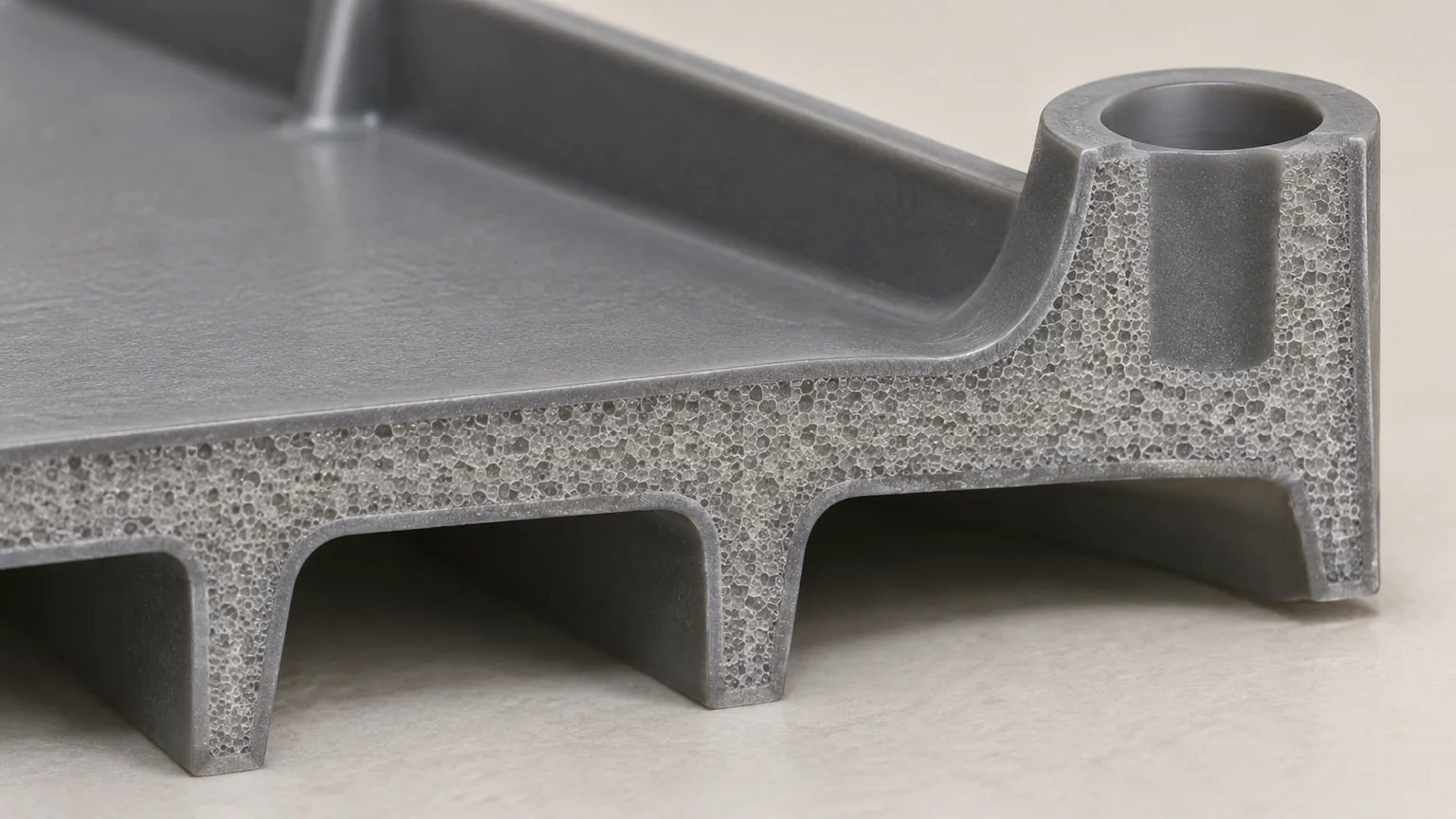
Consider a hypothetical equipment base with a broad panel and narrow mounting towers. Reducing the panel’s mass may be acceptable, but the towers still have to tolerate assembly preload and service loads. Test the attachment and the panel separately before deciding that one overall stiffness result represents the whole component. This is a design illustration, not a completed customer case.
Reinforcement adds another variable. Fiber orientation can make performance directional, and a foamed structure does not remove that concern. Agree where to section a trial component, which loading directions matter, and how to correlate local structure with the mechanical observations. Do not assume that adding glass fiber automatically restores every property lost through a material or process change.
Treat recycled content and additives as part of the qualification
A recycled-content requirement needs more detail than a percentage on the purchasing sheet. Identify the approved feedstock route, formulation, and controls for contamination and variability. Do not assume that a previously qualified virgin grade and a compound with recycled content will produce the same cellular structure or finished-part behavior.
Colorants, stabilizers, and functional additives also belong in the released formulation. A change can leave the family name unchanged while altering the processing or service behavior that the trial established. Ask which changes require supplier notification, a new material review, or renewed component testing.
Keep the sustainability claim separate from the engineering approval. A lower-mass or recycled-content part is not automatically recyclable in the destination market, and a material declaration does not prove the finished component’s load capacity. Record the claim being made, the supporting documentation, and the performance evidence as separate items.
Approve a material-process-part combination
A useful trial compares defined alternatives against the same acceptance criteria. Keep the CAD revision, attachment hardware, conditioning, and test method controlled. Document the process route and relevant material identities so a later formulation change cannot be mistaken for a repeat of the approved trial.
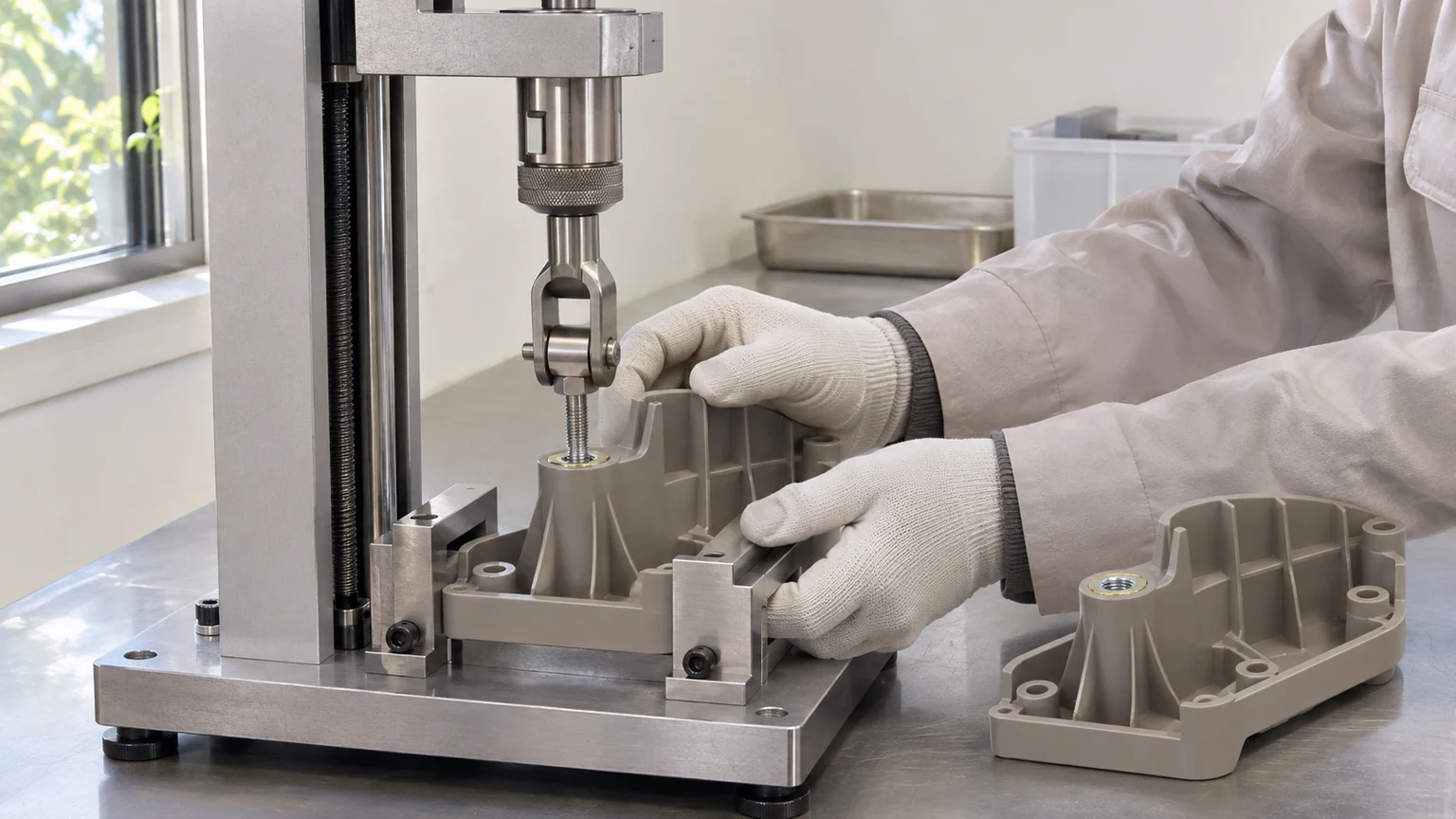
Utilizzare prova e validazione dello stampo to close the questions left open by the datasheet. Depending on the product, these may include sustained deflection, impact at service temperature, fastener retention, dimensional fit, and appearance. Choose tests for the actual risk rather than adding an impressive but irrelevant test list.
- Identify the unacceptable failure and the test condition that would reveal it.
- Shortlist exact grades compatible with the proposed foaming route.
- Map critical sections and load paths before trial sampling.
- Compare accepted parts, not only nominal mass or resin price.
- Record the approved material, process assumptions, and change-control requirements.
The final specification for foam injection molding materials should preserve this evidence trail. It should tell the next engineer what was qualified, what remains conditional, and which changes require renewed review. That is more useful than a blanket claim that one resin is the strongest or cheapest option.
Material questions before the next trial
Can the solid version’s datasheet values be used for design?
Use them as screening information, not guaranteed properties of the foamed component. The grade, cellular structure, skin, orientation, and test conditions need to represent the part being approved. Critical design values require suitable engineering evidence.
Is the lowest-density sample the best result?
No. A lower density is useful only while the part meets its functional and appearance requirements. Compare accepted performance and production consistency before selecting the lightest sample.
Does a flame rating transfer automatically to a foamed part?
Do not assume it does. Check the exact material recognition, relevant thickness and construction, and the finished-product approval requirements. A rating attached to a resin or solid specimen is not a blanket certification of every foamed component.