
Budgeting for multi-material polymer hardware requires balancing upfront mold development investments against high-volume piece-part manufacturing economics. Procurement managers and engineering directors frequently encounter capital sticker shock when reviewing initial tooling quotations for dual-shot rotary molds. Evaluating multi-shot manufacturing strictly through initial tooling expenses creates a misleading financial picture, ignoring dramatic reductions in secondary assembly labor.
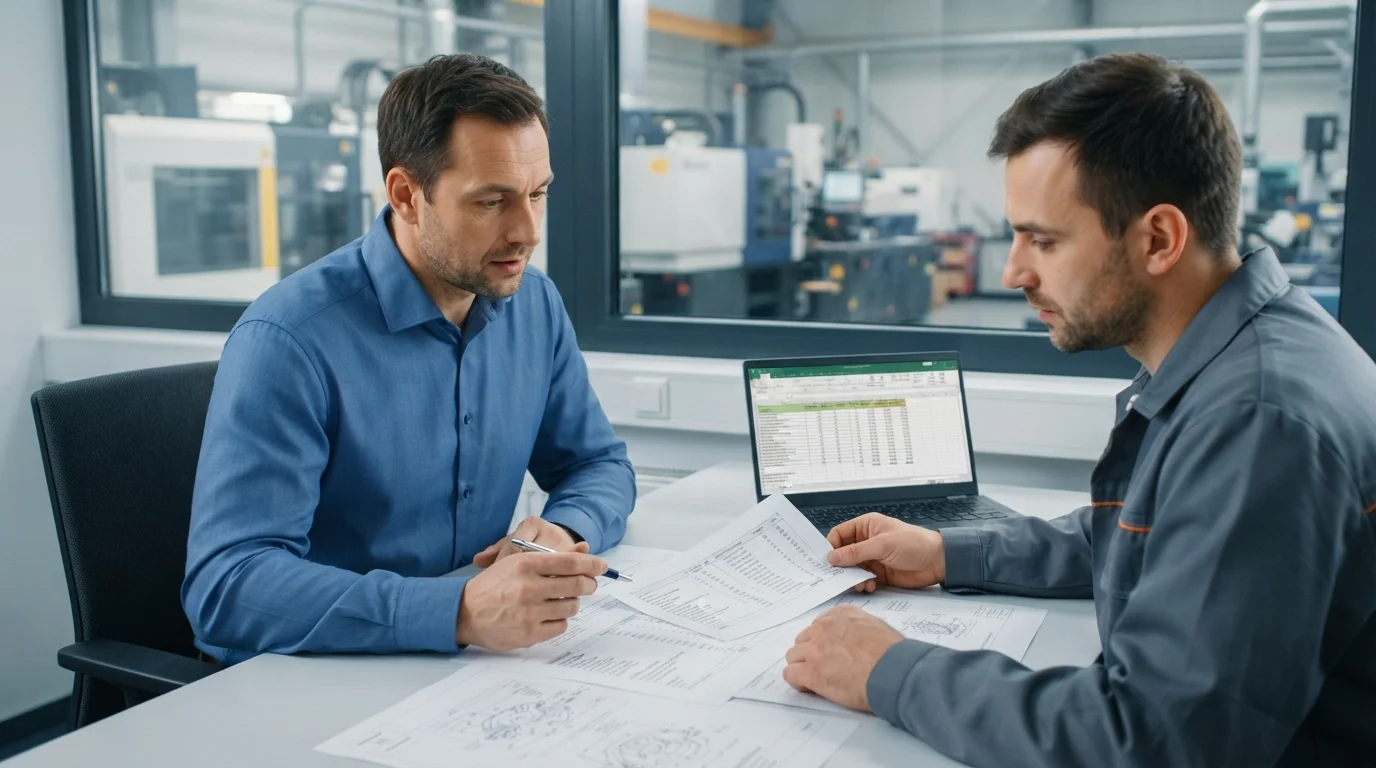
Understanding how automated single-cycle processing eliminates manual gluing, sonic welding, and handling scrap allows teams to calculate accurate capital payback periods. This commercial engineering guide breaks down tooling non-recurring engineering (NRE) drivers, volume break-even curves, and practical DfM cost-reduction methods.
Tooling Investment (2K Rotary Molds) vs. Assembly Labor Savings
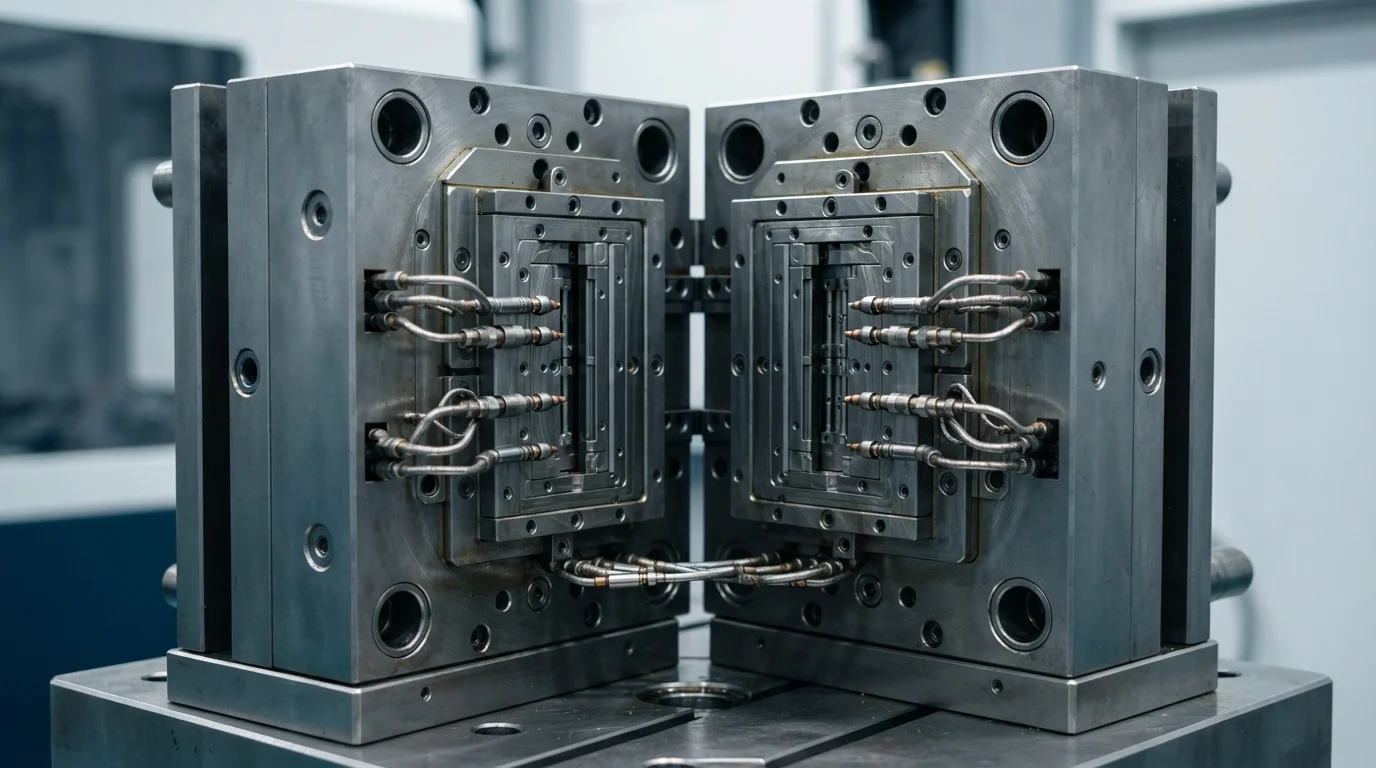
Estimating two shot injection molding cost requires balancing initial capital commitments against recurring piece-part labor expenses. Building custom أداة دوارة 2K requires complex mold bases equipped with 180-degree indexing turntable mechanisms, dual hot runner manifolds, and independent cavity shut-offs. Initial tooling NRE expenses typically range from $25,000 to $75,000+, representing a higher capital threshold than standard single-material injection molds.
However, single-press 2K processing delivers dramatically lower piece-part unit cost over high-volume series manufacturing. Eliminating manual secondary assembly, fixture maintenance, and inspection labor recovers initial tooling capital rapidly as production scales.
حجم نقطة التعادل: متى يصبح قولبة الحقن ثنائي اللقطات (2K) أرخص من القولبة الزائدة؟
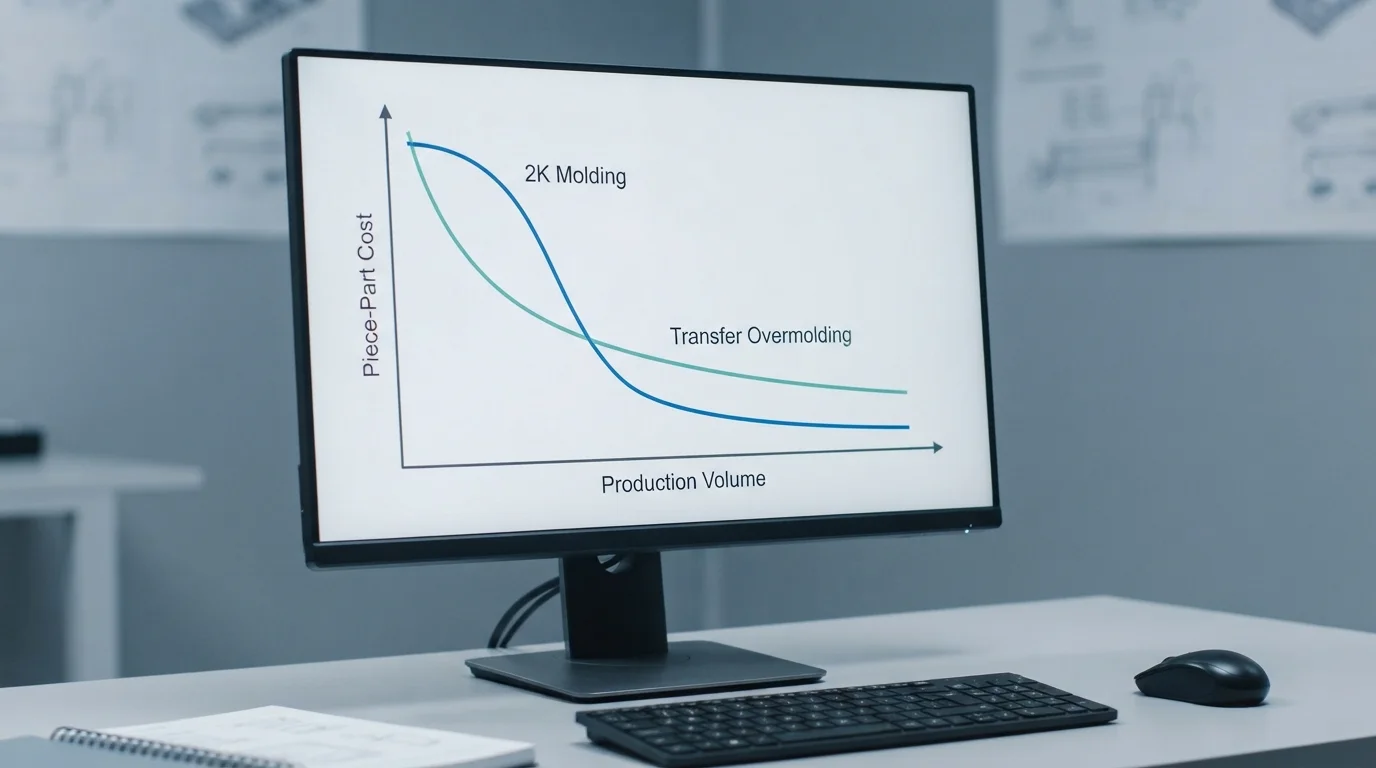
تحليل ديناميكيات تكلفة قولبة الحقن ثنائي اللقطات عبر مستويات الحجم يكشف عن عتبة حجم نقطة التعادل. تظل القولبة الزائدة بنقل الخطوتين اقتصادية للأحجام المنخفضة إلى المتوسطة من 1,000 إلى 20,000 وحدة لأن رأس المال الأولي للأدوات أقل. أحجام الإنتاج السنوية التي تتجاوز 50,000 وحدة تمثل نقطة التحول المالية حيث يصبح القولبة الدوارة ثنائية اللقطات (2K) أرخص بشكل ملحوظ.
قولبة الإطارات بولي كربونات (PC) الصلبة والأختام TPE المرنة داخل دورة ضغط واحدة ثنائية اللقطات (2K) يقلل مدة الدورة بنسبة 40%. يوضح الجدول 1 أدناه نمذجة تكلفة الإنتاج الإجمالية عبر مستويات الحجم السنوية المختلفة:
| حجم الإنتاج السنوي | تكلفة القولبة الزائدة بنقل الخطوتين | تكلفة القولبة ثنائية اللقطات (2K) بضغطة واحدة | التكلفة لكل قطعة (2K مقابل النقل) | قرار التصنيع الأمثل |
|---|---|---|---|---|
| 5,000 وحدة (نموذج أولي / تجريبي) | $12,000 أدوات + $3.50/وحدة (إجمالي $29,500) | $35,000 أدوات + $1.20/وحدة (إجمالي $41,000) | +$2.30/قطعة (2K أكثر تكلفة) | اختيار القولبة بالحقن المزدوج بنقل الخطوتين |
| 25,000 وحدة (توسيع متوسط الحجم) | $15,000 أدوات + $2.80/وحدة (إجمالي $85,000) | $38,000 أدوات + $1.00/وحدة (إجمالي $63,000) | -$0.88/قطعة (2K يحقق التعادل) | الانتقال إلى قولبة 2K بالحقن المزدوج |
| 100,000 وحدة (إنتاج ضخم عالي الحجم) | $20,000 أدوات + $2.40/وحدة (إجمالي $260,000) | $42,000 أدوات + $0.65/وحدة (إجمالي $107,000) | -$1.53/قطعة (توفير إجمالي في التكلفة 58%) | قولبة 2K بالحقن المزدوج تحقق أقصى عائد على الاستثمار |
تحسين التصميم للتصنيع (DfM) لخفض ميزانيات أدوات 2K
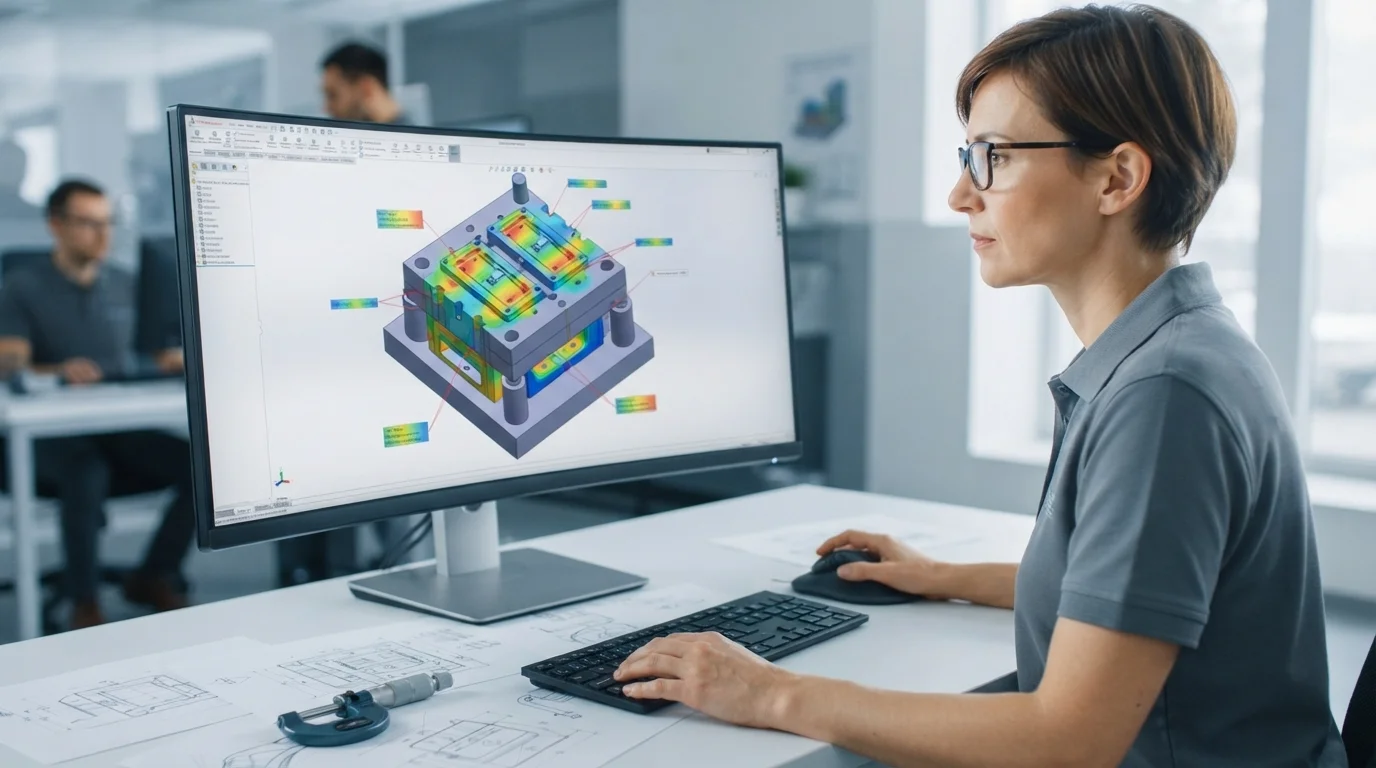
تطبيق إرشادات هندسية استباقية للتصميم للتصنيع قبل قطع فولاذ القالب يحقق وفورات رأسمالية كبيرة. تبسيط هندسة منطقة الإغلاق by designing flat 90-degree sealing shoulders avoids expensive 3D contoured EDM machining. Designing uniform wall thicknesses across both material layers avoids localized cooling delays, maximizing hourly press throughput.
Evaluating two shot injection molding cost factors during CAD modeling eliminates complex side-action sliders, reducing mold complexity by 20%.
Core tooling cost reduction rules include:
- Line-of-draw shut-off design—Designing flat 90-degree shut-off lands eliminates complex side-action sliding mechanisms.
- Wall thickness balancing—Maintaining uniform 1.5 mm to 2.5 mm wall thickness across both materials shortens cycle cooling times.
- Gate location consolidation—Positioning hot runner drops symmetrically balances melt filling and minimizes manifold zone costs.
- Standardized rotary mold bases—Utilizing standardized MUD rotary master frames reduces raw steel plate procurement expenses.
Why Choose JUCHENG for Cost-Effective 2K Tooling & Molding
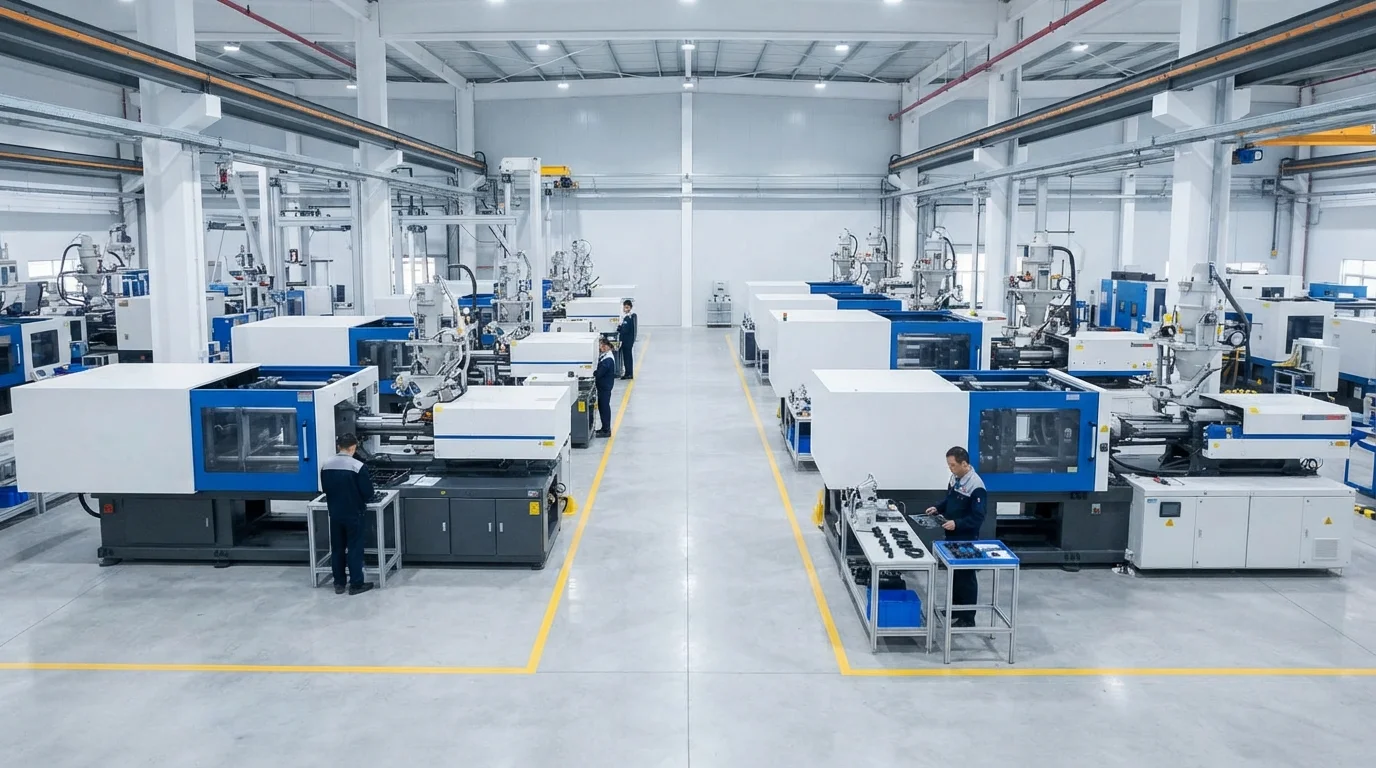
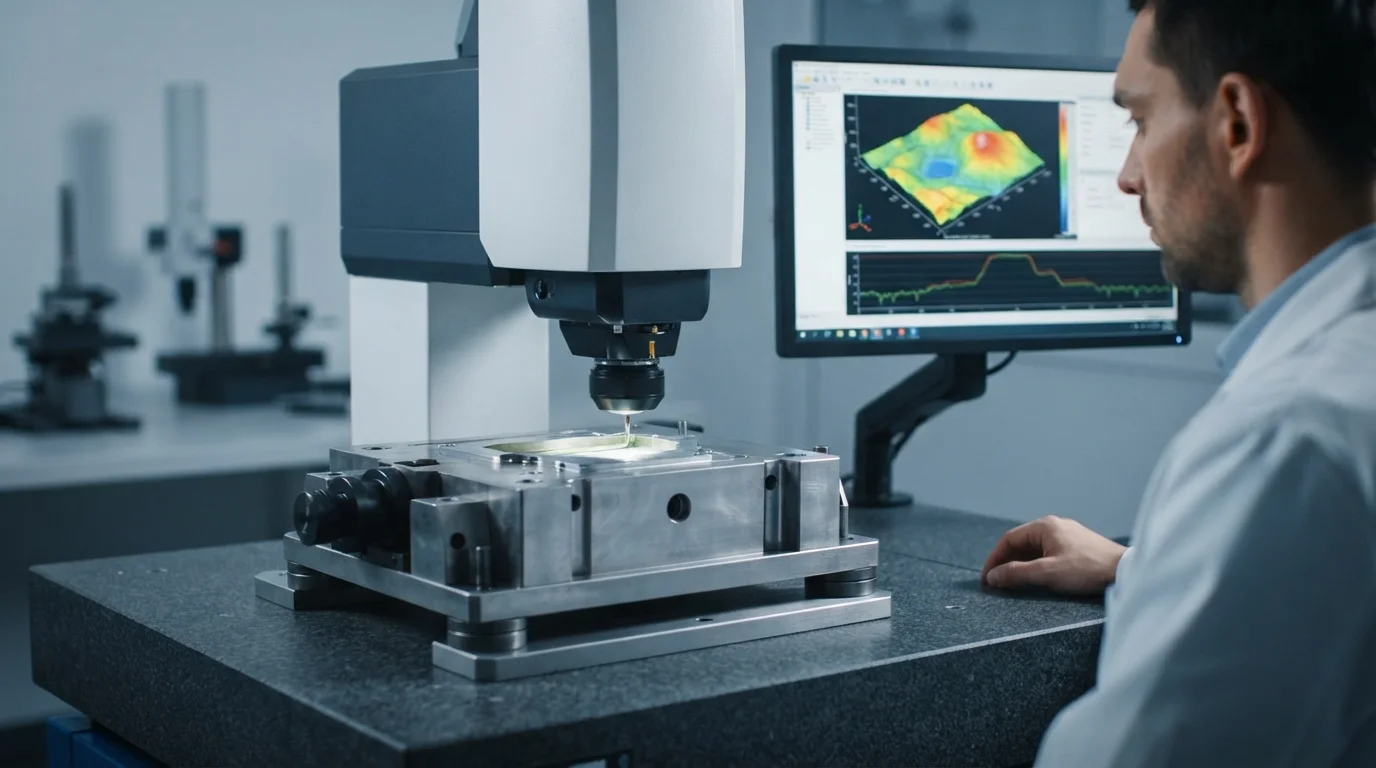
Partnering with JUCHENG provides access to an advanced manufacturing facility housing 35+ automated injection presses ranging from 15T to 3000T clamping force. Operating an in-house tool room with 25 sets of 5-axis CNC machines cuts mold cores from hardened الفولاذ المقاوم للصدأ S136 أو فولاذ الأدوات H13, ، مما يضمن إحكامًا خاليًا من النتوءات على مدى أكثر من 1,000,000 دورة.
Our engineering team delivers a free 24-hour DfM review for every CAD submission, analyzing substrate wall thickness, draft angles, and shut-off feasibility before cutting steel. Quality management systems certified to IATF 16949 and ISO 13485 back every multi-shot production run, offering full PPAP Level 3 documentation for automotive programs. Evaluating two shot injection molding cost helps procurement teams justify the tooling ROI of قولبة الحقن ثنائية اللقطة.
الأسئلة الشائعة (FAQs)
What is the typical tooling cost for a two-shot 2K injection mold?
Tooling costs for two-shot 2K injection molds typically range from $25,000 to $75,000+ depending on part size, cavity count, and rotary mechanism complexity. Higher upfront tooling expenses are justified by lower cycle times and zero secondary manual assembly labor.
How does two-shot molding reduce piece-part unit manufacturing costs?
Two-shot molding combines two material injections into a single automated press cycle. Eliminating manual part transfer, secondary adhesive gluing, ultrasonic welding, and sorting labor slashes direct piece-part costs by 30% to 50% on volume production.
What is the break-even production volume for 2K molding versus overmolding?
The break-even point typically occurs around 20,000 to 50,000 units. Below 20,000 units, two-step transfer overmolding is more economical due to lower initial tooling NRE. Above 50,000 units, 2K rotary molding delivers substantial total cost savings.
How does part design complexity influence 2K mold development expenses?
Complex 3D parting lines, deep undercuts, and contoured shut-off surfaces increase CNC milling time and EDM electrode fabrication costs. Designing flat 90-degree shut-off lands and line-of-draw features keeps mold construction simple and economical.
Can using regrind resin help lower 2K production material costs?
Blending regrind resin into the primary rigid substrate (like ABS or PP) can reduce material costs by 10% to 20%. However, secondary elastomeric overmolds (TPE/TPU) should utilize virgin material to ensure maximum chemical bonding and prevent surface splay.
Why is a 24-hour DfM review crucial for controlling 2K tooling budgets?
Conducting an early DfM review detects uneven wall thicknesses, sharp corners, and shut-off interference while the CAD model is still digital. Correcting geometry before cutting tool steel eliminates expensive mold rework, tooling modifications, and project launch delays.