
Micro molding material selection should begin with the failure the finished part must resist, not with a familiar resin name. At micro scale, flow through a thin feature, thermal history in a small shot, shrinkage around a datum, and the way a part is handled can change which material is practical. A polymer that looks ideal on a datasheet may be difficult to meter, replicate, release, or inspect in the actual geometry.
The useful goal is a short, testable material list. This guide moves from product requirements to molding behavior, then shows how to qualify a resin without confusing easy filling with long-term performance.
Selection path
Start With the Part’s Failure Mode
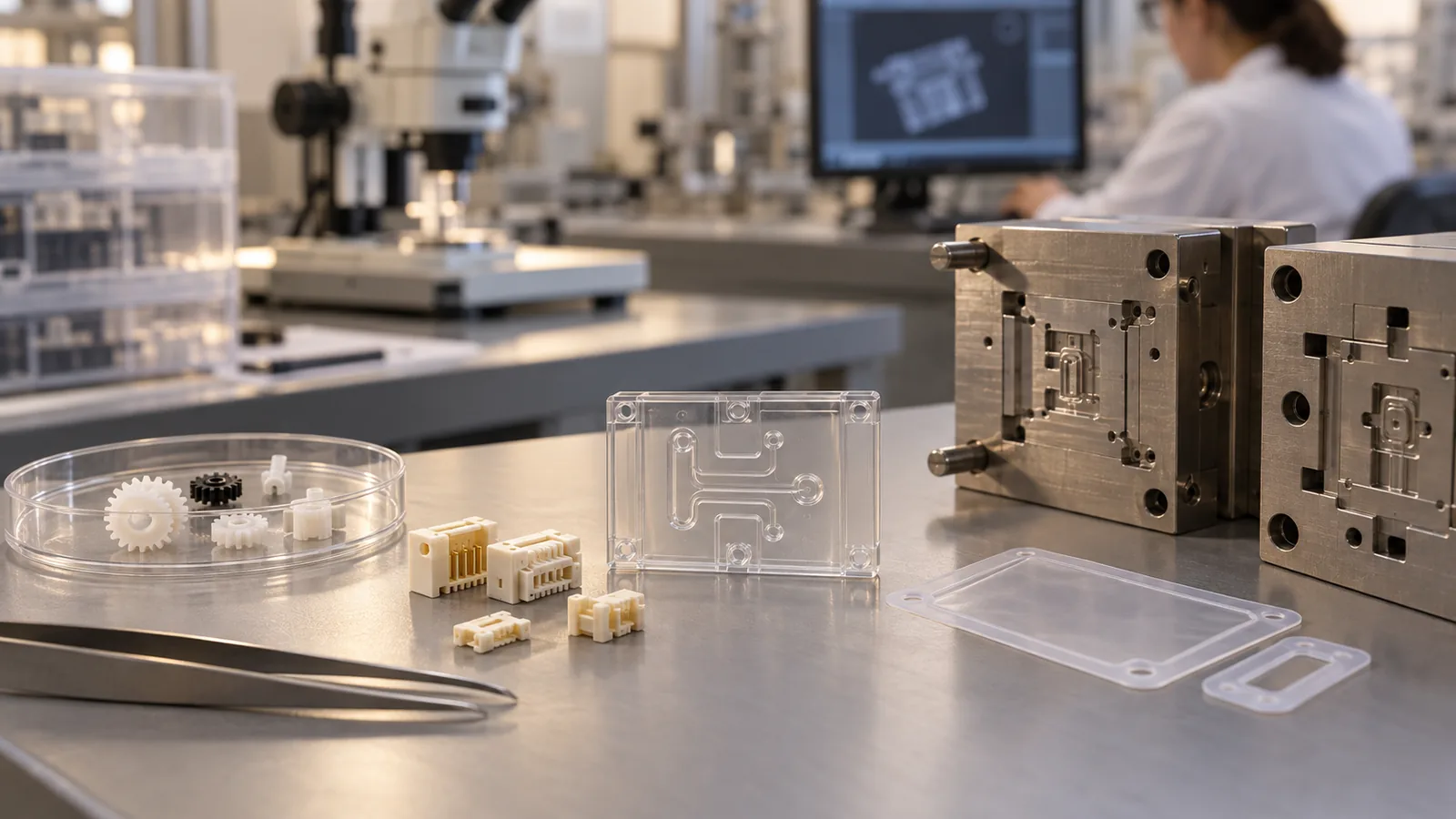
Define what would make the component unacceptable in use. A gear may fail through wear or noise; a connector body through creep, pin shift, or dielectric breakdown; a fluidic component through leakage, chemical attack, or particle contamination. These failure modes lead to different priorities even when the parts share a similar size.
Separate mandatory requirements from preferences. Temperature range, sterilization method, regulatory status, chemical exposure, electrical performance, fatigue life, optical transmission, color, and dimensional stability may be non-negotiable. Surface appearance or a preferred resin family may be flexible. This prevents a convenient molding material from surviving the shortlist after it has already failed the product requirement.
Also identify the time scale. A polymer can pass a short assembly test yet creep under sustained load. It can look transparent at molding and haze after chemical exposure. The selection brief should describe the real environment, load direction, duration, and acceptable change.
Translate Requirements Into Polymer Behavior

Product properties and process behavior are connected but not interchangeable. Low melt viscosity can help a polymer enter a thin section, but the same resin still needs a stable temperature window, suitable shear response, predictable shrinkage, and enough strength for ejection. Reinforcement can improve stiffness while increasing wear, flow-direction effects, and surface texture.
- Replication: assess the longest flow path, smallest feature, gate distance, and mold-surface temperature needed before freeze-off.
- Metering: confirm that the shot can be delivered repeatedly without excessive residence or inconsistent cushioning.
- Release: consider draft, core grip, brittleness, friction, and the allowable ejector contact area.
- Stability: review moisture sensitivity, degradation risk, color change, regrind policy, and lot-to-lot controls.
- Inspection: anticipate anisotropic shrinkage, conditioning, and the time at which dimensions will be accepted.
Compare Material Families Without a Universal Winner
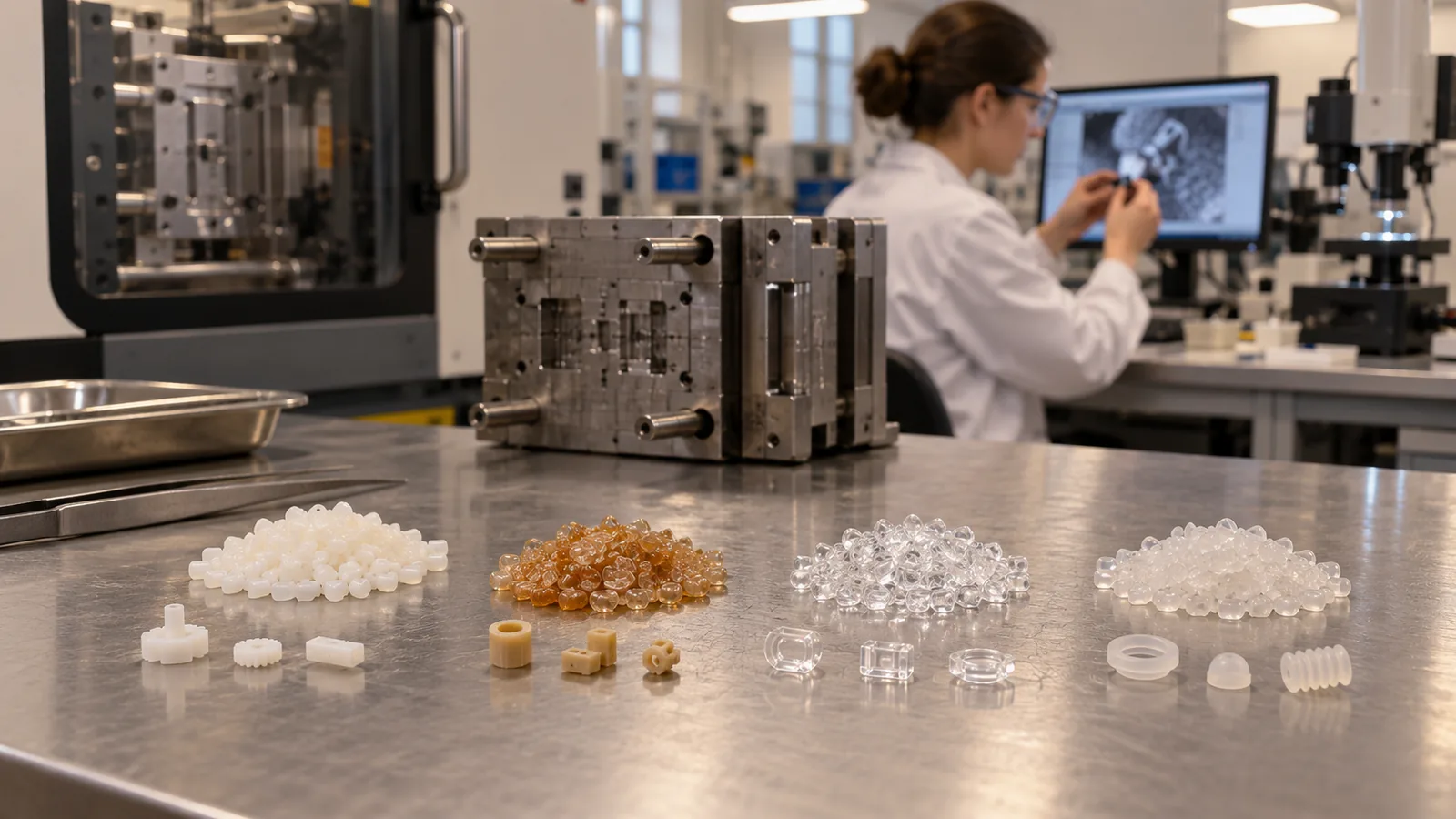
The table is a screening aid, not a specification. Grades within one family can behave differently because of molecular weight, fillers, impact modifiers, lubricants, flame retardants, and colorants.
| Requirement direction | Families often screened | Micro-molding watchpoint |
|---|---|---|
| Low friction or small moving parts | POM, selected PA or PBT grades | Shrinkage, moisture, wear debris, fine-feature strength |
| High temperature | PEEK, PEI, PPS, LCP | Processing window, tool temperature, residence, gate freeze |
| Electrical connector geometry | LCP, PBT, PA families | Warpage, knit lines, moisture, flash near contact locations |
| Optical or fluidic visibility | COC/COP, PC, PMMA | Stress, surface replication, bonding and chemical exposure |
| Flexible micro features | TPE, TPU and selected elastomers | Venting, sticking, flash, handling and compression set |
Account for Drying, Residence, and Thermal History

A very small part does not automatically mean the polymer experiences a short thermal history. The feed system and plasticizing unit may contain much more material than one cavity consumes. If throughput is low, resin can remain hot long enough to change viscosity, color, molecular structure, or mechanical performance.
Moisture-sensitive grades require controlled drying and transfer. The practical question is not only whether a dryer reaches a setpoint, but whether the material condition at the feed throat remains stable during stops, restarts, and long runs. Record lot, drying history, hopper exposure, residence estimate, and restart procedure during trials.
Colorants and additives also matter. A masterbatch carrier can alter flow or compatibility, while pigment can change laser detection, optical appearance, or dimensional behavior. Qualify the intended production formulation rather than assuming a natural-resin trial represents every color.
Match Shrinkage to the Measurement Plan

Published shrinkage ranges cannot replace cavity-specific evidence. Flow direction, pressure history, wall thickness, fiber orientation, gate position, cooling, and conditioning can produce different changes across one micro part. A single scale factor may not correct a feature whose geometry shrinks anisotropically.
Define functional datums and measurement timing before the tool is finalized. Hygroscopic materials may change after conditioning; semicrystalline materials may continue to stabilize after ejection. If the customer measures after a specified environment, the mold trial should use the same reference condition.
For tightly coupled features, measure more than overall length. Profile, flatness, concentricity, pin position, channel depth, and mating performance may reveal material effects that part weight cannot.
Use a Shortlist Instead of a Single Early Choice
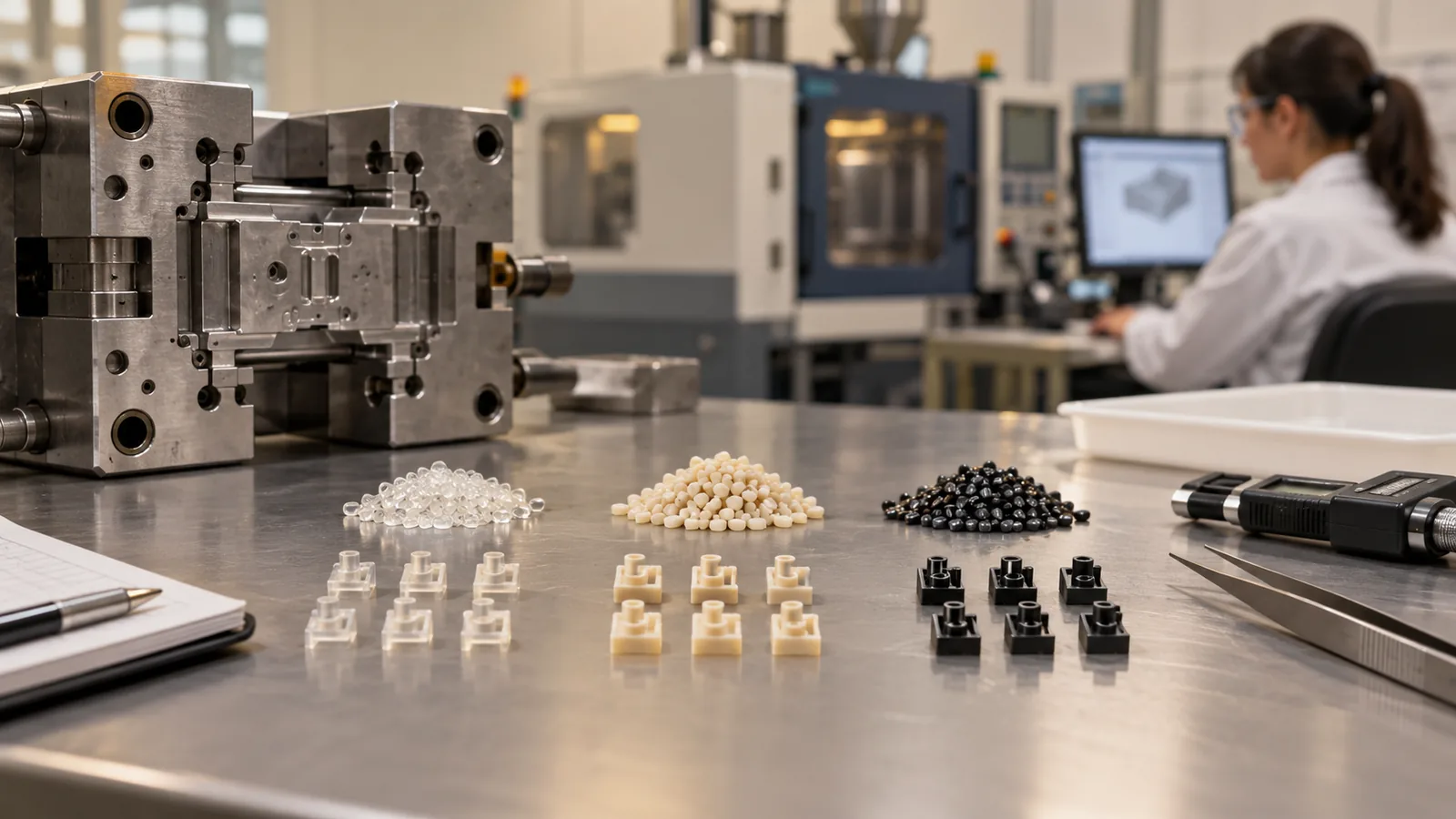
Two or three realistic candidates preserve learning during feasibility work. Each should satisfy the non-negotiable product requirements and be available in the intended grade, color, and compliance status. The comparison can then focus on fill, flash margin, release, dimensional stability, appearance, bonding, and functional testing.
- Freeze the requirement list and rank the failure risks.
- Remove grades that fail temperature, chemical, regulatory, or electrical requirements.
- Review feature flow, gate, venting, and release with each candidate.
- Trial the actual production formulation under a controlled process window.
- Condition and measure parts using the agreed method.
- Test the assembled function, not only isolated dimensions.
- Document the approved grade and change-control rules.
A qualified القولبة بالحقن الدقيق project treats material, tool, process, handling, and metrology as one system. That is why the most fluid resin is not automatically the most reliable choice.
الأسئلة الشائعة

Is the lowest-viscosity resin always best for micro molding?
No. Flow matters, but the resin must also survive the product environment, release without damage, hold dimensions, and remain stable during processing.
Can a filled polymer reproduce micro features?
It may, but filler size, orientation, surface finish, tool wear, and local flow must be evaluated. Reinforcement can improve stiffness while making fine-detail replication and appearance more demanding.
Why should the exact color be included in qualification?
Pigments and carrier resins can affect rheology, heat absorption, appearance, and sometimes properties. Production color should be treated as part of the material system.
When should dimensions be measured?
Use a defined interval and conditioning state that match the drawing or final application. Immediate measurements may not represent the stable part.
What material information should accompany an RFQ?
Provide the exact grade if fixed, or temperature, chemical, mechanical, optical, electrical, regulatory, color, and sterilization requirements if alternatives are allowed.