
Riveting
Riveting creates a mechanical connection by forming or expanding a fastener to retain the joined components. In assemblies containing molded plastic, the key challenge is controlling local pressure and deformation so the fastener retains the parts without cracking or excessively compressing the polymer. Fastener type, hole geometry, backing access and the service load must be reviewed together.
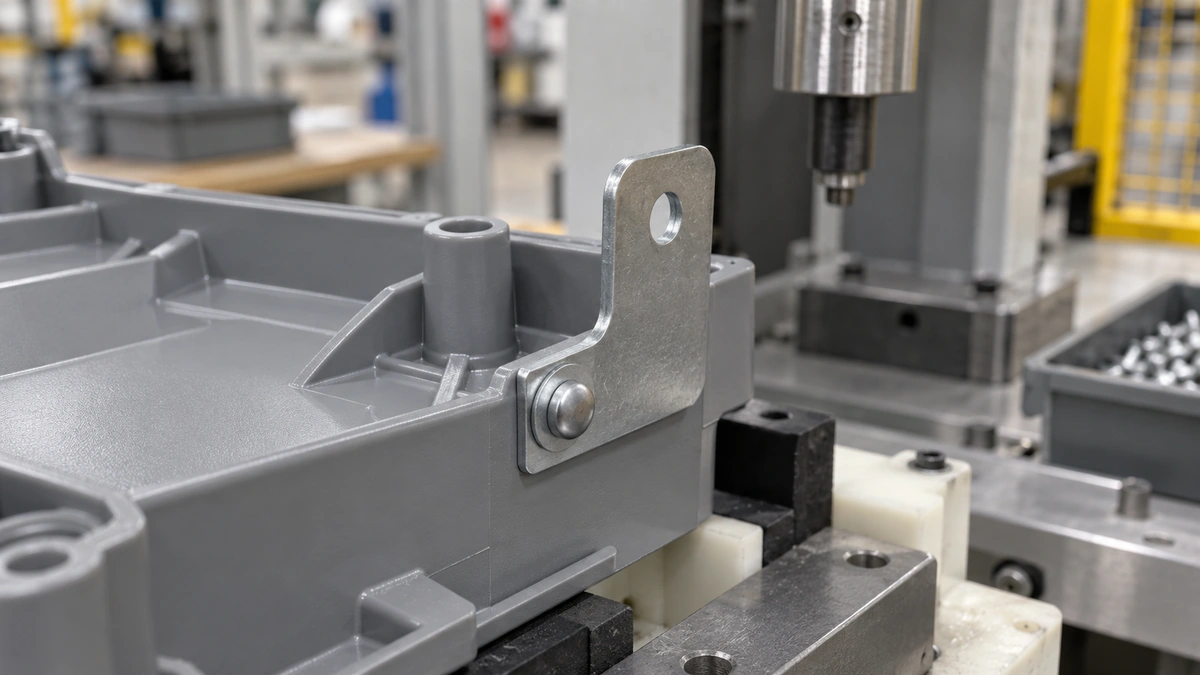
Plastic changes the load-distribution problem
A fastening approach suitable for sheet metal may overload a polymer around the hole. The design may need a larger bearing area, a washer, a sleeve or another load-spreading feature, depending on the joint. The correct solution comes from the load path and available geometry, not simply a larger rivet.
Consider long-term behavior as well as installation. A plastic region held under sustained compressive load may relax, particularly at elevated temperature. Initial tightness alone is not proof of retained performance throughout use.
Access determines the fastener options
Some riveting methods need tooling on both sides; others use a blind fastener installed from one side. Either arrangement still requires sufficient support and clearance. Check the complete assembly sequence to ensure that a later component does not obstruct the tool or prevent inspection.
| Detail | Drawing or process input |
|---|---|
| Hole | Position, diameter and edge condition |
| Plastic wall | Local thickness and supporting features |
| Fastener | Material, head shape and approved type |
| Assembly access | Installation direction and tool clearance |
Install without concealing damage
Use representative molded parts to establish installation conditions. Inspect around the hole for whitening, cracks or distortion, and check that a formed head or expanded region does not interfere with nearby parts. A neat visible head can coexist with damage on the hidden side.
Retention testing should reflect actual loading: pull-through, shear or vibration may matter differently for different products. Include relevant environmental conditioning where it could change polymer behavior.
Frequently asked questions
Is riveting the same as heat staking?
Not in this scope. Riveting uses a separate fastener, while heat staking forms a molded thermoplastic post into a retaining head.
Can a riveted joint be serviced repeatedly?
It is normally a permanent joint. Removing the fastener may be possible, but repeated assembly needs its own design and repair procedure.
Should holes be molded or drilled afterward?
That depends on position, geometry, volume and the required edge condition. Review both routes before fixing the tool design.
Review mechanical assembly early
Coordinate holes and support features through custom mold making. For alternative metal retention, consider the design implications of insert molding. Send the fastener and mating-part details with a project enquiry.