
PPS-Celanese Fortron 1140L4
For high-density microelectronics and SMT components that must survive lead-free reflow soldering temperatures up to 260°C without dimensional drift, Celanese’s Fortron 1140L4 provides a revolutionary solution. This 40% glass fiber reinforced linear PPS grade is uniquely formulated to minimize the flashing defects common to highly fluid polymers, offering exceptionally low melt viscosity and high structural weld strength. At Jucheng Precision, an ISO 9001 and IATF 16949 certified facility, we specialize in high-precision molding of Fortron 1140L4. Backed by 35+ advanced injection presses and five-axis CNC-machined S136 stainless steel molds, we control its anisotropic shrinkage (0.15%-0.5%) and manage volatile outgassing, delivering zero-defect components verified by Zeiss CMM.
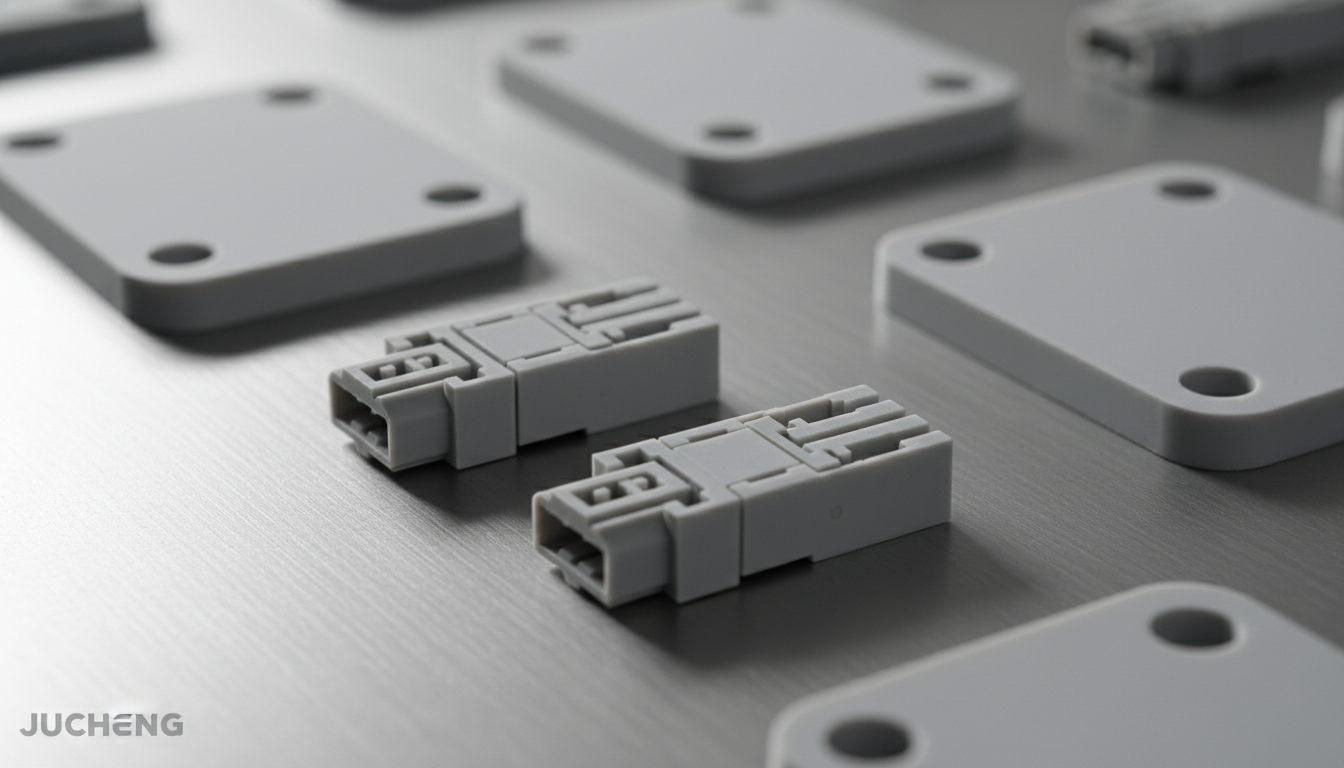
Fortron 1140L4 Low-Flash Performance & Structural Profile
Fortron® 1140L4 is a 40% glass fiber reinforced, linear polyphenylene sulfide (PPS) grade engineered by Celanese, specifically designed to minimize flash defects during high-volume precision runs:
| Material Property | Measured Value (ISO/ASTM) | Engineering Impact |
|---|---|---|
| Low-Flash Chemistry | Patented Linear Matrix Control | Specially formulated to drastically suppress typical PPS flashing on mold parting lines, reducing secondary deflashing processes. |
| Extreme Rigidity | Tensile Modulus 14,500 MPa | Provides exceptional high-stiffness, unyielding structural support for heavy-duty EV battery connectors and microelectronic frames. |
| Thermal Stability | HDT @ 1.80 MPa: 270 °C | Withstands uncompromised mechanical load and shape retention under continuous high heat, ideal for Lead-free Reflow (SMT) processes. |
Thin-Walled Component Process Suitability for Fortron 1140L4
With outstanding melt fluidity and linear macromolecular weight, Fortron 1140L4 processes beautifully inside complex dynamic components:
| Component Category | Molding Process Focus |
|---|---|
| Thin-Wall Electronic Sockets | Excellent. The primary process for Fortron 1140L4. Optimized for high-density, thin-walled micro-connectors, chip carriers, and relays. |
| High-Load Automotive Sensors | Excellent. Highly compatible with metal terminals, allowing encapsulation of multiple sensor pins directly within highly rigid PPS housings. |
| Chemical Water-Pump Impellers | Good. Outstanding dimensional stability, low water absorption, and excellent hot water resistance prevent structural distortion. |
Molding Analysis: Fortron 1140L4 Dynamic Heat Control and Venting Blueprint
Molding a low-flash linear 40% glass-fiber reinforced PPS like Fortron 1140L4 requires precise melt temperature controls and optimized venting to prevent outgassing:
Precision Parting Line Control (Tooling Tolerance)
Even though Fortron 1140L4 is custom-formulated to reduce flashing compared to typical PPS grades, its highly fluid nature still requires highly precise tool shut-offs. Jucheng’s tooling division uses 5-axis CNC machines to achieve micro-tolerances, keeping mold parting clearances strictly within 0.005mm on premium S136 stainless steel mold cavity blocks hardened to 48–52 HRC.
Oil-Heated Mold Temperature Matrix
Pressurized oil heaters are mandatory to keep mold temperatures at 135°C–150°C (275°F to 302°F). Low mold temperatures prevent the optimal semi-crystalline phase from forming, which severely degrades mechanical strength, chemical resistance, and dimensional stability over time.
Deep Outgassing Venting Slots
To prevent gas-induced diesel burn marks and short shots, we machine deep, strategically positioned venting channels (0.015mm depth) on the mold parting lines. This secures clean, blemish-free parts on multi-cavity runs.
Hygroscopic Pre-Drying Protocol
We dry raw resin in desiccant hopper dryers at 120°C–140°C (248°F–284°F) for 3–4 hours. This eliminates surface splay and prevents weld-line micro-voids, keeping internal moisture strictly below 0.02% to secure optimal molecular bonds.
Key Application Fields for PPS-Celanese Fortron 1140L4
- Electrical, Office & Printers: High-density micro-connectors, SMT-compatible chip bobbins, micro-switches, relay sockets, copier fuser units, and printer gears.
- Automotive Powertrains & Fluids (IATF 16949): High-pressure water pump impellers, thermostat housings, heater valves, cooling fluid pipes, throttle bodies, and fuel injection systems.
- Fluid Handling, Plumbing & Industrial: Boiler water mixing valves, chemical spray nozzles, household faucet combination valves, and high-pressure hot-water couplers.
Properties
| Density | 1.65 g/cm³ |
| Tensile Modulus (DAM) | 14,500 MPa |
| Tensile Stress at Break (DAM) | 195 MPa |
| Tensile Elongation at Break (DAM) | 1.6 % |
| Flexural Strength | 285 MPa |
| Flexural Modulus | 14,000 MPa |
| Charpy Notched Impact Strength (23°C) | 9 kJ/m² |
| Melting Temperature | 280 °C |
| Heat Deflection Temperature (HDT @ 1.80 MPa) | 270 °C |
| Linear Mold Shrinkage (Flow Direction) | 0.15 - 0.25 °C |
| Linear Mold Shrinkage (Cross Direction) | 0.35 - 0.50 % |
| Volume Resistivity | 1.0E+16 % |
| Maximum Part Size | 800 x 600 mm |
| Minimum Part Size | 1 x 1 mm |