
Formfüllanalyse
Die Simulation komplexer Polymer-Schmelzerheologie und die Vorhersage thermischer Kristallisationsverhalten vor dem Schneiden von Werkzeugstahl sind für eine ertragreiche Präzisionsfertigung unerlässlich. Die Spritzgieß-Formflussanalyse nutzt fortschrittliche Finite-Elemente-CAE-Simulationssoftware, um Formfüllung, Kavitätsdruckhaltung, Kühleffizienz und strukturelle Verformung zu modellieren. Bei Jucheng Precision bietet unser erfahrenes Ingenieurteam schlüsselfertige Formfluss-Simulationsdienste für komplexe Automobil-, Medizin- und Unterhaltungselektronik-Komponenten. Durch die Optimierung von Angusslagen, Angusskanal-Balance und konformer Kühlkreisläufe während der Designphase eliminieren wir Kurzspritzungen, Einfallstellen und Lufteinschlüsse und sichern eine CPK > 1,67 Prozessfähigkeit, verifiziert durch Zeiss-Koordinatenmessmaschinen-Prüfung.
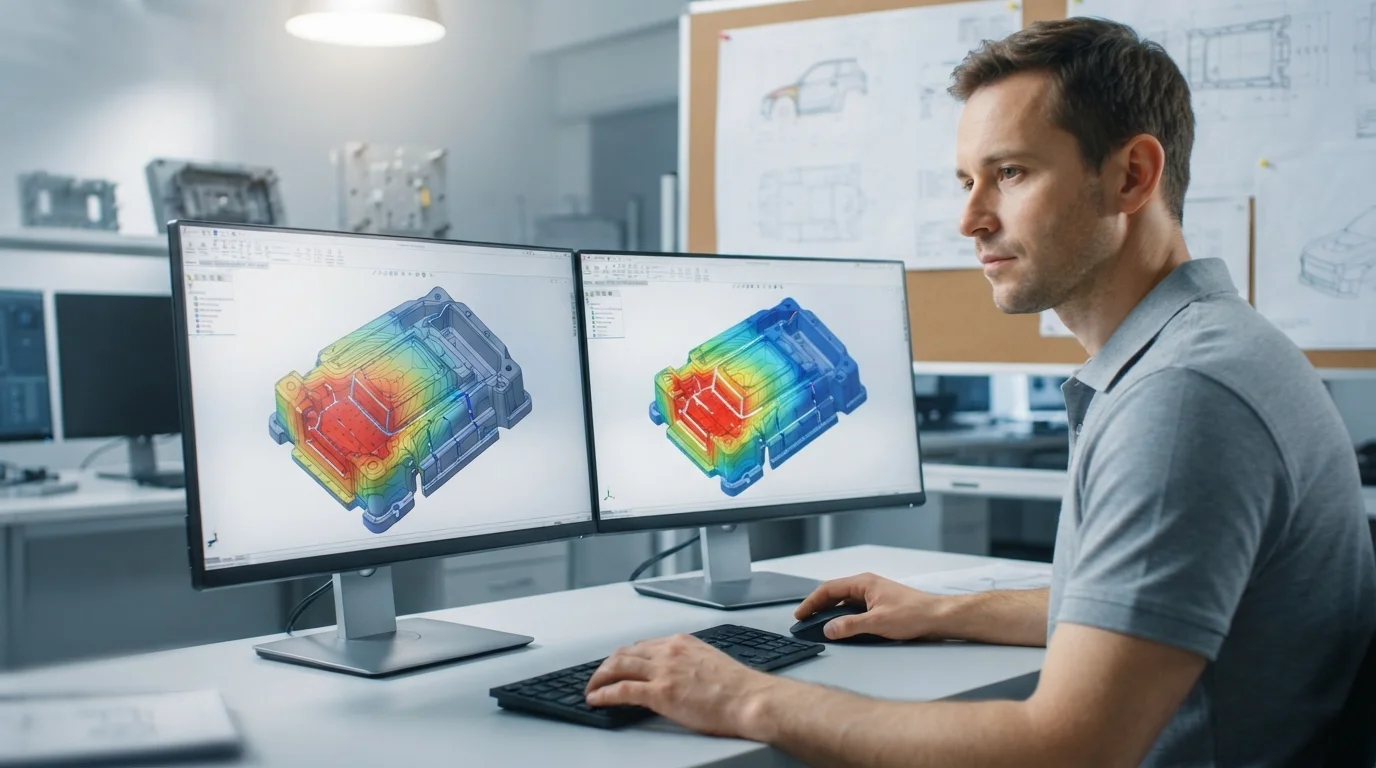
Fortschrittliche Mold-Flow-Analyse Dienstleistungen, die computergestützte CAE-Strömungssimulationssoftware nutzen. Unser erfahrenes Formenbau-Team liefert prädiktive Füll-, Kühl- und Verformungssimulationen, um Angussscherung zu optimieren, kosmetische Fehler zu beseitigen und Werkzeuglayouts vor dem Schneiden von Werkzeugstahl zu validieren.
Warum Formfluss-Simulation wichtig ist
Die Simulation des Polymer-Schmelzeverhaltens in einem virtuellen Formhohlraum behebt vier Hauptfertigungsfehler vor Kundenspezifischer Formenbau:
1. Eliminierung von Kurzspritzungen und Verzögerungen
Sagt lokale Fließverzögerungen und übermäßige Druckabfälle in Dünnwand-Spritzguss Abschnitten voraus, um eine vollständige Formfüllung ohne übermäßige Einspritzdrücke der Maschine zu gewährleisten.
2. Vorhersage von Bauteilverzug und Verformung
Identifiziert ungleichmäßige volumetrische Schrumpfung und Orientierungsspannungen, die durch Glasfaser (GF) Verstärkung verursacht werden, sodass Ingenieure Kühlkanäle ausgleichen und Werkzeugabmessungen im Voraus korrigieren können.
3. Verhinderung von Einfallstellen und inneren Lunkern
Lokalisiert ungekernte dickwandige Kreuzungen und berechnet Gefrizeiten des Angusses, um eine ordnungsgemäße Nachdruckversorgung zu gewährleisten und kosmetische Einfallstellen auf sichtbaren Oberflächen zu verhindern.
4. Verschiebung von Bindenähten und Lufteinschlüssen
Vorhersagen, wo zusammenlaufende Schmelzfronten aufeinandertreffen (Bindenähte) und wo Luft eingeschlossen wird. Anschnitte werden neu positioniert, um Bindenähte von hochbelasteten oder ästhetischen Zonen wegzuverlagern.
Unsere Mold-Flow-Analyse umfasst
Unsere umfassenden CAE-Simulationsstudien bewerten vier Kernphasen des Spritzguss Zyklus:
| Simulationsphase | Wichtige analysierte Variablen | Ergebnis der Werkzeugoptimierung |
|---|---|---|
| Füllanalyse | Schmelzfrontfortschritt, Scherrate, Füllzeit und Druck beim Umschalten auf Nachdruck. | Gleicht Mehrfachkavitäten-Angusssysteme aus und bestimmt präzise Anschnittgrößen für Harze wie ABS, Polycarbonat (PC), und Polyamid (PA/Nylon). |
| Nachdruck- und Druckanalyse | Volumetrische Schrumpfung, Anschnitt-Einfrierzeit, Nachdruckabfall und Schließkraft. | Optimiert Nachdruckprofile, um Lunker und Einfallstellen an schweren Strukturrippen zu vermeiden. |
| Kühlsimulation | Kühlmittel-Durchflussrate, Formoberflächentemperaturverteilung und Kühlzeit. | Führungen für die Konstruktion von 3D-konformen Kühlkanälen zur Reduzierung der Zykluszeiten um 20%–30%. |
| Verzugsprognose | Gesamtverformungsvektoren, thermische Spannungen und Effekte der Faserorientierung. | Verformt Werkzeugstahlkavitäten vor, um Schrumpfung zu kompensieren und ebene, CAD-konforme Teile zu gewährleisten. |
Optimieren Sie das Formdesign vor der Fertigung
Integration Formfüllanalyse mit frühen DFM-Analyse und 3D Spritzgussform-Design bietet vollständige technische Sicherheit. Durch die Simulation von Hochtemperatur-Superpolymeren wie Polyetheretherketon (PEEK), komplexen Insert-Spritzguss Baugruppen oder Mehrkomponenten- Overmolding-Dienstleistungen, gewährleisten wir eine erstmals korrekte Werkzeugstahlbearbeitung auf unseren 5-Achs-CNC-Maschinen.
Häufig gestellte Fragen (FAQ)
Q: What mold flow simulation software do you use?
A: Our engineering team utilizes industry-standard Autodesk Moldflow Insight and Adviser software suites for advanced filling, packing, cooling, and warpage simulation.
Q: How long does a mold flow analysis report take?
A: Standard filling and gate location simulations are completed within 24 to 48 hours. Comprehensive warpage and conformal cooling optimization studies require 2 to 4 business days.
Q: Can mold flow analysis simulate glass-fiber filled plastics?
A: Yes. Moldflow accurately simulates fiber orientation tensor alignment for glass-filled (GF) and carbon-filled (CF) resins, predicting anisotropic shrinkage and differential warpage.
Q: Is mold flow analysis necessary for simple prototype molds?
A: While simple parts may only require basic DFM reviews, mold flow analysis is strongly recommended for high-precision components, thin-wall enclosures, and expensive production tooling.