
Análisis de flujo de moldeo
Simular la reología compleja del fundido de polímeros y predecir los comportamientos de cristalización térmica antes de cortar el acero de herramientas es esencial para la fabricación de precisión de alto rendimiento. El análisis de flujo de molde de inyección utiliza software avanzado de simulación CAE de elementos finitos para modelar el llenado del fundido, el empaquetado de la cavidad, la eficiencia de enfriamiento y la deformación estructural. En Jucheng Precision, nuestro experimentado equipo de ingeniería ofrece servicios llave en mano de simulación de flujo de molde para componentes complejos de automoción, médicos y de electrónica de consumo. Al optimizar las ubicaciones de las compuertas, el equilibrio de los canales de alimentación y los circuitos de enfriamiento conformal durante la fase de diseño, eliminamos los llenados incompletos, las marcas de hundimiento y las trampas de aire, asegurando una capacidad de proceso CPK > 1.67 verificada mediante inspección con CMM Zeiss.
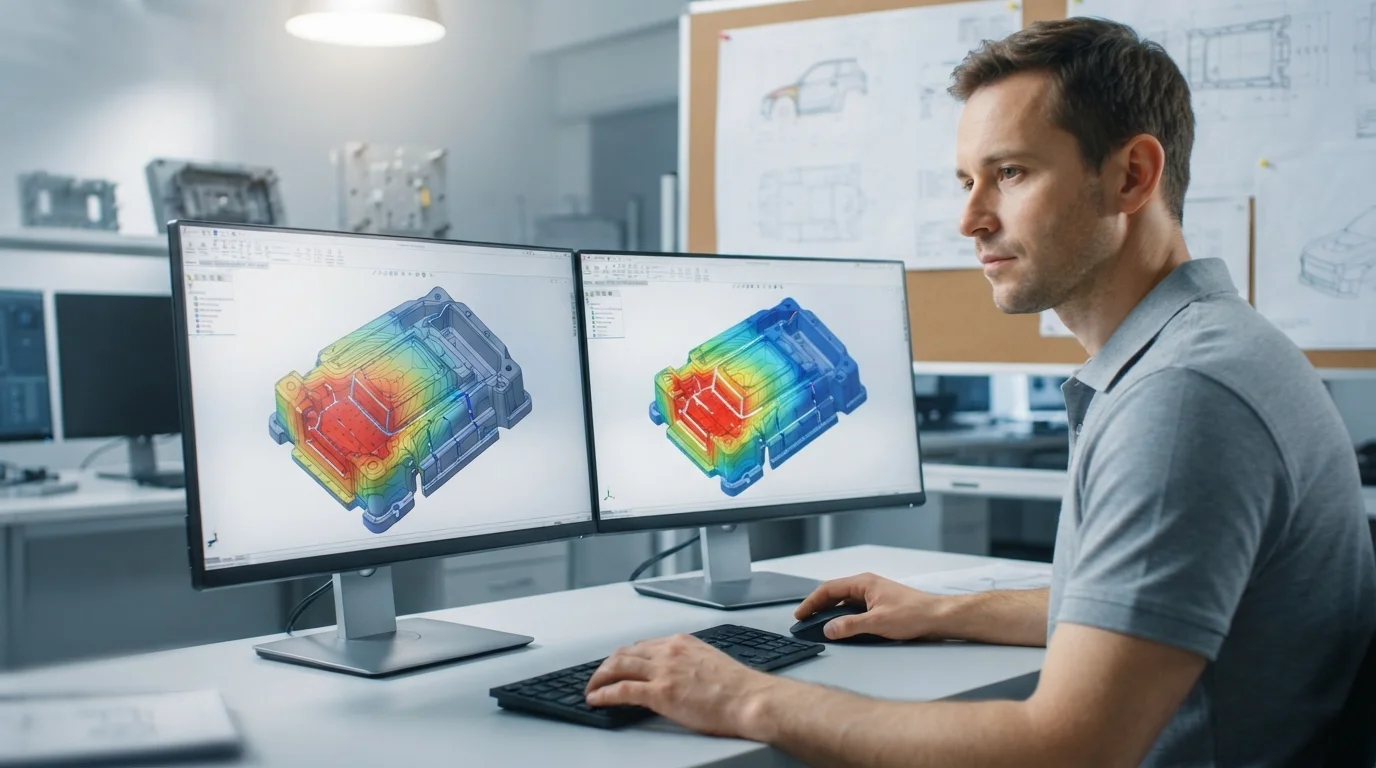
Avanzados análisis de flujo de molde servicios que utilizan software de simulación de flujo CAE asistido por computadora. Nuestro experimentado equipo de ingeniería de moldes ofrece simulaciones predictivas de llenado, enfriamiento y deformación para optimizar el cizallamiento en las compuertas, eliminar defectos cosméticos y validar los diseños de herramientas antes de cortar el acero de herramientas.
Por qué importa la simulación de flujo de molde
Simular el comportamiento del fundido de polímeros dentro de una cavidad de molde virtual resuelve cuatro defectos de fabricación importantes antes de Fabricación de Moldes Personalizados:
1. Eliminación de llenados incompletos y vacilación
Predice la vacilación del flujo localizada y las caídas de presión excesivas en Moldeo por Inyección de Pared Delgada secciones, asegurando el llenado completo de la cavidad sin requerir presiones de inyección excesivas de la máquina.
2. Predicción de la deformación y distorsión de la pieza
Identifica la contracción volumétrica desigual y las tensiones de orientación causadas por el Fibra de Vidrio (GF) reforzamiento, permitiendo a los ingenieros equilibrar los canales de enfriamiento y corregir las dimensiones de la herramienta de antemano.
3. Prevención de marcas de hundimiento y huecos internos
Identifica las intersecciones de paredes gruesas sin núcleo y calcula los tiempos de solidificación de las compuertas, asegurando la entrega de la presión de empaquetado adecuada para prevenir marcas de hundimiento cosméticas en las superficies visuales.
4. Desplazamiento de líneas de soldadura y trampas de aire
Predice dónde se encuentran los frentes de fusión convergentes (líneas de unión) y dónde queda atrapado el aire. Las entradas se reposicionan para desplazar las líneas de soldadura fuera de las zonas de alta tensión o estéticas.
Nuestro análisis de flujo de molde abarca
Nuestros completos estudios de simulación CAE evalúan cuatro fases fundamentales del Moldeo por Inyección de Plástico ciclo:
| Fase de simulación | Estudios de variables analíticas clave | Resultado de la optimización del utillaje |
|---|---|---|
| Análisis de llenado | Progresión del frente de fusión, velocidad de cizallamiento, tiempo de llenado y presión en el cambio V/P. | Equilibra los sistemas de canales de múltiples cavidades y determina los tamaños precisos de las entradas para resinas como ABS, Policarbonato (PC), y Poliamida (PA/Nylon). |
| Análisis de compactación y presión | Contracción volumétrica, tiempo de congelación de la entrada, decaimiento de la presión de compactación y fuerza de cierre. | Optimiza los perfiles de presión de mantenimiento para evitar huecos y marcas de hundimiento en nervios estructurales pesados. |
| Simulación de enfriamiento | Caudal del circuito, distribución de la temperatura de la superficie del molde y tiempo de enfriamiento. | Guía el diseño de canales de enfriamiento conformal 3D para reducir los tiempos de ciclo en un 20%-30%. |
| Predicción de deformación | Vectores de deflexión total, estrés térmico y efectos de orientación de fibras. | Predeforma las cavidades de acero para herramientas para compensar la contracción, garantizando piezas planas y fieles al CAD. |
Optimice el diseño del molde antes de la fabricación
Integrando Análisis de flujo de moldeo con anticipación Análisis DFM y 3D Diseño de moldes de inyección proporciona una confianza total en la ingeniería. Al simular superpolímeros de alta temperatura como Poliéter éter cetona (PEEK), complejos Moldeo por Inyección de Insertos ensamblajes o multiinyección Servicios de sobremoldeo, aseguramos el mecanizado de acero para herramientas correcto a la primera en nuestros CNC de 5 ejes.
Preguntas frecuentes (FAQ)
P: ¿Qué software de simulación de flujo de molde utiliza?
R: Nuestro equipo de ingeniería utiliza los paquetes de software estándar de la industria Autodesk Moldflow Insight y Adviser para simulaciones avanzadas de llenado, empaquetado, enfriamiento y alabeo.
P: ¿Cuánto tiempo tarda un informe de análisis de flujo de moldeo?
R: Las simulaciones estándar de llenado y ubicación de puntos de inyección se completan en un plazo de 24 a 48 horas. Los estudios exhaustivos de optimización de alabeo y enfriamiento conformal requieren de 2 a 4 días hábiles.
P: ¿Puede el análisis de flujo de moldeo simular plásticos rellenos de fibra de vidrio?
R: Sí. Moldflow simula con precisión la alineación del tensor de orientación de fibras para resinas rellenas de vidrio (GF) y rellenas de carbono (CF), prediciendo la contracción anisotrópica y el alabeo diferencial.
P: ¿Es necesario el análisis de flujo de moldeo para moldes prototipo simples?
R: Si bien las piezas simples pueden requerir solo revisiones básicas de DFM, se recomienda encarecidamente el análisis de flujo de moldeo para componentes de alta precisión, carcasas de pared delgada y utillaje de producción costoso.