
Hydrographics
Hydrographics, also called water transfer printing, applies a decorative pattern over a prepared three-dimensional surface. It can suit curved molded covers and trim pieces where direct flat printing is difficult. The finished result depends on the complete preparation, pattern-transfer and protective-coating system, with particular attention to stretching, joining lines and masked functional areas.
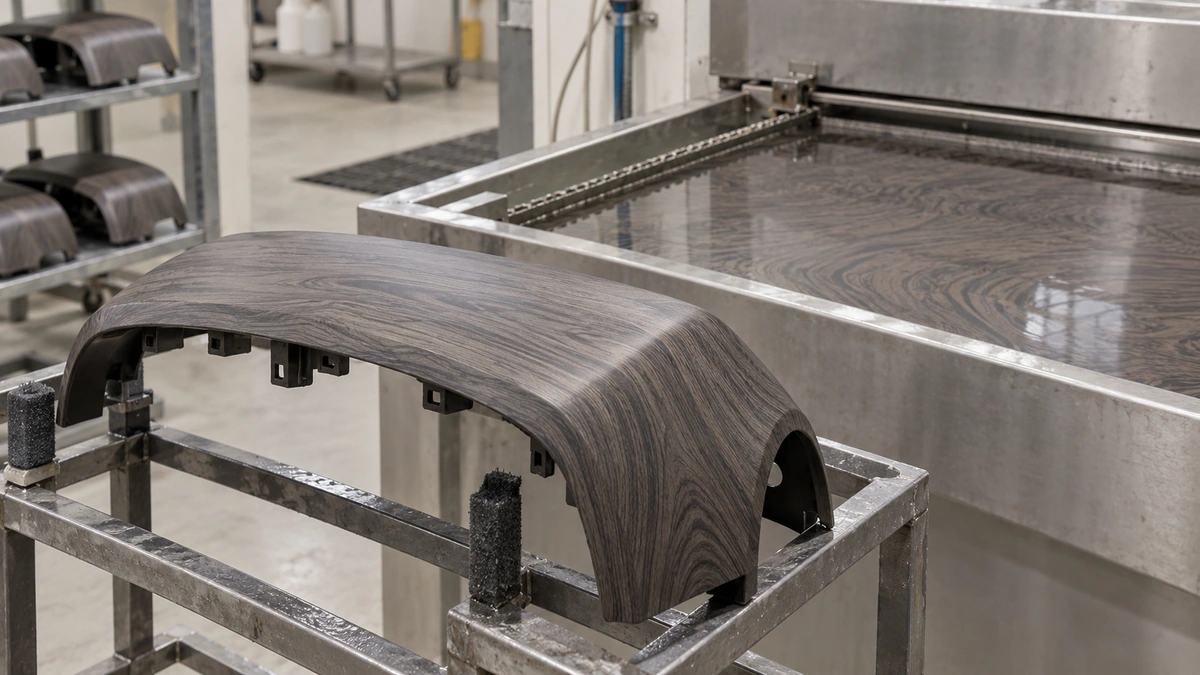
Choose patterns that can tolerate a three-dimensional part
A pattern changes as it wraps around a shape. Deep recesses, sharp transitions and broad changes in curvature may stretch or interrupt the design. An exact-position logo is a different requirement from an all-over decorative texture; do not assume both can be controlled in the same way.
Use marked CAD views to identify the primary viewing face and acceptable pattern transitions. For directional designs, define the orientation on the assembled product rather than on the loose component alone.
The coating stack determines more than color
The substrate must accept the preparation and base-coat system. The base influences the appearance of many patterns, while the protective clear coat contributes to the final gloss and exposure resistance. Each layer needs compatible application and conditioning requirements.
| Area of the part | Practical decision |
|---|---|
| Main visible face | Preferred pattern orientation and appearance reference |
| Deep return or recess | Allowable stretch, interruption or seam |
| Mating and sealing feature | Mask boundary and permitted coating build |
| Hidden cavity | Cleaning, drainage and drying access |
Sample the complete decorated part
Flat samples help with color selection but do not show the distortion created by the part geometry. Approve representative components after the complete finish has been applied. Evaluate color, gloss and the transition between visible and hidden surfaces under consistent lighting.
For frequently handled trim, add the appropriate abrasion and cleaner-exposure checks. Decorative appearance alone does not establish suitability for exterior exposure or contact with a particular chemical.
Frequently asked questions
Will every part have an identical pattern position?
Do not assume exact repeat registration. Establish the acceptable range of appearance on production-shaped samples.
Does a carbon-fiber pattern reinforce the part?
No. A printed carbon-fiber appearance is decoration, not a structural fiber reinforcement.
Can hydrographics cover a molding defect?
Surface defects may remain visible through the finish. Address the molded substrate before approving decoration.
Define the finish without compromising function
Review this route alongside other surface finishes and the original plastic molding requirements. Send the pattern reference, CAD and use environment for a project review.