
UV Coating
UV coating applies a formulation that cures under suitable ultraviolet exposure to create the required protective or decorative surface. On molded plastic, the result depends on the coating and substrate working as a system. Appearance, adhesion and wear resistance must be specified for the real use environment; a glossy surface alone does not show that the coating is adequately cured or fit for service.
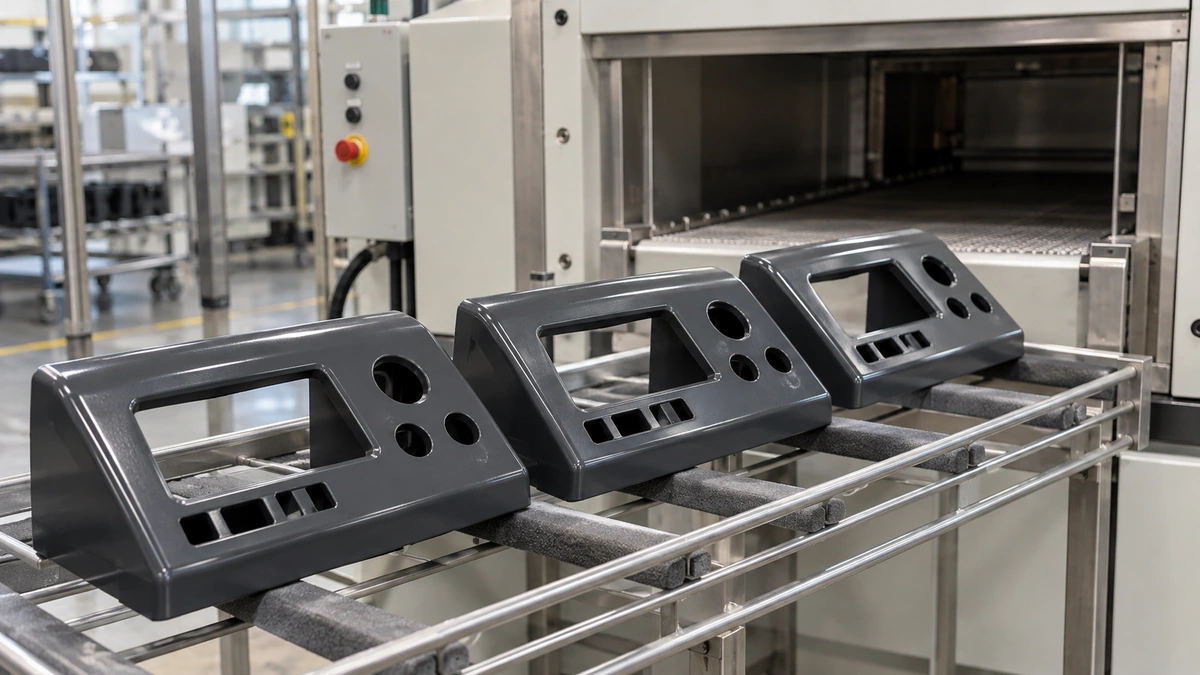
Coverage and cure are separate requirements
A coating can reach a recess that the curing light cannot adequately reach. Review ribs, undercuts, fixture contact points and the orientation of the part during exposure. A formulation intended only for light curing should not be assumed to cure in shadowed areas. Any secondary cure mechanism must belong to the selected coating system and its validated process.
The resin grade, pigments, molded-in stress and surface contamination also matter. Trial the production substrate, not merely a flat coupon of a related polymer. This is especially important where solvents or processing heat could affect a transparent or stressed part.
Build the specification around use
| Service condition | Evidence to request |
|---|---|
| Repeated handling | Defined abrasion or scratch evaluation |
| Cleaner contact | Exposure test with the actual chemical and contact conditions |
| Visible enclosure | Approved color, gloss and texture reference |
| Tight assembly fit | Coating boundaries and allowance in the dimension stack |
Avoid a blanket promise of “scratch-proof” or “chemical-proof.” A meaningful requirement identifies the load, exposure and acceptance limit. Test edges and local transitions as well as the broad face.
From sample approval to repeatable finishing
- Establish preparation and coating compatibility on molded samples.
- Define wet application, coating thickness targets and masked features.
- Validate the required light exposure and any specified secondary cure.
- Inspect the finished surface after handling and the relevant conditioning test.
Frequently asked questions
Can every molded resin receive UV coating?
No universal compatibility should be assumed. Exact grade, additives and the coating chemistry require assessment.
Should coating extend into snap fits?
Only when designed and validated that way. A brittle or excessive film may alter engagement or crack during flexing.
Coordinate the finish before tooling release
Review surface finishes alongside the plastic injection molding drawing. Send the intended exposure conditions and reference appearance for a project quotation with clearly bounded coating requirements.