
Prototype Injection Mold
Validating real polymer shrinkage, snap-fit engagement, and mechanical performance under actual molding conditions is the ultimate safeguard against costly mass-production tool failures. Prototype injection mold manufacturing utilizes rapid 7075 aluminum or pre-hardened steel tooling to produce functional, production-grade plastic parts in as fast as 7 to 10 business days. At Jucheng Precision, we specialize in low-cost prototype tooling and bridge manufacturing for complex medical, automotive, and consumer hardware devices. Driven by 25+ in-house 5-axis CNC machining centers and 35+ injection presses, we process real engineering thermoplastics, delivering fully validated functional prototypes backed by free 24-hour DFM analysis and Zeiss CMM inspection.
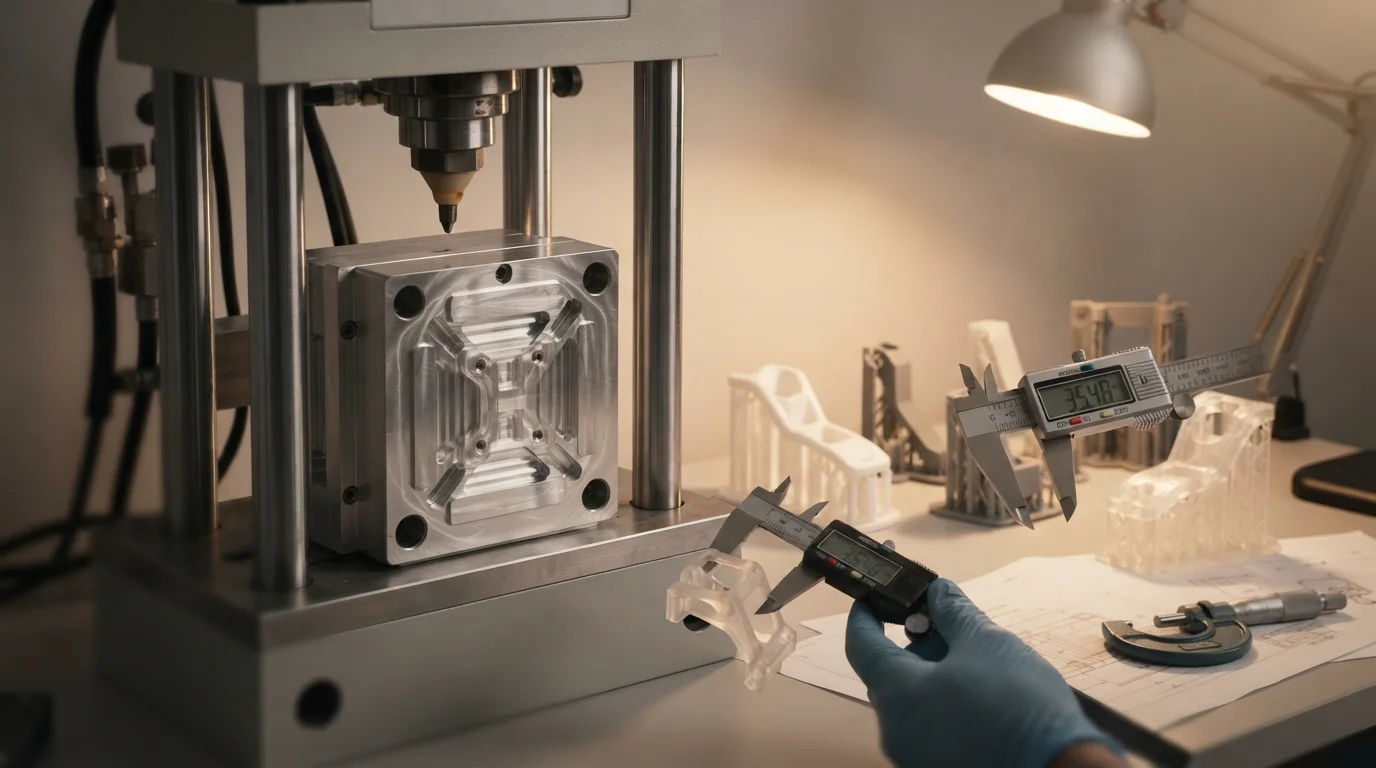
Fast-turnaround prototype injection mold manufacturing utilizing high-speed aluminum and pre-hardened steel tooling. Validate functional engineering samples, test mechanical snap-fits, and execute pilot market testing before committing to full-scale production molds.
Fast Tooling Solutions for Product Development
Building a Prototype Tooling cavity provides functional, production-grade plastic parts to accelerate your engineering hardware milestones:
1. Real Functional Engineering Samples
Unlike 3D printed models, prototype injection molded parts use real production thermoplastics (such as ABS, Polycarbonate (PC), or Polyamide (PA/Nylon)). This allows true mechanical drop-testing, tensile stress evaluation, and fluid pressure validation.
2. Verification of Assembly & Fitment
Test complex snap-fit engagements, ultrasonic weld joints, and Overmolding Services adhesion on actual molded parts before releasing high-cavitation production steel tooling.
3. Low-Risk Market Testing & Pilot Runs
Fulfill early regulatory clinical trials or initial market pilot orders (100 to 10,000 units) via Low Volume Injection Mold bridge production while full-scale mass tooling is being manufactured.
Prototype Mold vs Production Mold
Comparing prototype aluminum tooling against multi-cavity hardened steel production molds helps determine the right tooling strategy for your project budget:
| Comparison Metric | Prototype Injection Mold | Production Injection Mold |
|---|---|---|
| Tooling Investment Cost | Low ($2,000 to $8,000 typical) | High ($15,000 to $50,000+ typical) |
| Tooling Lead Time | Fast (7 to 14 Business Days) | Longer (4 to 8 Weeks) |
| Production Part Volume | Low (100 to 10,000 parts) | High (100,000 to 1,000,000+ shots) |
| Mold Material Choice | QC-10 Aluminum / P20 & NAK80 Soft Steel | Hardened S136 Stainless or H13 Steel (52 HRC) |
| Design Change Modification | Easy & Inexpensive (Aluminum mills rapidly) | Complex & Costly (Requires EDM on hardened steel) |
Frequently Asked Questions (FAQ)
Q: How much does a prototype injection mold cost?
A: Aluminum or soft-steel prototype molds typically cost between $2,000 and $8,000 depending on part size and undercut complexity, providing up to 60% savings compared to mass production tooling.
Q: How fast can I receive prototype injection molded parts?
A: First-off T1 prototype samples are delivered in as fast as 7 to 10 business days after 3D CAD approval and DFM sign-off.
Q: Can prototype molds process high-temperature resins like PEEK?
A: Yes. For high-temperature thermoplastics like Polyetheretherketone (PEEK) or glass-filled resins, we build pre-hardened steel prototype tool inserts with pressurized oil heating loops to ensure complete crystallization.
Q: Can a prototype mold be used for low-volume bridge production?
A: Absolutely. Aluminum and P20 steel prototype tools can reliably produce 1,000 to 10,000+ parts, serving as the perfect bridge to fulfill initial market orders while full-scale production tooling is built.