
Screw Assembly
Screw assembly provides a mechanical route for joining molded components and can support service access when the joint is designed for it. The fastener, plastic boss or threaded insert, mating stack and tightening method must work as a system. A screw that fits the hole is not necessarily a screw that produces reliable retention without damaging the molded part.
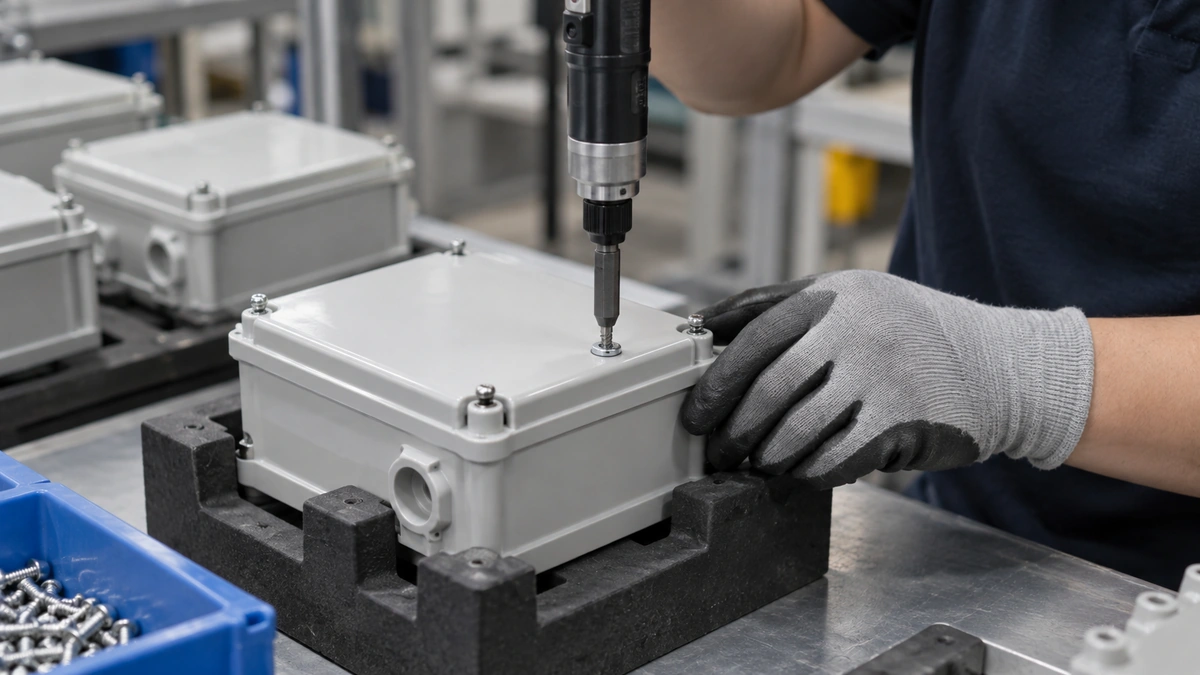
Decide where the thread belongs
Thread-forming fasteners designed for plastic can engage a suitable molded boss. A threaded insert offers a different interface and may be considered where repeated assembly or other requirements justify it. Neither route is universally preferable: compare resin, wall space, loads and expected service cycles.
If inserts are part of the concept, review insert kalıplama early. The surrounding plastic still has to transmit load; adding metal threads does not eliminate the need for a sound boss design.
The boss must withstand installation and use
Boss geometry, pilot-hole dimensions, engagement depth and nearby support influence the result. Use the selected fastener supplier’s design guidance as a starting point and verify it on the actual resin grade. Filled polymers and ductile unfilled materials should not automatically share the same geometry.
| Joint feature | Failure to consider |
|---|---|
| Thin boss wall | Splitting during thread formation or tightening |
| Excessive screw length | Bottoming before the joint is clamped |
| Weak mating surface | Local compression or distortion |
| Poor alignment | Cross-threading, angled engagement or inconsistent seating |
Define a tightening window, not just a torque number
The assembly process must seat the joint without stripping the thread or damaging the part. Establish the relationship between driving, seating and failure on representative assemblies. Tightening speed, fastener variation and material condition can influence that relationship.
Where multiple screws clamp a cover, sequence can affect gap uniformity and distortion. Where a gasket is present, consider its compression requirement as part of the stack. Recheck retention after relevant environmental exposure because polymer relaxation can change the joint over time.
Sıkça sorulan sorular
Are all screwed joints suitable for repeated opening?
No. The intended number of service cycles should be specified and tested. A direct plastic thread and a metal insert may behave differently.
Can more torque fix a loose joint?
Not reliably. Excess torque can strip the thread, split the boss or deform the mating part. Investigate engagement and stack-up first.
Do screws make the enclosure watertight?
Not by themselves. Sealing depends on the interface, gasket or other sealing system and a defined validation test.
Review the complete assembly drawing
Provide CAD, fastener specifications, mating components and service requirements. Coordinate boss geometry with özel kalıp imalatı and include assembly verification in kalite kontrol.