
PTFE (Teflon)
Polytetrafluoroethylene (PTFE), widely known as Teflon, is the ultimate high-performance fluoropolymer celebrated for its total chemical inertness, extreme thermal stability (-200°C to +260°C), and lowest friction coefficient among all solids (0.04). At Jucheng Precision, we process virgin PTFE, filled compounds, and melt-processable fluoropolymers like PFA and FEP for severe chemical, semiconductor, and medical applications. Utilizing high-temperature injection presses equipped with corrosion-resistant nickel-alloy barrels and 5-axis CNC machining, we fabricate tight-tolerance valve seats, dynamic seals, and chemical manifolds. We provide free DFM analysis within 24 hours, ensuring zero-defect components verified by Zeiss CMM inspection.
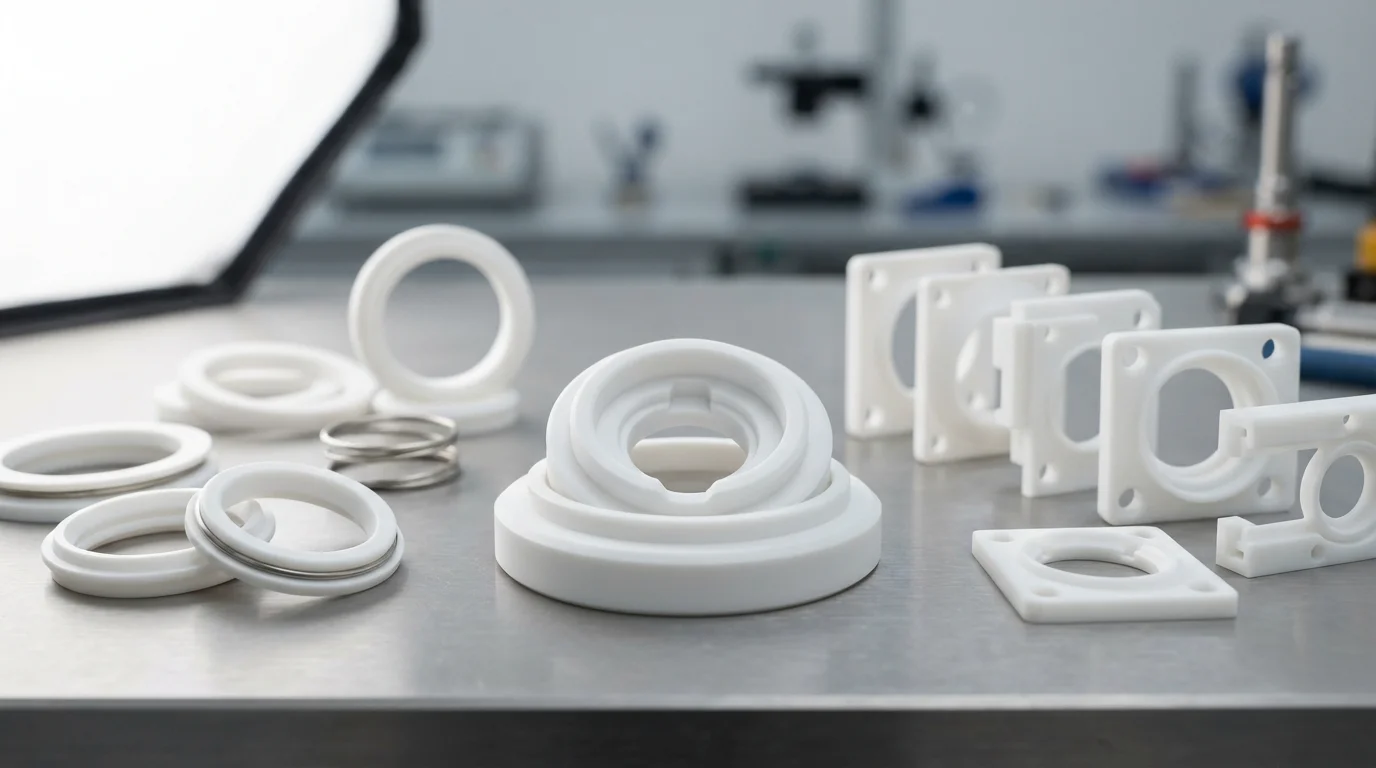
Common Fluoropolymer & PTFE Grades We Process
We process high-purity virgin PTFE, filled compounds, and melt-processable fluoropolymers (PFA/FEP) from world-leading chemical compounders:
| Fluoropolymer Class | Типичная марка и сорт | Ключевые характеристики и преимущества |
|---|---|---|
| Virgin & Modified PTFE | • Chemours Teflon PTFE Granular • Daikin Polyflon PTFE |
Ultra-low coefficient of friction (0.04), complete chemical insolubility, and extreme thermal limits (-200°C to +260°C). Ideal for high-purity chemical valve seats, gaskets, and seals. |
| Injection-Moldable PFA / FEP | • Chemours Teflon PFA 340 / FEP 100 • Solvay Hyflon PFA / FEP |
Fully melt-processable fluoropolymers that retain PTFE’s chemical and thermal performance while allowing complex injection molding of fluidic manifolds and semiconductor fittings. |
| Filled PTFE Compounds | • Glass-Filled PTFE (15%-25% GF) • Carbon / Bronze-Filled PTFE |
Reinforced with glass, carbon, or bronze powders to dramatically decrease cold-flow deformation (creep) and increase wear resistance in heavy-load hydraulic bearings and piston rings. |
Applicable Processing Methods for Fluoropolymers
Fluoropolymers require specialized processing techniques due to their extreme melt viscosity and thermal boundaries:
| Processing Technology | Process Suitability & Operational Details |
|---|---|
| High-Temp PFA/FEP Injection Molding | Excellent. Designed for complex chemical manifolds, semiconductor wafer-handling fittings, and high-purity medical valves using melt-processable fluoropolymers. |
| Compression Molding & Sintering | Primary for Pure PTFE. Cold compaction of fine powder followed by high-temperature sintering above 360°C to form dense structural billets and rings. |
| 5-Axis CNC Precision Machining | Excellent. Precision machining of molded or extruded PTFE billets down to micro-tolerances for dynamic lip seals, thread adapters, and valve cores. |
PTFE & Fluoropolymer Processing Technical Guide
Processing fluoropolymers requires extreme temperature boundaries and corrosion-proof machine metallurgy:
- Extreme Processing Temperatures: Melt-processable PFA and FEP resins require high barrel temperatures between 350°C and 400°C (662°F to 752°F). Mold temperatures are kept at 180°C–230°C (356°F to 446°F) using pressurized oil heating controllers.
- Nickel-Alloy & Hastelloy Corrosion Protection: At temperatures above 360°C, molten fluoropolymers release trace corrosive hydrogen fluoride (HF) vapors. Jucheng uses specialized Hastelloy or heavy nickel-plated tool cavities and bimetallic machine barrels to prevent tool degradation.
- Ultra-Low Friction Demolding: The self-lubricating matrix of PTFE/PFA ensures smooth part release. However, due to low tensile modulus at elevated temperatures, generous draft angles (minimum 1.5°) and wide ejector plates are designed to prevent part deformation during ejection.
- Zero Moisture Absorption: PTFE and PFA have water absorption rates below 0.01% (hydrophobic). While drying is rarely necessary, raw materials are kept in cleanroom environments to prevent dust contamination prior to high-temp processing.
Key Application Industries for PTFE & Fluoropolymer Parts
- Chemical Processing & Fluid Handling: Corrosive acid valve seats, pump impellers, chemical pipe gaskets, diaphragm pump seals, and lining sleeves.
- Semiconductor & High-Purity Infrastructure: Wafer carriers, ultra-pure chemical etching fittings, high-frequency coaxial cable insulators, and wet-bench components.
- Medical & Biotechnology (ISO 13485 Compliant): Biocompatible catheter valves, blood-contact fluidic manifolds, analytical reagent seals, and surgical implants.
Свойства материала
| Плотность | 2.15 - 2.20 g/cm³ |
| Coefficient of Friction (Dynamic, vs Steel) | 0.04 - 0.10 - |
| Предел текучести при растяжении | 20 - 35 MPa |
| Относительное удлинение при разрыве | 250 - 450 % |
| Модуль упругости при изгибе | 500 - 750 MPa |
| Shore D Hardness | 50 - 65 - |
| Melting Temperature (Crystalline Peak) | 327 °C |
| Continuous Operating Temperature | -200 to +260 °C |
| Электрическая прочность | 40 - 80 kV/mm |
| Удельное объемное сопротивление | 1.0E+18 Ohm·cm |
| Water Absorption (24h) | < 0.01 % |
| Flammability Rating | UL 94 V-0 / 5VA Class |
| Максимальный размер детали | 600 x 400 мм |
| Минимальный размер детали | 0.5 x 0.5 mm |