
COC-TOPAS 5013
Substituting optical glass and quartz in microfluidic chips, labware, and diagnostic cuvettes without compromising heat resistance during high-temperature PCR protocols requires an ultra-pure amorphous polymer, which Polyplastics’ TOPAS 5013S-04 Cyclic Olefin Copolymer (COC) delivers. Featuring a density of 1.02 g/cm³ and a glass transition temperature (Tg) of 130°C, this USP Class VI and ISO 10993 compliant resin provides 92% light transmittance, ultra-low birefringence, and a nearly non-existent moisture absorption of 0.01%. Jucheng Precision, under ISO 13485 certified medical frameworks, specializes in micro-molding TOPAS 5013. Supported by certified ISO Class 7/8 cleanrooms and in-house 5-axis CNC-machined S136 stainless steel tooling, we guarantee zero-particulate contamination and pristine detail replication verified by Zeiss CMM.
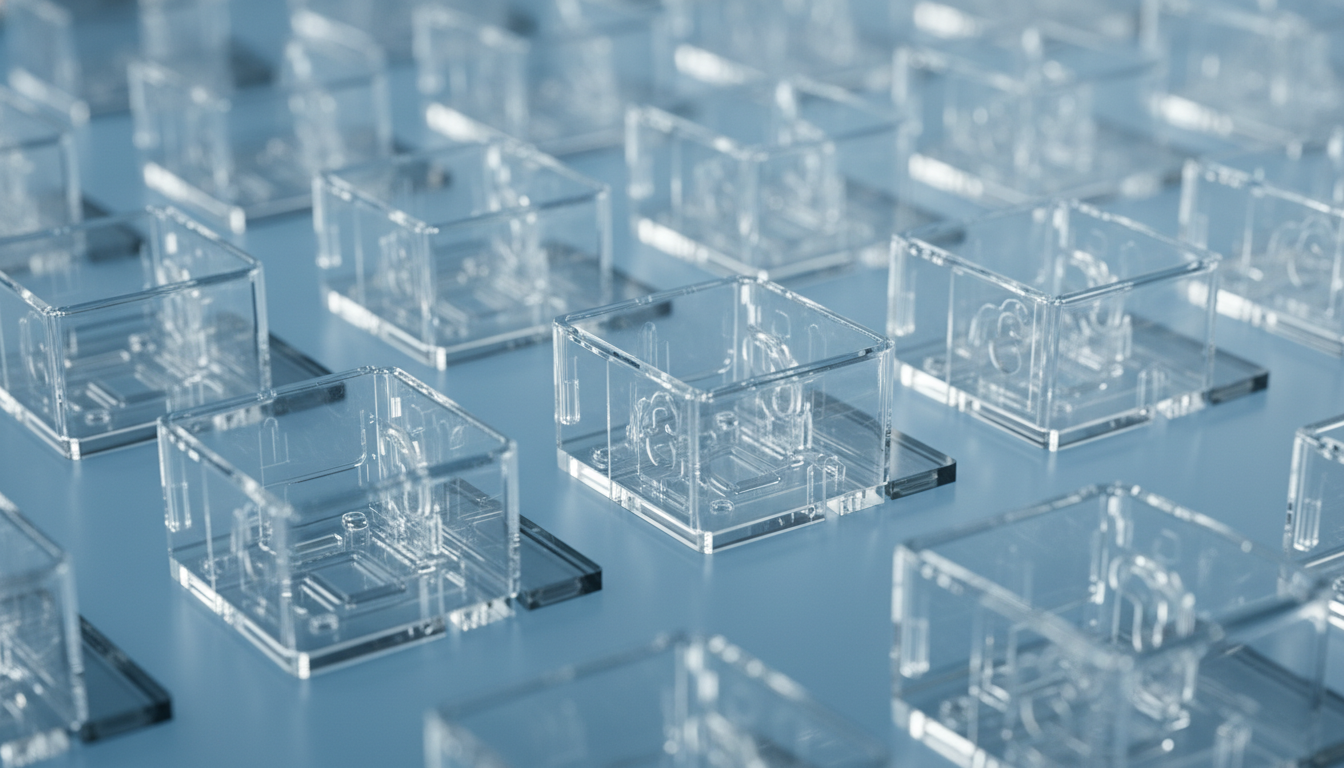
TOPAS 5013S-04 Optical Clarity & Regulatory Compliance Profile
TOPAS® 5013S-04 is a high flow, unreinforced amorphous Cyclic Olefin Copolymer (COC) resin engineered by Polyplastics, certified to deliver outstanding light transmission, low birefringence, and high heat resistance for MedTech applications:
| Attribut physique et optique | TOPAS 5013S-04 Value | MedTech & Optical Advantage |
|---|---|---|
| Transmittance lumineuse | 92.0% Optical Transmission (at 589nm) | Delivers glass-matching transparency and high refractive index directly from polished mold cavities, ideal for diagnostic cuvettes. |
| Hydrophobie extrême | Water Absorption 0.010% (at 23°C saturation) | Virtually non-hygroscopic. Excludes environmental moisture swelling or volume shifting, preventing micro-volume diagnostic errors. |
| Ramollissement thermique | Vicat B50 Softening Temp 125°C | Maintains absolute structural stiffness and flat dimensional replication up to 130°C, fully resisting 95°C thermal PCR cycles. |
Biocompatible Process Configurations for Easy-Flow TOPAS 5013
With outstanding melt fluidity and amorphous stability, TOPAS 5013S-04 processes consistently inside microfluidic tools:
| Catégorie de processus de moulage | Compatibilité des processus et détails opérationnels |
|---|---|
| Laboratoire sur puce microfluidique | Excellent. The primary process for TOPAS 5013. Optimized for multi-cavity, ultra-thin-walled medical diagnostics and biochips down to 0.1mm channels. |
| Precision Cuvettes & Microplates | Excellent. Highly compatible with high-speed automated runs, providing low-noise optical windows and excellent chemical-solvent resistance. |
| High-Accuracy Lenses & Optics | Excellent. Low dielectric constant and low birefringence are perfect for molding precise spherical lenses and optical diffusers. |
Optical Birefringence & Microfluidic Control Matrix
Molding an amorphous high-purity, easy-flow polymer like TOPAS 5013S-04 requires strict particulate controls and specialized tooling to prevent optical strain:
Low Birefringence & Stress Prevention
High melt shear during injection causes internal molding stresses, resulting in birefringence (rainbow refraction effects). Jucheng’s tooling division uses 5-axis CNC machines to cut precise runner geometries, applying slow, uniform packing pressures to prevent optical stress marks.
S136 Mirror-Polished Tooling (Purity Preservation)
Any microscopic tool mark on core or cavity surfaces will scatter light and compromise optical clarity. We build molds using high-chromium S136 stainless steel, mirror-polished to a high level using clean diamond paste, ensuring non-porous biocompatible part surfaces with zero particulates.
Contrôle de température de moule à huile sous pression
We maintain mold temperatures at 95°C–125°C (203°F to 257°F) using pressurized temperature controllers. High mold temperatures maximize surface gloss, reduce weld lines, and completely prevent weld-line stress cracking near intricate snap-fits.
Mandatory Desiccant Pre-Drying Protocol
Though COC absorbs virtually zero water, pre-drying raw material in clean-air desiccant hopper dryers at 100°C (212°F) for 6 hours is mandatory to prevent surface splay, dynamic micro-voids, and loss of transparent optical quality during high-speed runs.
Key Application Fields for COC-TOPAS 5013
- Medical Diagnostics & Microfluidics: Puces de diagnostic microfluidiques à haute densité, dispositifs de diagnostic de laboratoire sur puce, cuvettes, plaques de dosage et corps de seringues préremplis.
- High-End Optics & Lenses: Lentilles optiques sphériques et asphériques, protections d'objectif pour caméras, guides de lumière et plaques de diffusion de lumière.
- Boîtiers électroniques haute technologie : Plateaux de transport de puces à faible constante diélectrique, emballages de manipulation de semi-conducteurs et fenêtres d'affichage transparentes.
Propriétés
| Densité | 1.02 g/cm³ |
| Melt Volume-Flow Rate (MVR) (260°C/2.16kg) | 48 cm³/10min |
| Module de traction (1mm/min) | 3 200 MPa |
| Contrainte de traction à la rupture (5 mm/min) | 46 MPa |
| Déformation de traction à la rupture (5 mm/min) | 1.7 % |
| Charpy Impact Strength (Unnotched, 23°C) | 13 kJ/m² |
| Résistance au choc Charpy entaillé (23°C) | 1.6 kJ/m² |
| Transmittance lumineuse (3,0 mm) | 92 % |
| Indice de réfraction | 1.533 - |
| Température de transition vitreuse (Tg) | 130 °C |
| Point de ramollissement Vicat (B/50) | 125 °C |
| Température de déflexion sous charge (HDT @ 0,45 MPa) | 130 °C |
| Absorption d'eau (23°C Saturation) | 0.01 % |
| Retrait au moulage linéaire | 0.40 - 0.70 % |
| Taille maximale de pièce (limite salle blanche) | 600 x 400 mm |
| Taille minimale de pièce (limite du canal microfluidique) | 0,1 x 0,1 mm |