
If an acetal mechanism works cold but loses clearance or load capacity when hot, a resin upgrade deserves review. If the failure occurs at an overloaded corner, the design may need attention first. PEEK vs Delrin should begin with a simple question: what is forcing you beyond acetal? Delrin, a well-known POM homopolymer family, is a practical choice for gears, clips, bushings and precision mechanisms at moderate conditions. PEEK becomes justified when temperature, aggressive chemistry, sustained load, flame performance or fatigue exceeds what the selected acetal grade can reliably tolerate.
في هذا الدليل:
- Identify the upgrade trigger
- Compare dimensions and wear
- Account for molding differences
- Avoid over-specification
- Build a qualification test
Do not upgrade without a named failure
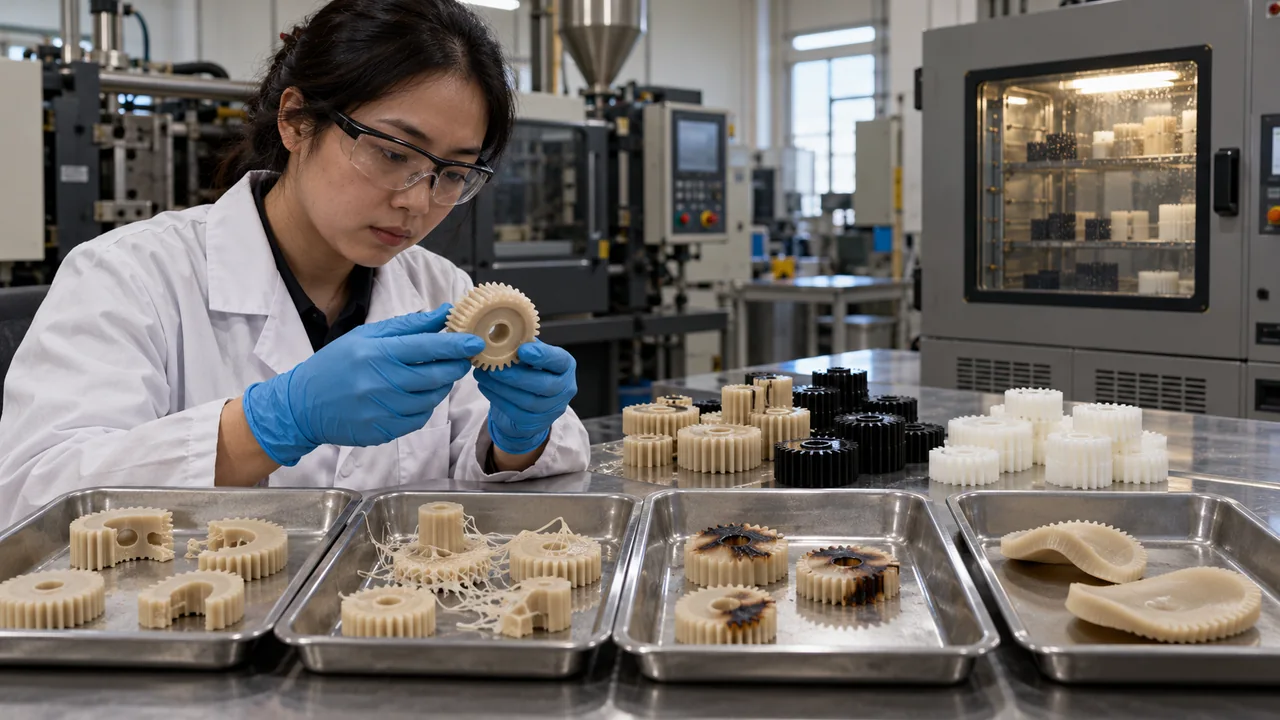
If the current Delrin part meets temperature, load, wear and chemical requirements, PEEK may add cost without improving the customer outcome. A valid upgrade trigger is specific: gear teeth soften during a thermal excursion, a valve component swells in a process fluid, a fastened boss relaxes, or a flame requirement cannot be met. Delrin can remain the better choice for many precision gears, clips and mechanisms operating near ambient conditions. Moving to PEEK may add tooling heat and material cost without improving the controlling requirement. Identify the exact thermal, chemical or load condition that Delrin fails first. A lightly loaded mechanism at moderate temperature may gain little from the change, especially when Delrin already provides acceptable friction and dimensions.
Write that failure as an acceptance criterion. It keeps the material decision tied to evidence rather than to the reputation of a premium polymer. If failure occurs only around a sharp corner or overstressed boss, redesign that feature before assigning the cause to the resin. Record whether the problem appears during molding, assembly or service. That timing determines whether the next step is process correction, geometry modification or a material upgrade. Acetal offers low moisture uptake and stable friction behavior, while PEEK adds a much higher thermal and chemical performance ceiling. The useful comparison is made after each candidate sees its intended environment and assembly stress. Measure dimensions, torque and wear after conditioning rather than only after molding. Delrin is a trade name for acetal homopolymer; other POM grades should not automatically inherit the same data.
Where PEEK changes the design boundary
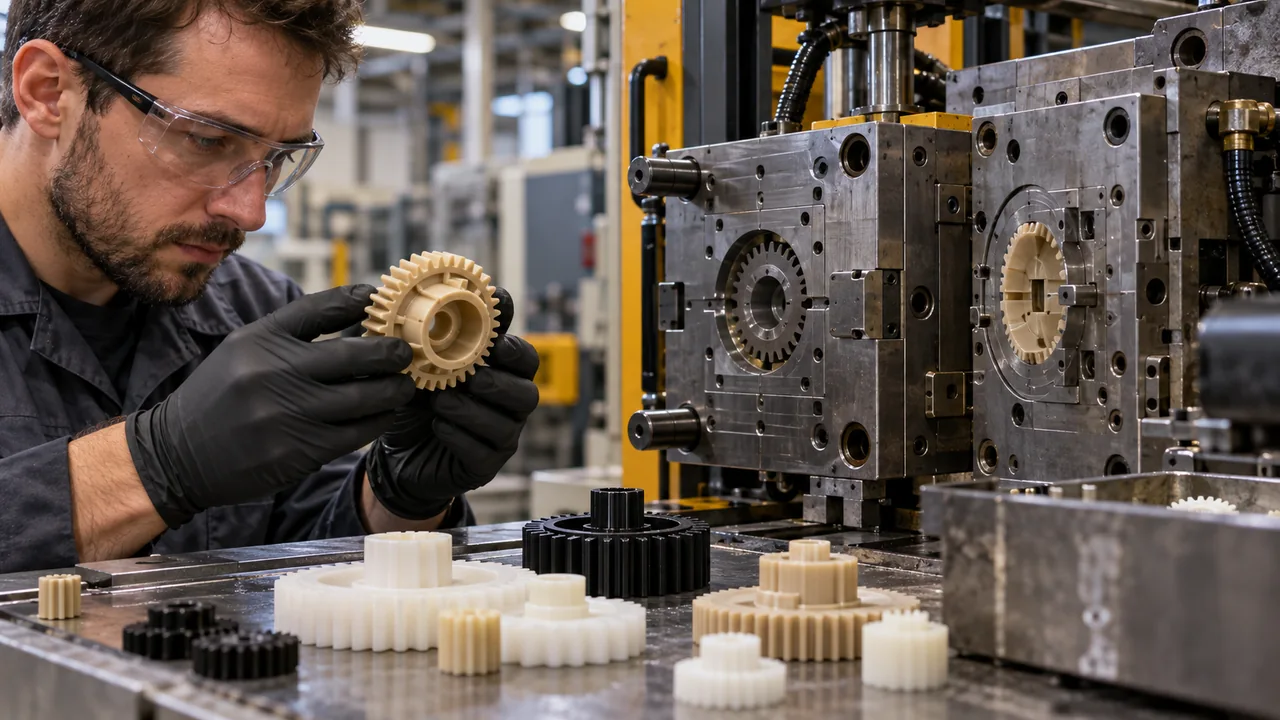
| Design condition | Delrin/POM | PEEK |
|---|---|---|
| Moderate-temperature precision mechanism | Usually the economical starting point | Often unnecessary |
| High load at elevated temperature | Creep risk rises | Stronger candidate |
| Aggressive chemical exposure | Fluid-specific limitations | Broader resistance |
| Low-cost sliding component | Often preferred | Use when heat or load requires it |
Tight tolerance is not a material property
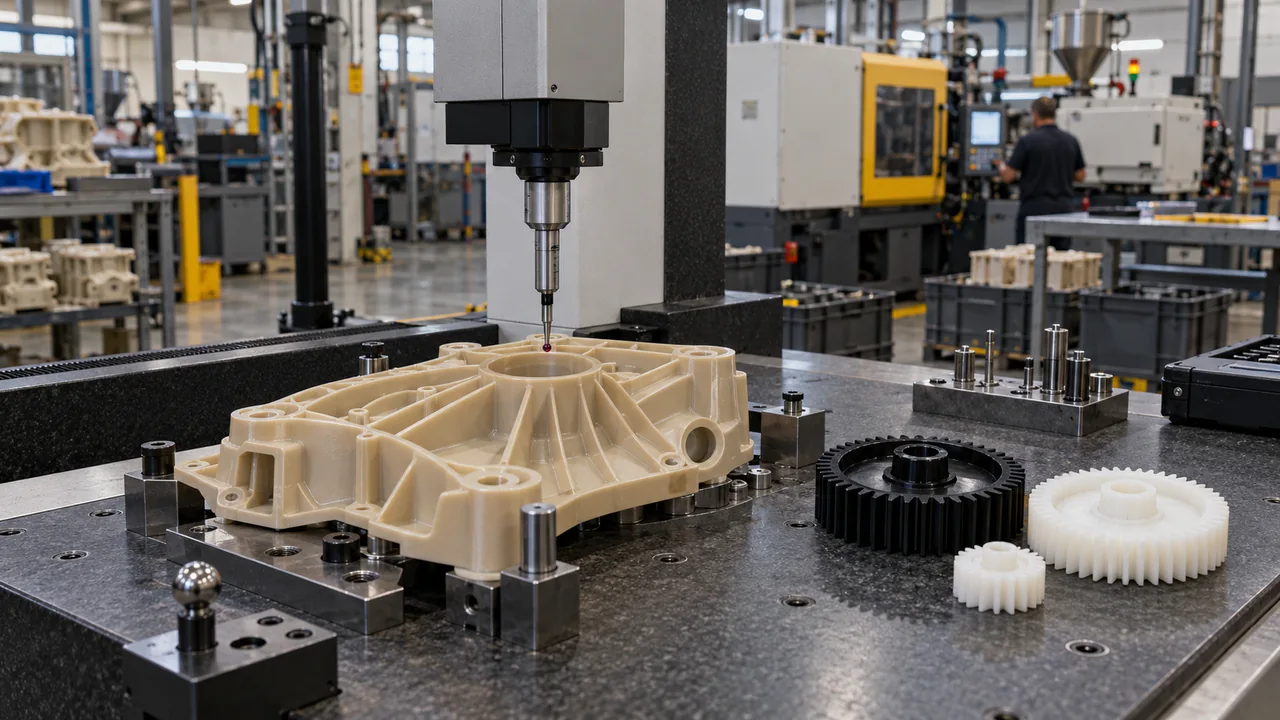
Both materials can produce precise components, but they reach stable dimensions through different process windows. POM has useful molding behavior for precision mechanisms, while PEEK dimensions depend strongly on mold temperature, crystallization, packing and cooling history. Reinforced PEEK adds directional shrinkage and fiber-orientation effects. Match the exact grade, reinforcement and intended application when comparing against PEEK. For a gear or latch, impact and repeated load may matter more than one tensile value. Evaluate temperature, contact pressure and chemicals together, and avoid selecting from a chart that mixes dry, conditioned and different test-method results. PEEK crystallinity and reinforced-grade orientation can move dimensions even when nominal resin shrinkage appears controlled. Delrin also requires balanced packing and cooling to avoid sink, voids and post-mold movement. Create cavity-specific capability data on the drawing datums that control assembly. Define which dimensions locate the assembly, which provide clearance and which control sealing.
State whether the drawing tolerance applies immediately after molding, after conditioning, or at the operating temperature. A room-temperature inspection can miss the failure that prompted the upgrade. A change in resin shrinkage can require steel adjustment even when nominal part geometry remains identical. PEEK parts also need a consistent measurement age and thermal history. Keep cavity identity in the inspection record and compare dimensions before and after the relevant service cycle. Otherwise, a good first article can hide later movement that defeats an apparently tighter material specification.
Compare the complete wear system
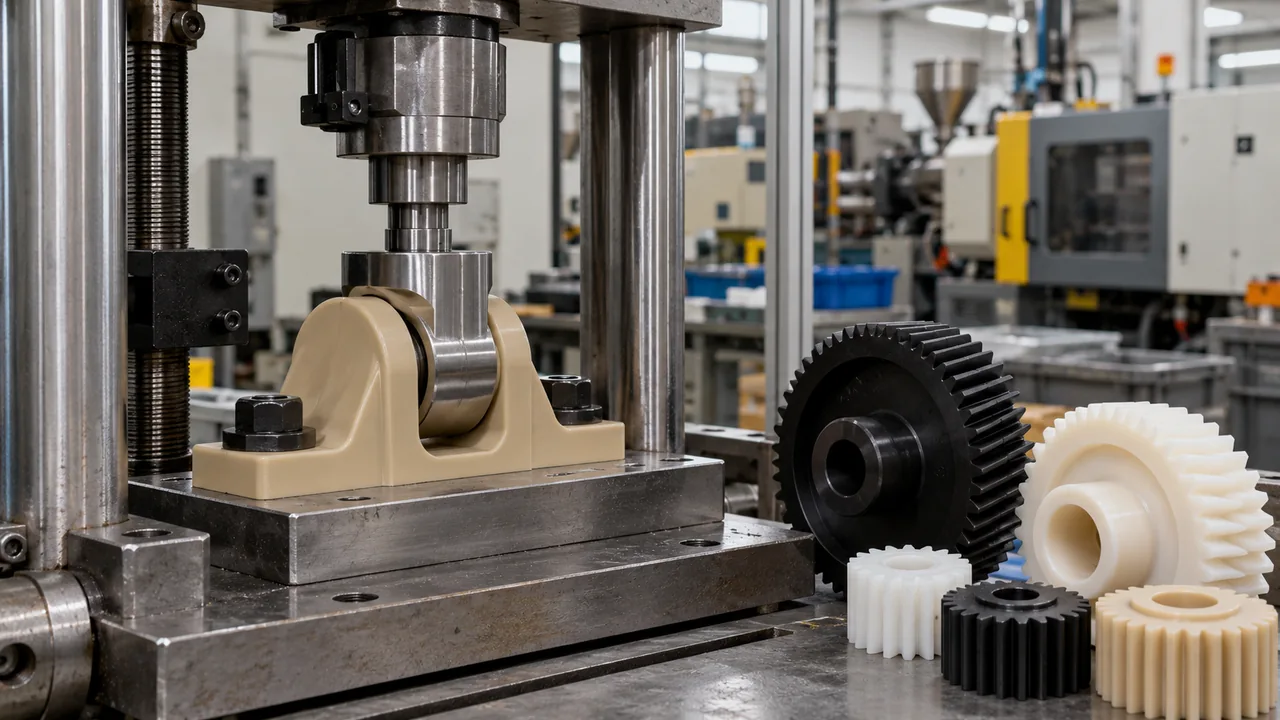
Delrin is widely used for low-friction gears and bearings. PEEK can outperform it under greater heat, pressure or chemical exposure, especially in wear-modified grades. The correct comparison includes mating material, surface finish, lubrication, speed, pressure and debris. Neither polymer has one universal wear value because load, speed, counterface and lubrication govern the contact. PEEK may retain geometry at heat; Delrin may provide excellent economical sliding performance in a moderate environment. Use a test that reproduces pressure, velocity, temperature and debris. For a gear, compare tooth contact, torque, speed, mating material and lubrication; for a bearing, compare pressure, velocity and heat removal.
A short coupon test can mislead when the production part has a molded weld line, sharp root radius or different fiber direction. Test the representative component whenever wear controls service life. A short dry sliding test may not represent months of intermittent operation. Wear particles can also affect a sealed mechanism even before dimensional loss reaches its limit. Select a representative duty cycle and check running torque, wear profile and counterface condition, rather than treating a friction coefficient as a complete performance guarantee.
The tooling jump is substantial
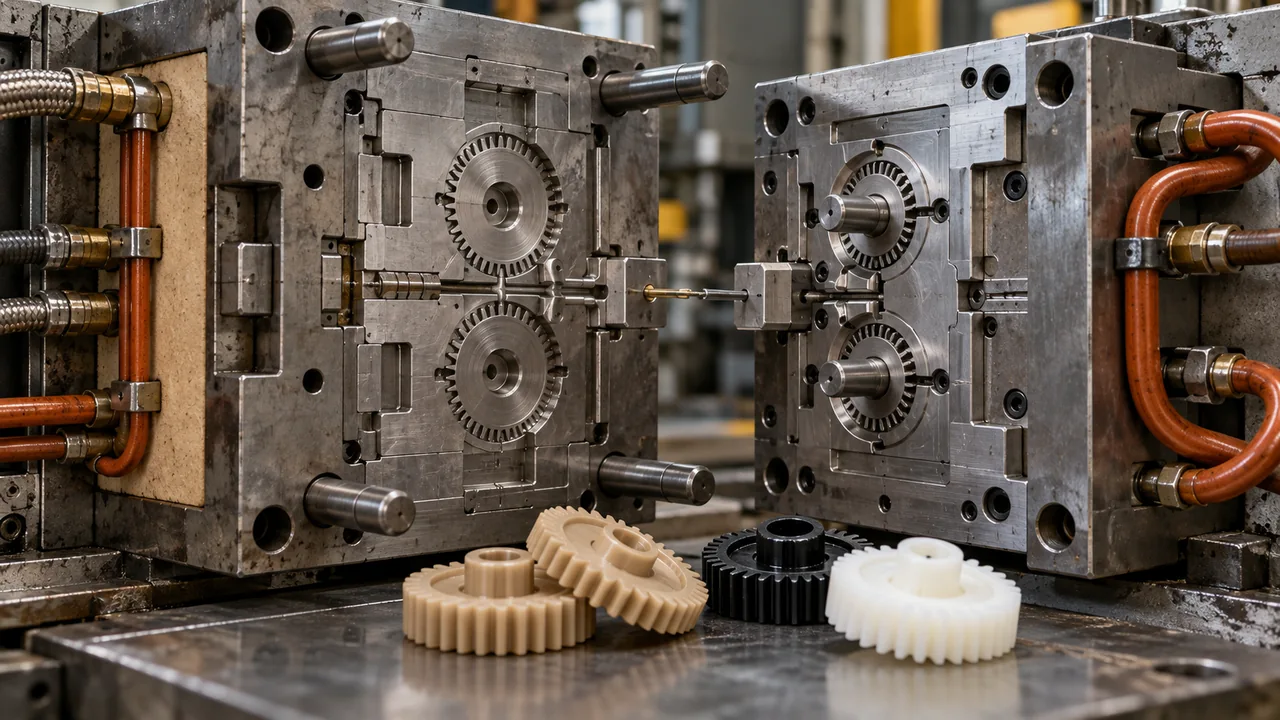
Moving from POM to PEEK is not a simple barrel-temperature change. PEEK generally requires a much hotter melt and mold, thermal insulation, suitable tool steel, careful purging and tight residence-time control. The gate and shrinkage allowance may also need redesign. A mold developed for Delrin may lack the heating, insulation, steel condition and shrinkage allowance needed for PEEK. Simply raising barrel settings can damage equipment or produce nonuniform crystallinity. Review every thermal and dimensional assumption before quoting a resin conversion. Different heating, shrinkage and melt behavior may require changes to the gate, runner, insulation and ejection sequence.
Review the project as قولبة البوليمر عالي الحرارة, then compare the available POM/acetal materials with the exact PEEK grades. Reusing the old mold without a thermal and dimensional review creates avoidable risk. Review the machine’s thermal ratings and the tool’s interfaces as well as the resin settings. An existing mold is an asset only if it can safely hold the conditions needed by the new grade. Ask for a conversion assessment before accepting a quotation that assumes the tool is reusable without modification.
A useful upgrade test plan
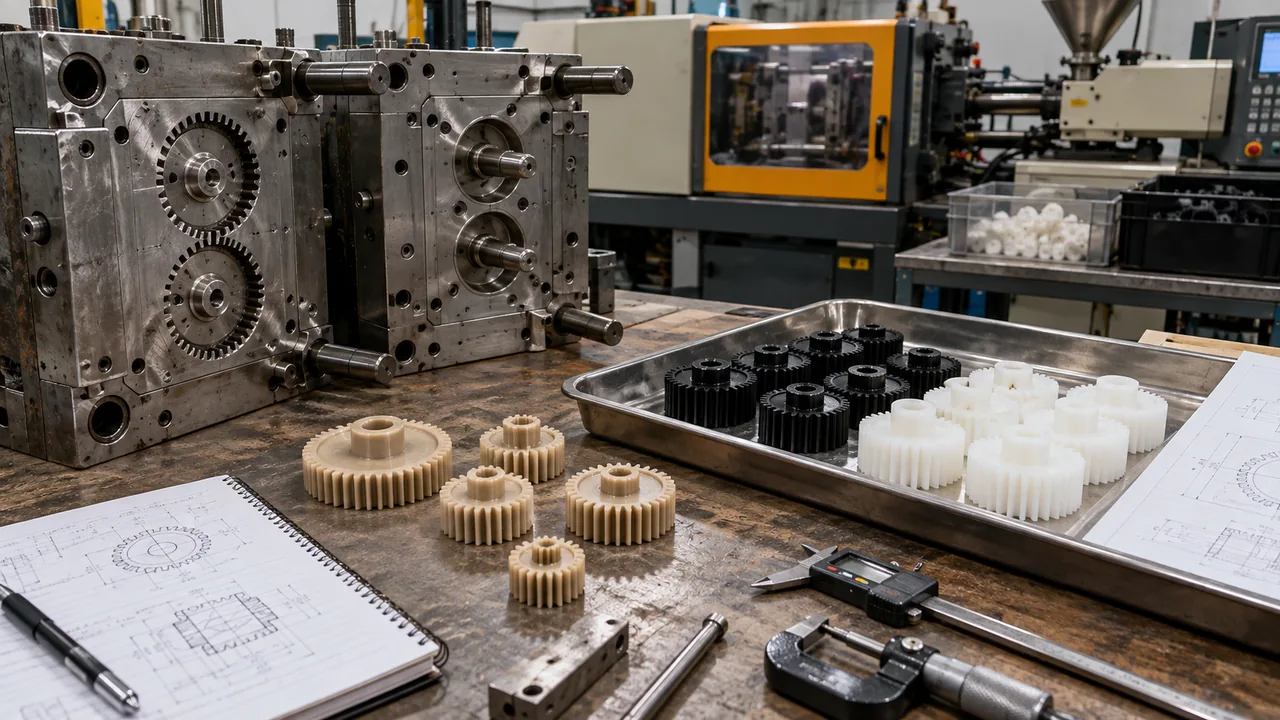
- Measure the failure in the existing Delrin part. Run Delrin and PEEK against the same acceptance criteria, including wear, load retention, chemistry and dimensions. This exposes whether PEEK removes the actual failure or only increases material capability elsewhere.
- Screen exact PEEK grades, including reinforcement only if needed. Document the decision so future cost reduction does not repeat the same debate. Set the same functional acceptance limit for both candidates so the comparison remains meaningful.
- Review gate, shrinkage and heating changes. Include heat exposure under assembly load, the actual chemical environment and the required cycle life. If PEEK performs better, identify the margin and whether it allows a design simplification or removes an inspection burden.
- Mold samples at the intended process window. If Delrin still passes, record that evidence as the reason to retain it. A successful comparison ends with an approved condition, not a general ranking of polymer families.
- Test after thermal and chemical conditioning under real load.
- Compare total qualified cost, not pellet price.
الأسئلة الشائعة
Is Delrin the same as POM?
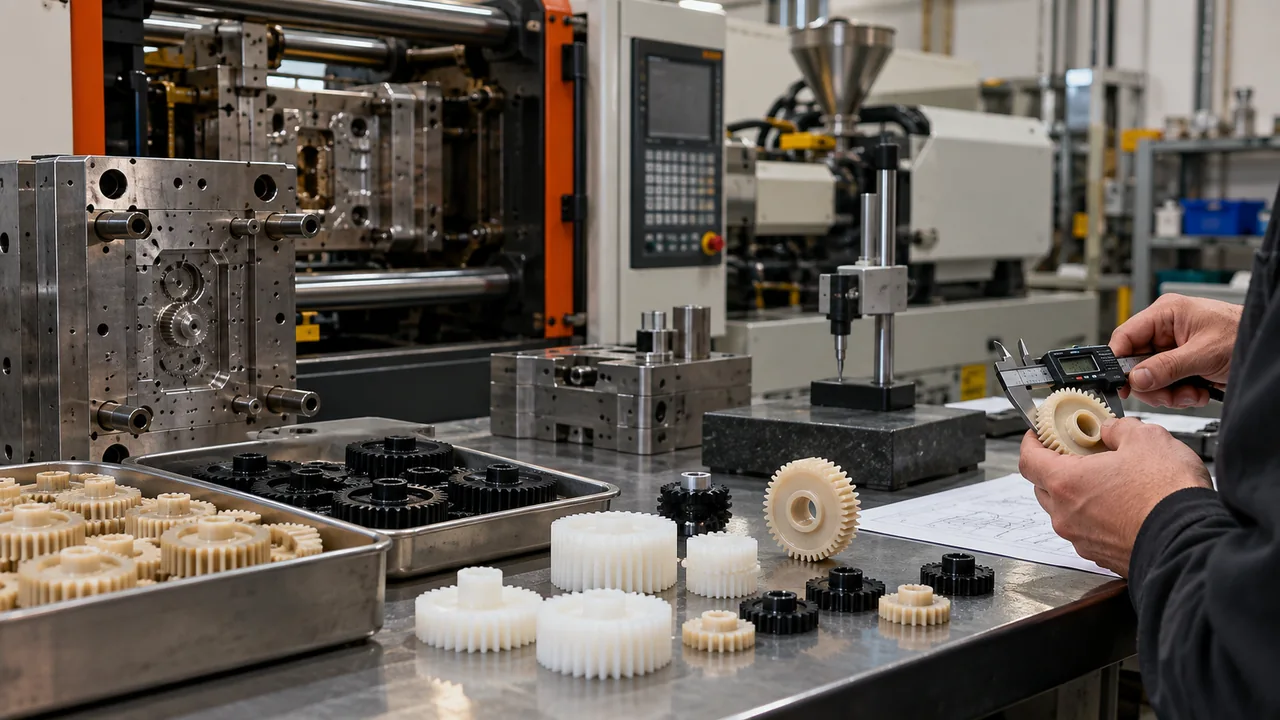
Delrin is a trade name associated with acetal homopolymer grades. POM is the broader polymer family and also includes copolymers. Delrin is an acetal homopolymer family, not a synonym for every POM grade. Supplier, grade and the approved service condition should be included in the comparison.
Can PEEK replace Delrin without changing the mold?
Not safely by assumption. Processing temperature, shrinkage, gate design, heating and ejection should be reviewed for the exact grade. Review gate size, shrinkage allowance, tool heating and equipment interfaces before accepting reuse. Qualify dimensions and ejection with the selected PEEK grade rather than copying the Delrin setup.
When is PEEK overkill?
When Delrin already meets temperature, load, chemistry, wear and compliance requirements with adequate margin, PEEK may add unnecessary material and processing cost. Include tooling, qualification and production losses in the calculation. Delrin remains economical where it passes, while PEEK needs a documented requirement that justifies the additional capability.