
Two proposals can quote the same cover while changing its material, secondary operations, and validation scope. Injection molding vs compression molding is a useful comparison only after the material system and finished-part requirements are defined. The processes introduce material into the tool differently, but that difference alone cannot decide cost, accuracy, or suitability. Establish what each route must actually deliver before comparing its price.
A thermoplastic enclosure, a silicone seal, and a reinforced thermoset component are not interchangeable examples. Their material preparation, forming, cooling or curing, and verification can differ substantially. This guide explains how a buyer can separate a genuine process choice from a material or product redesign. It does not imply that every route discussed is a service available from the same factory.
First ask whether the material is staying the same
Record the specified grade, its supplied form, relevant fillers, and required finished-part properties. A material family is not a complete process specification. The same family can contain grades developed for different flow behavior or processing routes, while two apparently similar compounds may produce different properties in the actual component.
Thermoplastic injection molding commonly melts a suitable resin, fills a closed cavity, and removes heat before release. A thermosetting compound instead needs a process suited to its curing behavior. Compression processes can handle different material systems and charge forms, so “compression molding” should not be treated as one recipe or as a synonym for silicone production.
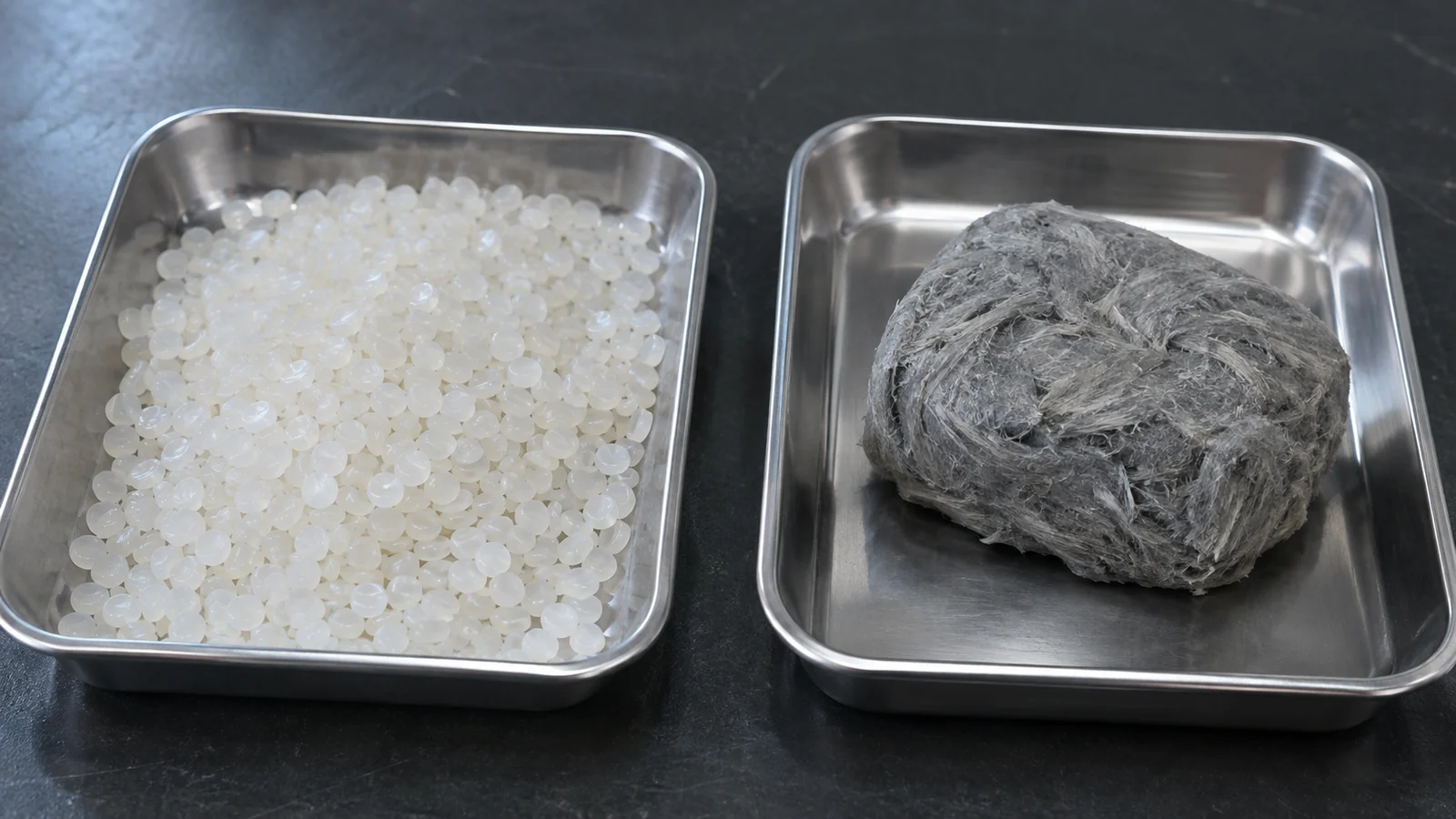
If the comparison changes from a thermoplastic to a reinforced thermoset, label it as a material-and-process alternative. Recheck impact, stiffness, temperature exposure, chemical resistance, appearance, joining, and any required compliance evidence. A lower quoted molding price cannot approve those changes. The material selection guide provides a way to organize the requirement and evidence review.
What changes when the material enters the mold?
In conventional injection molding, the material travels through a delivery path and gate into the cavity. That path creates questions about flow distance, pressure, local shear, meeting flow fronts, and gate location. The proposed tool must support filling, temperature control, release, and the required product surfaces.
In compression molding, a defined charge is placed into an open or partially open tool and shaped as the tool closes under a controlled process. Charge quantity, placement, material behavior, tool closure, and venting therefore become important inputs. The detailed sequence depends on the actual material system and equipment, not on a single generic diagram.
Neither route removes the need for a tooling and validation plan. Injection does not guarantee a mark-free part, and compression does not guarantee negligible scrap or simpler inspection. Identify the marks, flash, trimming, and handling that the proposed process may leave on the finished component. Compare the complete route needed to meet acceptance, not an idealized process with its difficult operations omitted.
Compare the geometry each route must actually deliver
Use the same functional drawing as the starting point, then mark any geometry that must change. Mounting features, deep returns, internal details, thin regions, and critical surfaces can impose different demands on the proposed routes. Avoid declaring that one process always makes complex parts and the other always makes simple ones; the material, tooling architecture, and feature determine feasibility.
For a hypothetical electrical cover, an injection concept might integrate mounting posts and a local latch. A compression alternative might use a different compound or arrangement. These are illustrative concepts, not a customer case. If the alternative requires a separate bracket, additional machining, or another fastening method, include those items in the comparison and verify the assembled function.
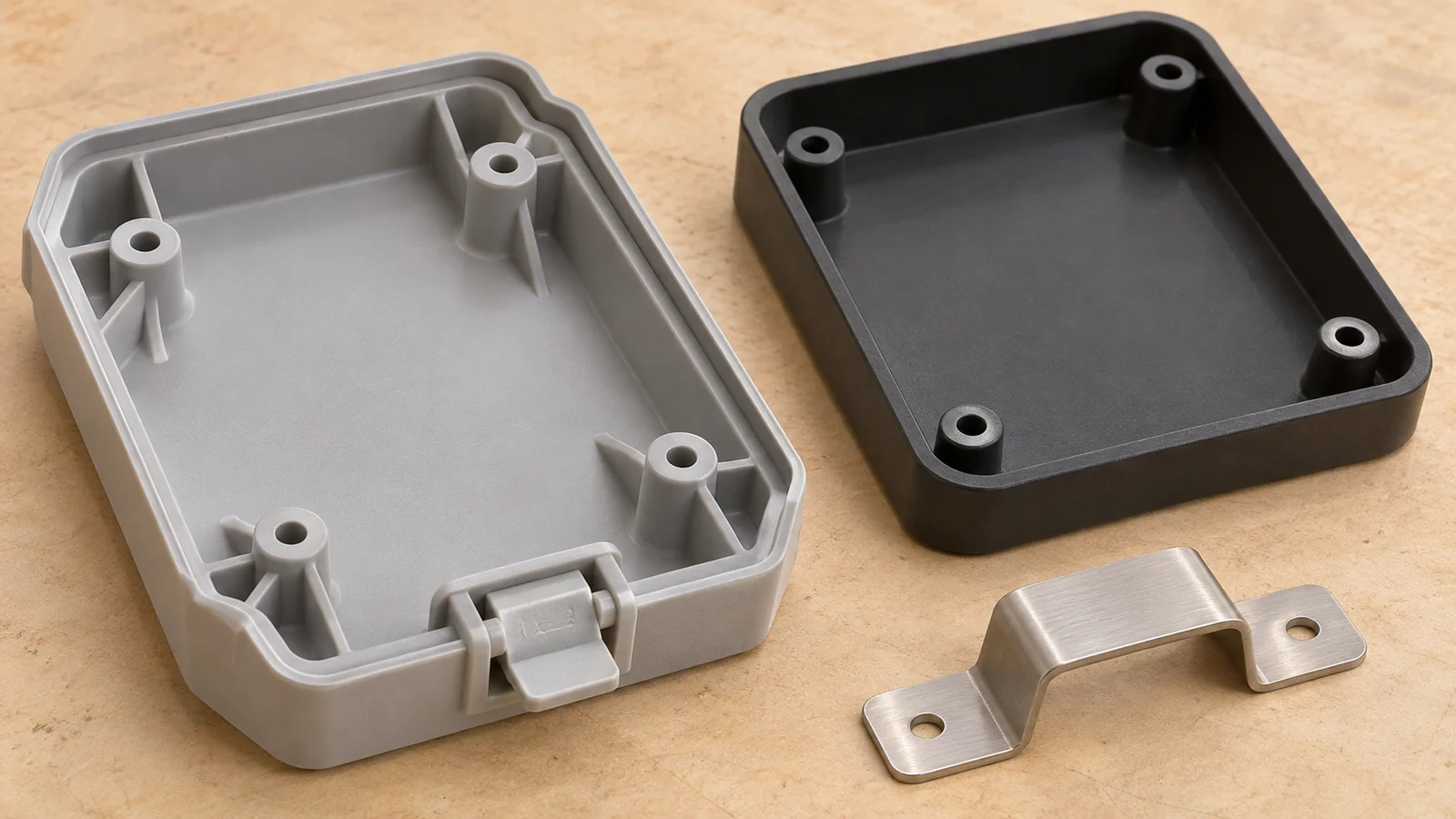
Within Ép phun nhựa, the relevant question is whether the selected resin, tool concept, and process can deliver the specified features consistently. An alternative route should be asked the same functional question. Do not compare one as-molded component against another route’s fully finished and inspected assembly without accounting for the difference.
Two exceptions that break the usual comparison chart
Compression is not always a slow, manually loaded low-volume route
That description can fit particular operations, but not the entire process family. SACMI describes continuous compression molding for small closures and compares it with injection in that specific application. Its product scope matters: conclusions about flat-top caps and dedicated rotary systems cannot be transferred directly to a large instrument cover.
Trang SACMI closure comparison is useful precisely because it identifies its boundary. Ask a supplier to name the actual loading, forming, and removal arrangement before accepting claims about labor or throughput. A process label is not enough to calculate the economics of a different part.
Injection molding is not restricted to thermoplastics
Specialized injection processes also handle suitable elastomeric or thermosetting systems. For example, ENGEL documents thermoset injection molding, including bulk molding compounds. That establishes the existence of a processing route, not compatibility of every compound or a capability of the supplier preparing this article.
Do not classify a material as compression-only because it is a thermoset, or assume an ordinary thermoplastic cell can process it unchanged. Confirm the grade’s supported methods and the proposed equipment arrangement. Keep specialized processes such as injection-compression distinct from the conventional routes being compared; a hybrid name does not make their behavior equivalent.
Use a matched evidence sheet instead of a winner table
A useful comparison records the assumptions that determine the answer. The table below is intended for a quotation or technical review. Populate it with actual proposal information and identify differences; blanks are unresolved questions, not permission to assume the same value.
| Comparison item | Keep consistent where possible | Record explicitly when it changes |
|---|---|---|
| Product function | Loads, environment, interfaces, and acceptance criteria | Any redesign needed to meet them |
| Vật liệu | Approved grade and supplied condition | New compound, reinforcement, cure system, or validation scope |
| Delivered geometry | Required features and assembly outcome | Added machining, brackets, trim, or joining |
| Production basis | Demand scenario, lot assumptions, and inspection scope | Cavities, loading, yield assumptions, or automation |
| Investment and change | Quoted deliverables and design revision | Tool scope, fixtures, maintenance terms, and modification work |
Separate quoted facts from estimates. Tool investment, cycle assumptions, scrap, inspection effort, and expected demand should have identifiable sources and dates. Where measured production data does not exist, use clearly labeled scenarios and test sensitivity to uncertain inputs. Do not turn an optimistic cycle or yield assumption into a promised unit price.
For an injection molding vs compression molding review, send the controlled drawing, assembly requirements, specified material, demand range, cosmetic criteria, and required evidence. Ask each proposed route to state exclusions and secondary operations. This makes a difference in scope visible before it becomes a dispute about the first sample.
Make the selection conditional on the unresolved risk
Choose the next step according to what remains uncertain. If material equivalence is unresolved, establish the required properties and evidence before buying tooling. If the material is acceptable but a particular feature is difficult, review that geometry and the tool concept. If both routes appear technically viable, compare delivered-part economics under matched assumptions.
Approval should connect the selected material and process to representative parts. Check dimensions under agreed conditions, assembled fit, appearance, and the relevant functional or environmental requirements. A good sample from an unidentified material or uncontrolled process cannot establish repeatability. Likewise, an analysis can identify risks without proving that the final tool has resolved them.
Injection molding vs compression molding should finish with a conditional decision: what the chosen route must deliver, which assumptions support it, and what evidence closes the remaining risk. There is no useful universal volume threshold or cost winner across all materials and products. The right outcome is a defensible route for the actual component.
Questions that remain after the comparison
Can compression and injection use the same material?
Some material systems have grades or formulations suited to more than one route, but this must be confirmed for the exact proposed compound. Even then, processing history and geometry can affect the resulting part, so route substitution still requires review.
Does a lower tooling quote make compression the economical choice?
Not by itself. Include material preparation, loading, forming, trimming, secondary work, inspection, yield assumptions, demand, and design changes. Compare what is delivered against the same product requirements.
Is injection-compression simply another name for compression molding?
No. It combines injection with a controlled compression stage and needs its own process definition. Do not transfer its reported results to conventional injection or compression without checking the actual arrangement and application.