
Approving injection molding DFM should mean accepting a defined manufacturing proposal, not giving the toolmaker unrestricted permission to change the product. Some recommendations make the part possible to mold; others trade appearance, assembly, or tooling cost against the original design. The person authorizing each change needs to understand which requirement moves and what evidence will close it.
A green wall-thickness plot cannot settle whether a latch still holds, a sealing face still mates, or a gate mark is acceptable to the end user. This guide follows the decision between receiving a supplier report and releasing the design for tooling. It concerns how to review the proposal, rather than another list of universal rib and draft dimensions.
Put the original requirement beside the proposal
Start with the controlled CAD model and drawing revision. Identify the intended resin grade, mating parts, cosmetic zones, and conditions of use. When those inputs are still open, the report should say which assumptions support its recommendations. A supplier cannot responsibly close a shrinkage or texture question against an unidentified material or finish.
The review also needs a distinction between the nominal model and acceptance requirements. The CAD surface may define the shape, while the drawing defines a functional clearance or restricted witness-mark area. If a proposed change satisfies one and contradicts the other, resolve the conflict before approval. Otherwise, both parties can follow different documents and still believe they complied.
Trong Thiết kế khuôn ép phun, the opening direction, parting surfaces, moving features, gates, cooling, and release system have consequences for the product. Review the proposed mold concept with those consequences visible. A simplified straight-pull construction is valuable only if the resulting part still performs its intended job.
Record exclusions as carefully as included checks. A geometry review may not include structural analysis, chemical exposure testing, or verification of a finished assembly. Calling the document “approved DFM” does not add those activities to its scope. Ask who will answer each outstanding product question and at what stage.
Not every red mark means the same thing
Classify comments by the decision they require. An undercut that prevents the selected release motion is a feasibility concern. A different parting line that reduces tool complexity may be an alternative. A larger corner radius that enters an assembly clearance is a product-design change, even when it makes machining easier.
The distinction matters because the most economical tool concept is not necessarily the only feasible one. Before agreeing to remove a feature, ask whether a different orientation, separate insert, or moving mechanism could preserve it. Compare the resulting cost, maintenance, appearance, and production implications without assuming that additional tooling is always justified.
| Supplier comment | What the buyer must decide | Evidence needed to close it |
|---|---|---|
| Feature obstructs the proposed draw direction | Change the part or change the release concept | Updated geometry and a credible motion proposal |
| Heavy junction may produce a visible depression | Core the section, relocate support, or accept a defined risk | Revised section and an appearance-verification plan |
| Gate or ejector contact enters a visible zone | Approve that location or request an alternative | Marked surface zones and agreed sample criteria |
| Tool simplification changes an assembly feature | Approve the functional change or retain the original requirement | Fit or performance assessment of the affected interface |
This is a decision framework, not a standard acceptance table. Classify the actual concern and assign an owner before changing the drawing. A risk can remain open while a proposal develops; it should not disappear because the report was forwarded with a short “looks good” email.
Follow a cover through three different changes
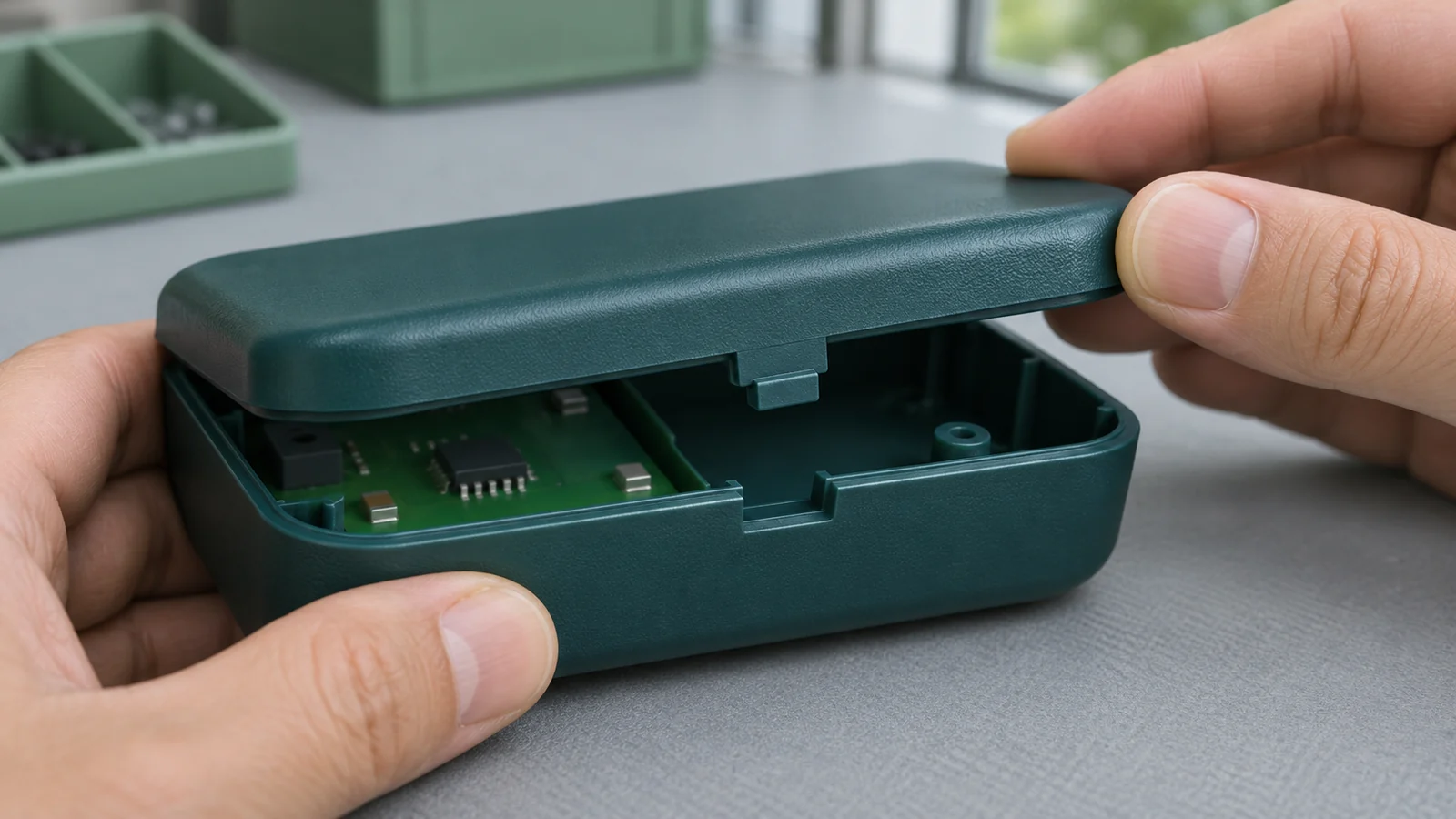
Consider a hypothetical handheld-device cover with a snap latch, internal screw supports, and a textured outer face. The examples and accompanying images are illustrative, not a Jucheng customer project, facility photograph, or test result. They show why seemingly small manufacturing edits need different approval paths.
Moving a rib away from the outer wall
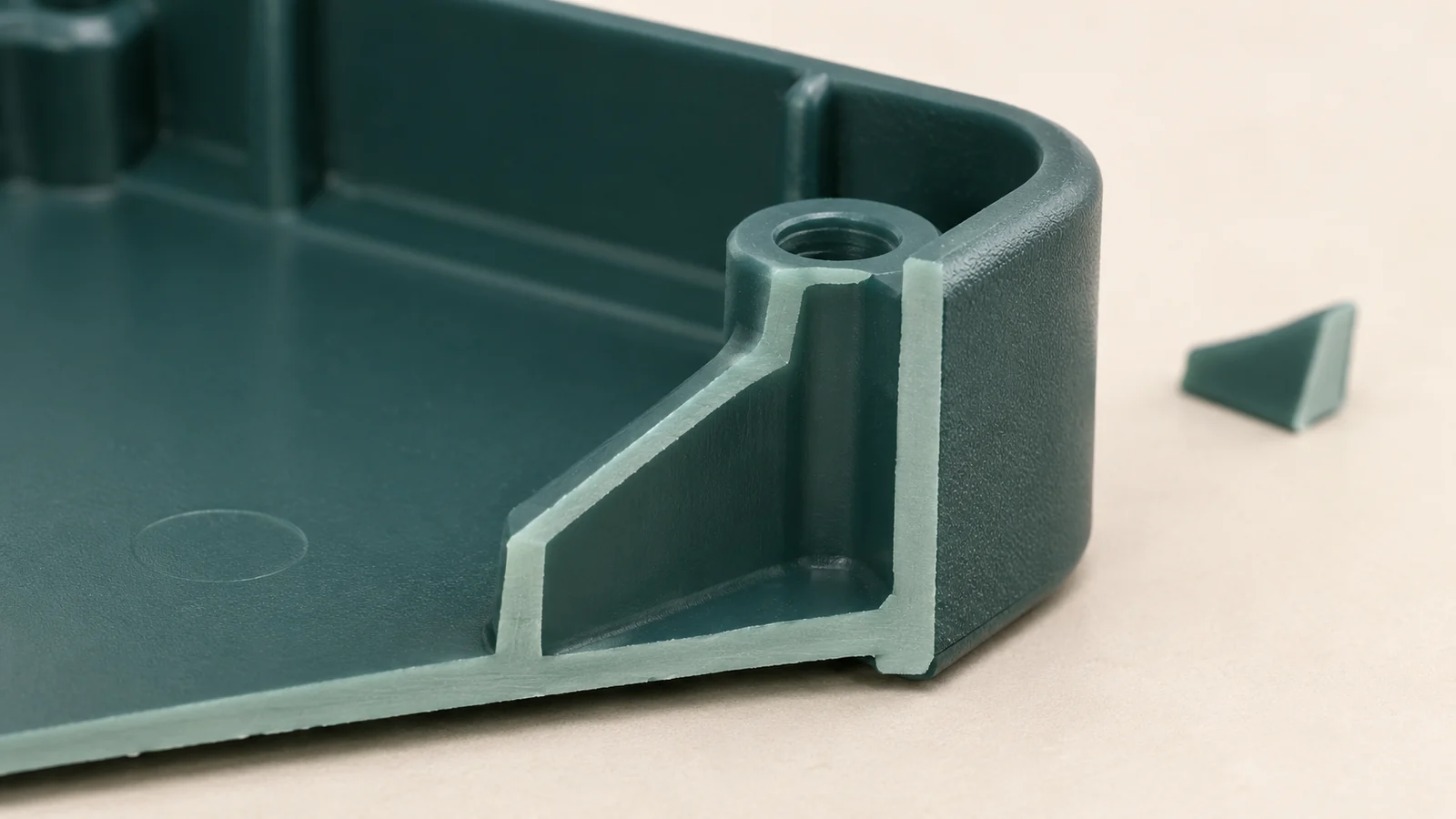
The toolmaker proposes moving a support rib to reduce a heavy junction behind the appearance surface. That may improve the section arrangement, but it also changes how the screw support carries assembly load. Ask whether the relocated rib interferes with the board, weakens a support direction, or alters access for assembly. Review the section and the functional consequence together.
Adding draft to the latch
Draft helps release, but applying it to the wrong face can change latch engagement or the contact surface. Establish which face is a functional datum and which surfaces can move. An acceptable solution might preserve the engagement interface while modifying surrounding geometry or the tool concept. The review should not reduce this to a blanket instruction to add the same angle everywhere.
Relocating a gate to the outer face
A gate relocation can improve the melt path while introducing a visible vestige. Approval needs a marked location, the permitted condition after removal, and the viewing conditions used for samples. If the user touches that area, appearance alone may not settle acceptance. Ask about sharpness, interference, and any subsequent finishing rather than approving an unspecified “small mark.”
These decisions show the practical purpose of dịch vụ phân tích DFM cho ép phun: connect a manufacturing concern to a product consequence before the correction becomes expensive steel work. The report should preserve alternatives until the responsible product owner has enough information to choose.
Make the approval record usable
Keep one issue identifier through the discussion, revised CAD, and final disposition. A useful entry names the affected feature, the concern, the proposed action, and the requirement that action might change. Add the drawing revision, decision owner, status, and evidence reference. A new screenshot without an issue reference makes later reconstruction unnecessarily difficult.
Trang BSH DFM report example illustrates project identification, design proposals, and customer-confirmation fields. It is an example of a purchaser’s documentation, not a universal report format or a specification for every supplier. Adapt the level of detail to the actual tool and product risks.
Separate the proposed solution from its verification. “Reduce the local section” describes an action; “verify the approved cosmetic zone and the support’s assembly function on representative samples” describes what still needs proving. Simulation may support the choice, but its predictions are not the same as an appearance approval or functional test on the final molded part.
For a Jucheng Injection Molding project discussion, submit the controlled model together with the drawing, resin information, assembly interfaces, and appearance map. This gives the manufacturing review a defined basis. It does not replace the buyer’s responsibility to identify product requirements that are invisible in a standalone CAD file.
Release the agreed scope, not the whole future process
Close each critical issue before authorizing the next affected activity. Some decisions must precede cavity manufacture; others can remain explicitly conditional for trial review. The release record should identify what may proceed and what remains restricted, rather than treating all open comments as either harmless or equally blocking.
- Confirm the exact part, drawing, material, and tool-concept revisions.
- List accepted changes and the person authorized to approve each functional consequence.
- Identify unresolved risks and the work that cannot proceed until they are closed.
- Carry the required sample checks into the trial and inspection plan.
- Reopen affected issues if a later revision changes the agreed assumptions.
A completed injection molding DFM review does not establish long-term process capability or approve every future material change. Its value is a traceable set of manufacturing decisions. Before asking Jucheng to review the part and tooling requirements, mark the dimensions, surfaces, and interfaces that cannot change without your approval.
Questions before signing
Can purchasing approve the report without the product designer?
Purchasing can manage the approval process, but changes affecting fit, loading, safety, or another product requirement need the responsible technical authority. Define that authority within the project. A commercial approval should not silently become engineering acceptance of a changed feature.
Must every suggested change be accepted?
No. Distinguish a limitation of the selected mold concept from a universal limitation of molding. An alternative may preserve the design at a different cost or risk. Record why a suggestion was accepted, rejected, or deferred instead of assuming the supplier’s first proposal is the only solution.
Does a later material substitution reopen DFM?
It can. A different grade, reinforcement, color system, or processing requirement may affect shrinkage, filling, release, or performance. Review the affected assumptions and verification scope before using the earlier approval for the revised material.